F. Paul Wilson - The Keep
Здесь есть возможность читать онлайн «F. Paul Wilson - The Keep» весь текст электронной книги совершенно бесплатно (целиком полную версию без сокращений). В некоторых случаях можно слушать аудио, скачать через торрент в формате fb2 и присутствует краткое содержание. Жанр: Ужасы и Мистика, на английском языке. Описание произведения, (предисловие) а так же отзывы посетителей доступны на портале библиотеки ЛибКат.
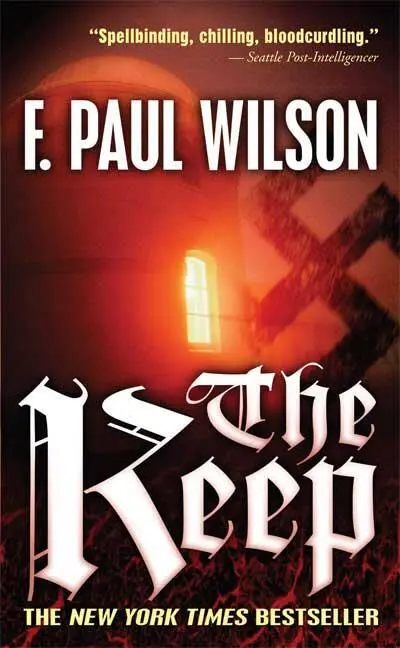
- Название:The Keep
- Автор:
- Жанр:
- Год:неизвестен
- ISBN:нет данных
- Рейтинг книги:3 / 5. Голосов: 1
-
Избранное:Добавить в избранное
- Отзывы:
-
Ваша оценка:
The Keep: краткое содержание, описание и аннотация
Предлагаем к чтению аннотацию, описание, краткое содержание или предисловие (зависит от того, что написал сам автор книги «The Keep»). Если вы не нашли необходимую информацию о книге — напишите в комментариях, мы постараемся отыскать её.
The Keep — читать онлайн бесплатно полную книгу (весь текст) целиком
Ниже представлен текст книги, разбитый по страницам. Система сохранения места последней прочитанной страницы, позволяет с удобством читать онлайн бесплатно книгу «The Keep», без необходимости каждый раз заново искать на чём Вы остановились. Поставьте закладку, и сможете в любой момент перейти на страницу, на которой закончили чтение.
Интервал:
Закладка:
The only thing that bothered him about all this was the unsettling, inescapable fact that Woermann was afraid. Truly afraid. And Woermann did not frighten easily.
He closed his eyes and tried to doze. After a while he felt sleep begin to slip over him like a warm, gentle blanket. He was almost completely covered when he felt it brutally snatched away. He found himself wide awake, his skin suddenly clammy and crawling with fear. Something was outside the door to his room. He heard nothing, saw nothing. Yet he knew it was there. Something with such a powerful aura of evil, of cold hate, of sheer malevolence, that he could sense its presence through the wood and the stone that separated it from him. It was out there, moving along the corridor, passing the door, and moving away. Away....
His heart slowed, his skin began to dry. It took a few moments, but he was eventually able to convince himself that it had been a nightmare, a particularly vivid one, the kind that shakes you from the early stages of sleep.
Major Kaempffer arose from his bedroll and gingerly began removing his long underwear. His bladder had involuntarily emptied during the nightmare.
Privates Friedrich Waltz and Karl Flick, members of the first Death's Head unit under Major Kaempffer, stood in their black uniforms, their gleaming black helmets, and shivered. They were bored, cold, and tired. This was not the sort of night duty they were accustomed to. Back at Auschwitz they had had warm, comfortable guardhouses and watchtowers where they could sit and drink coffee and play cards while the prisoners cowered in their drafty shacks. Only occasionally had they been required to do gate duty and march the perimeter in the open air.
True, here they were inside, but their conditions were as cold and as damp as the prisoners'. That wasn't right.
Private Flick slung his Schmeisser behind his back and rubbed his hands together. The fingertips were numb despite his gloves. He stood beside Waltz who was leaning against the wall at the angle of the two corridors. From this vantage point they could watch the entire length of the entry corridor to their left, all the way to the black square of night that was the courtyard, and at the same time keep watch on the prison block to their right.
"I'm going crazy, Karl," Waltz said. "Let's do something."
"Like what?"
"How about making them fall out for a little Sachsengruss?"
"They aren't Jews."
"They aren't Germans, either."
Flick considered this. The Sachsengruss, or Saxon greeting, had been his favorite method of breaking down new arrivals at Auschwitz. For hours on end he would make them perform the exercise: deep knee bends with arms raised and hands behind the head. Even a man in top condition would be in agony within half an hour. Flick had always found it exhilarating to watch the expressions on the prisoners' faces as they felt their bodies begin to betray them, as their joints and muscles cried out in anguish. And the fear in their faces. For those who fell from exhaustion were either shot on the spot or kicked until they resumed the exercise. He and Waltz couldn't shoot any of the Romanians tonight, but at least they could have some fun with them. But it might be hazardous.
"Better forget it," Flick said. "There's only two of us. What if one of them tries to be a hero?"
"We'll only take a couple out of the room at a time. Come on, Karl! It'll be fun!"
Flick smiled. "Oh, all right."
It wouldn't be as challenging as the game they used to play at Auschwitz, where he and Waltz held contests to see how many of a prisoner's bones they could break and still keep him working. But at least a little Sachsengruss would be diverting.
Flick began fishing out the key to the padlock that had transformed the last room on the corridor into a prison cell. There were four rooms available and they could have divided the villagers up; instead, they had crowded all ten into a single chamber. He was anticipating the look on their faces when he opened the door—the wincing, lip-quivering fear when they saw his smile and realized they would never receive any mercy from him. It gave him a certain feeling inside, something indescribable, wonderful, something so addictive that he craved more and more of it.
He was halfway to the door when Waltz's voice stopped him.
"Just a minute, Karl."
He turned. Waltz was squinting down the corridor toward the courtyard, a puzzled expression on his face. "What is it?" Flick asked.
"Something's wrong with one of the bulbs down there. The first one—it's going out."
"So?"
"It's fading out." He glanced at Flick and then back down the corridor. "Now the second one's fading!" His voice rose half an octave as he lifted his Schmeisser and cocked it. "Get over here!"
Flick dropped the key, swung his own weapon to the ready position, and ran to join his companion. By the time he reached the juncture of the two corridors, the third light had faded out. He tried but could make out no details of the corridor behind the dead bulbs. It was as if the area had been swallowed by impenetrable darkness.
"I don't like this," Waltz said.
"Neither do I. But I don't see a soul. Maybe it's the generator. Or a bad wire." Flick knew he didn't believe this any more than Waltz did. But he had had to say something to hide his growing fear. Einsatzkommandos were supposed to arouse fear, not feel it.
The fourth bulb began to die. The dark was only a dozen feet away.
"Let's move into here," Flick said, backing into the well-lit recess of the rear corridor. He could hear the prisoners muttering in the last room behind them. Though they could not see the dying bulbs, they sensed something was wrong.
Crouched behind Waltz, Flick shivered in the growing cold as he watched the illumination in the outer corridor continue to fade. He wanted something to shoot at but could see only blackness.
And then the blackness was upon him, freezing his joints and dimming his vision. For an instant that seemed to stretch to a lifetime, Private Karl Flick became a victim of the soulless terror he so loved to inspire in others, felt the deep, gut-tearing pain he so loved to inflict on others. Then he felt nothing.
Slowly the illumination returned to the corridors, first to the rear, then to the access passage. The only sounds came from the villagers trapped in their cell: whimpering from the women, relieved sobs from the men as they all felt themselves released from the panic that had seized them. One man tentatively approached the door to peer through a tiny space between two boards. His field of vision was limited to a section of floor and part of the rear wall of the corridor.
He could see no movement. The floor was bare except for a splattering of blood, still red, still wet, still steaming in the cold. And on the rear wall there was more blood, but this was smeared instead of splattered. The smears seemed to form a pattern, like letters from an alphabet he almost recognized, forming words that hovered just over the far edge of recognition. Words like dogs howling in the night, naggingly present, but ever out of reach.
The man turned away from the door and rejoined his fellow villagers huddled in the far corner of the room.
There was someone at the door.
Kaempffer's eyes snapped open; he feared that the earlier nightmare was going to repeat itself. But no. He could sense no dark, malevolent presence on the other side of the wall this time. The agent here seemed human. And clumsy. If stealth were the intruder's aim, he was failing miserably. But to be on the safe side, Kaempffer pulled his Luger from the holster coiled at his elbow.
"Who's there?"
No reply.
The rattle of a fumbling hand working the latch continued. Kaempffer could see breaks in the strip of light along the bottom of the door, but they gave no clue as to who might be out there. He considered turning on the lamp, but thought better of it. The dark room gave him an advantage—an intruder would be silhouetted against the light from the hall.
Читать дальшеИнтервал:
Закладка:
Похожие книги на «The Keep»
Представляем Вашему вниманию похожие книги на «The Keep» списком для выбора. Мы отобрали схожую по названию и смыслу литературу в надежде предоставить читателям больше вариантов отыскать новые, интересные, ещё непрочитанные произведения.








Обсуждение, отзывы о книге «The Keep» и просто собственные мнения читателей. Оставьте ваши комментарии, напишите, что Вы думаете о произведении, его смысле или главных героях. Укажите что конкретно понравилось, а что нет, и почему Вы так считаете.