Sofia Samatar - A Stranger in Olondria
Здесь есть возможность читать онлайн «Sofia Samatar - A Stranger in Olondria» весь текст электронной книги совершенно бесплатно (целиком полную версию без сокращений). В некоторых случаях можно слушать аудио, скачать через торрент в формате fb2 и присутствует краткое содержание. Жанр: Фэнтези, на английском языке. Описание произведения, (предисловие) а так же отзывы посетителей доступны на портале библиотеки ЛибКат.
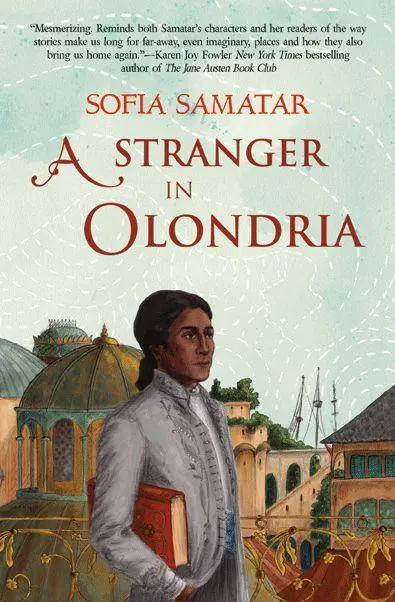
- Название:A Stranger in Olondria
- Автор:
- Жанр:
- Год:неизвестен
- ISBN:нет данных
- Рейтинг книги:5 / 5. Голосов: 1
-
Избранное:Добавить в избранное
- Отзывы:
-
Ваша оценка:
A Stranger in Olondria: краткое содержание, описание и аннотация
Предлагаем к чтению аннотацию, описание, краткое содержание или предисловие (зависит от того, что написал сам автор книги «A Stranger in Olondria»). Если вы не нашли необходимую информацию о книге — напишите в комментариях, мы постараемся отыскать её.
In desperation, Jevick seeks the aid of Olondrian priests and quickly becomes a pawn in the struggle between the empire’s two most powerful cults. Yet even as the country shimmers on the cusp of war, he must face his ghost and learn her story before he has any chance of becoming free by setting her free: an ordeal that challenges his understanding of art and life, home and exile, and the limits of that seductive necromancy, reading.
A Stranger in Olondria — читать онлайн бесплатно полную книгу (весь текст) целиком
Ниже представлен текст книги, разбитый по страницам. Система сохранения места последней прочитанной страницы, позволяет с удобством читать онлайн бесплатно книгу «A Stranger in Olondria», без необходимости каждый раз заново искать на чём Вы остановились. Поставьте закладку, и сможете в любой момент перейти на страницу, на которой закончили чтение.
Интервал:
Закладка:
“ And this shall be the place where the people live ,” the angel sang. “ This shall be the home of the human beings .”
I remembered it, I felt it—home, with all its distant sweetness—I remembered it through the high voice of the dead girl. One memory in particular came back to me when she sang: that early memory of how I had tried to teach a song to my brother. “My father is a palm,” I said. “Repeat!” He said: “My father.” “Is a palm,” I insisted. But he would not answer. He gazed into the trees, rubbing the edge of his sandal in the chalky groove between the flagstones. As always when he was pressed, he seemed to recede behind a protective wall of incomprehension and maddening nonchalance.
I saw him clearly. How old was he? Six, perhaps seven years old. He was already unable to learn, but my father had not yet noticed. He wore a short blue vest with fiery red-orange embroidery, just like mine. His trouser leg was torn. If I asked him how he had torn it he would not know, or he would not tell me, though the edges of the tear were stained with blood. He would not even complain he was hurt, though he must have cut his knee, somewhere, in a place that would never be named.
“My father is a palm,” I said. “Repeat!”
I had seen other children play the game. I had learned it from them, copied the intricate clapping—this was what I had brought for my brother. When I shouted at him a wariness went flitting across his gaze like the wing of a bird.
“You say it,” I snarled through clenched teeth, glaring, trying to frighten him—to break through his simplicity and reach him.
He looked away, his eyes uncertain. Did he know what was coming?
My two fists rammed straight into his chest, and he sprawled on his back, howling.
And now, years later, in a strange land, to the sound of an angel’s singing, I relived that moment of despair, that attempt to bridge the divide, that terrible reaching, desperate and cruel, when love swerved into violence, when I would have torn the skin from his face to discover what lay beneath.
“Jevick,” the angel whispered.
Her eyes met mine, black, secretive, moonless. Her luminous gaze. “Why don’t you answer me? Why don’t you write?”
Grief and rage, a gathering ocean.
“I can’t,” I said. “I can’t.”
“Listen to me!” she screamed.
And the waves fell in a rush.
The silence struck me like a blow. I sat up, sweating and panting, and looked into the lighted face of a demon.
It hovered above me, a deformed face with elements of the human and of the iguana. Its fleshless lips were parted, showing tiny teeth. I shrank toward the wall, cold with terror, and babbled a snatch of Kideti prayer: “From what is unseen… from what is afoot before dawn…”
“You had a bad dream,” the demon said in the language of the north. Its voice was husky and childish, with a slight lisp.
“God of my father,” I whispered, trembling. I wiped my face on the sheet. The shapes in the room began to resolve themselves: I recognized the window and marked the position of the screen, and knew that the figure before me was no monster, but the scarred child. She was dressed in a tattered blue shift, made no doubt from a worn-out robe, and her soft hair, unplaited, stood up around her head. She was holding a saucer of oil in which a twist of cotton was burning with a light that fluttered like a dying insect.
“You shouted,” she said.
“No doubt I did,” I muttered.
“What did you dream about?”
“An angel,” I said. I looked up into her face, trying to focus on her beautiful eyes with their vibrancy, their sweet directness. She looked back at me curiously.
“If you have a bad dream, you should never stay in bed. You should get up. Look.” She set the saucer of oil on the floor, took my wrist, and pulled until I got up from the pallet. Then she stretched her arms above her head. “You do this. Yes. Now you turn around.” Slowly we rotated, our hands in the air, our shadows huge on the walls, while the child recited solemnly:
I greet thee, I greet thee:
Send me a little white rose,
And I will give thee a deer’s heart.
“There,” she said, letting her arms fall. She smiled at me, brightness brimming in her eyes. “You ought to say it around a garlic plant, but we’re not allowed out at night. The others are on the roof. Do you want to go up?”
I nodded and put on my shirt, and the child picked up her meager light and glided soundlessly into the hall. The rooms were black and vacant; we surprised rats in the corners. The air was chill, with the odor of moldy straw. I saw that a radhu —often so bright, so cheerfully domestic—could also be a place of stark desolation. The bare feet of the child were silent on the cold stone floors, and the light she held up trembled under the arches.
At last we came to a narrow stairway where the air was fresh and the stars looked down through a triangular hole in the roof. The stairs were so steep that the girl crawled up and I followed the soles of her feet, already hearing soft voices outside. We emerged onto the roof, into the immeasurable night. The sky was littered with sharp, crystal stars. A sliver of moon diffused its powdery light onto the ruined house and the consummate stillness of the surrounding fields.
“Jevick!” Miros cried in a voice so heavily laden with feeling that I knew he was drunk even before I saw him. “Thank Avalei you’ve come. This is terrible. It’s been terrible.”
I moved toward him. Vines rustled about my ankles.
“Amaiv!” said a sharp voice. “What are you doing with that light? Put it out, and don’t spill the oil.”
The little girl blew out the light obediently. “He had a bad dream, yamas .”
“A bad dream.” Miros sighed. “Even sleep is dangerous…”
They sat against the low wall along the edge of the roof, where the vines made a thick curtain over the stone. Miros was holding a bottle and looking down, his face in shadow; the girl with the obstinate chin rested her head on his shoulder. A little apart from them sat the tall girl in the scarf, her legs splayed out and her toes pointing inward. I supposed she was half-witted. I stumbled over an empty bottle as I approached them and then sat down among the vines.
“Careful,” Miros said. “If you fall off the roof, vai , I’ll have killed an avneanyi on top of everything.”
The girl leaning against him began to giggle and could not stop. Miros held the bottle unsteadily toward me. “There, my friend,” he said. “Drink. I’ve given it all to Laris. We are drinking through her hospitality now.”
I drank some of the cleansing teiva and handed back the bottle. The scarred girl, like a deft little animal, curled up her legs beside me.
“You should be in bed,” the girl with Miros reprimanded her, suddenly recovering from her giggles.
“I can’t sleep,” the child protested, wheedling.
“You’ll sleep soon enough, and then who’s going to carry you downstairs?”
“I’ll sleep on the roof,” said the child decidedly.
“You can’t sleep on the roof.” The sister had lowered her head like an angry cow. It was this, along with the dogged way she spoke, and her slurred consonants, which showed me that she was very drunk as well.
Miros had one arm around her. He caressed the top of her head, and she nestled back into his shoulder with a sigh. He raised his head and looked at me, and the moonlight showed his features blurred with drink. “This is Laris,” he said brokenly. “This is Laris, a true daughter of the Valley. I’ve already given her two bottles of teiva . It was all I had. I’m going to give her everything I own. It will never be enough. Never enough for the Night Market.”
Читать дальшеИнтервал:
Закладка:
Похожие книги на «A Stranger in Olondria»
Представляем Вашему вниманию похожие книги на «A Stranger in Olondria» списком для выбора. Мы отобрали схожую по названию и смыслу литературу в надежде предоставить читателям больше вариантов отыскать новые, интересные, ещё непрочитанные произведения.










Обсуждение, отзывы о книге «A Stranger in Olondria» и просто собственные мнения читателей. Оставьте ваши комментарии, напишите, что Вы думаете о произведении, его смысле или главных героях. Укажите что конкретно понравилось, а что нет, и почему Вы так считаете.