Sofia Samatar - A Stranger in Olondria
Здесь есть возможность читать онлайн «Sofia Samatar - A Stranger in Olondria» весь текст электронной книги совершенно бесплатно (целиком полную версию без сокращений). В некоторых случаях можно слушать аудио, скачать через торрент в формате fb2 и присутствует краткое содержание. Жанр: Фэнтези, на английском языке. Описание произведения, (предисловие) а так же отзывы посетителей доступны на портале библиотеки ЛибКат.
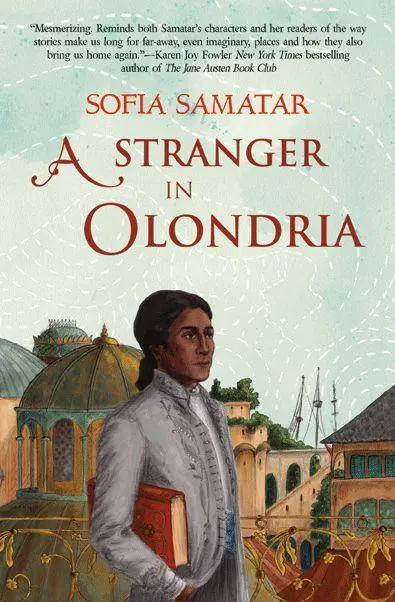
- Название:A Stranger in Olondria
- Автор:
- Жанр:
- Год:неизвестен
- ISBN:нет данных
- Рейтинг книги:5 / 5. Голосов: 1
-
Избранное:Добавить в избранное
- Отзывы:
-
Ваша оценка:
A Stranger in Olondria: краткое содержание, описание и аннотация
Предлагаем к чтению аннотацию, описание, краткое содержание или предисловие (зависит от того, что написал сам автор книги «A Stranger in Olondria»). Если вы не нашли необходимую информацию о книге — напишите в комментариях, мы постараемся отыскать её.
In desperation, Jevick seeks the aid of Olondrian priests and quickly becomes a pawn in the struggle between the empire’s two most powerful cults. Yet even as the country shimmers on the cusp of war, he must face his ghost and learn her story before he has any chance of becoming free by setting her free: an ordeal that challenges his understanding of art and life, home and exile, and the limits of that seductive necromancy, reading.
A Stranger in Olondria — читать онлайн бесплатно полную книгу (весь текст) целиком
Ниже представлен текст книги, разбитый по страницам. Система сохранения места последней прочитанной страницы, позволяет с удобством читать онлайн бесплатно книгу «A Stranger in Olondria», без необходимости каждый раз заново искать на чём Вы остановились. Поставьте закладку, и сможете в любой момент перейти на страницу, на которой закончили чтение.
Интервал:
Закладка:
“What’s the matter with him?” asked the girl.
“He’s had a fall,” Miros said curtly. A moment later he paused and met her eyes. “The truth is, we’ve come from the Night Market outside Nuillen.”
Her eyes widened, but she said only: “You are most welcome, telmaron .”
Slowly, furtively, the huvyalhi came out of the darkness, wearing the faded blue robes of their class. There was a bent, defeated-looking woman, a tall girl with a vacant smile, and an aged man who mumbled incessantly. Last of all came a small girl, perhaps nine or ten years old, whose face had been horribly disfigured by smallpox. There were no men but the demented grandfather, and no infants. The bent woman and the tall girl stared at us with their mouths open.
The black-eyed girl with the firm jaw, who clearly ran the household, brought us wooden bowls of stew and rough tin spoons. She looked no older than sixteen, and her hair hung in four plaits, but she had the capable hands and decided tread of a matron. She arranged the two older women—her mother and sister, I supposed—on a mat and gave them a bowl and spoon to share. Both of them wore white scarves bound tightly around their heads, a mark of widowhood.
The little girl came around with cups of water. She was a lively, graceful creature, with snapping black eyes in her melted face. Miros could hardly look at her, and his hand shook as he spooned stew into his mouth. He asked in a subdued voice about the mumbling old man.
“My mother’s father,” the matronly girl explained. “He has rheumatism and cramp, and is almost blind with cataracts. But in his day, he was a bull! He plowed the fields by hand and built this room when he was already old. He attacked the dadeshi with his big knife—men on horseback, imagine! He used to keep their dried-up ears in a box…”
“Until Kiami ate them,” the small girl added wickedly, her lovely eyes flashing at her sister.
The older girl showed her sixteen years in a burst of wild laughter, putting one hand quickly over her mouth.
“Who’s Kiami?” Miros asked.
“One of the cats,” said the younger girl. “Oh! Grandfather was angry! He pulled our hair…”
The child, utterly unconcerned with her sad and monstrous appearance, regaled us with stories of this most incorrigible of animals. She sat with her legs crossed, her back straight and her arms relaxed, sometimes raising a tiny finger for emphasis. Her speech was rapid, her eyes shone with mischief and intelligence; she was all brightness, merriment, and vivacity. Her sister’s black eyes softened as she looked at the slender child with the wonderful strength of character and the rough, reptilian features. The little girl so enjoyed the attention and her own inventiveness that she ended the story prostrated with giggles. Even Miros smiled, and some of the old animation came back to his face as he put down his bowl and said: “A demon, your Kiami!”
When the child went out for more water, her older sister leaned forward and said in a tense whisper: “You’ve really come from the Night Market?”
“Yes,” said Miros.
“The one where so many were killed?”
“Yes.”
“Yes,” the girl said bitterly. “That is Olondria these days.”
All at once her mother broke in softly: “We have no men anymore. Ours is a house without windows. He is the last.”
She was pointing her soiled spoon at the grandfather. Her intent gaze, and the strange way she had blurted out the words, cast a pall over the room.
“Yes, Mama,” her daughter answered soothingly. “They know.” She turned to us. “An accident,” she explained. “A part of the house fell on my brothers and killed them, both of them. And my father died before them, of an ague.”
“ Bamai ,” Miros whispered— Bamanan ai , “May it go out,” the old Olondrian charm against misfortune.
“Oh, it’s already gone out.” The girl smiled, rising to collect the dishes. “Evil’s gone through this house. We’re safe now. Nothing else can happen to us.”
Afterward she led me to a dank, smoke-blackened room. “Thank you,” I said. The girl turned, careless, bearing away her little lamp. Through an aperture high in the wall the stars showed white. There was a battered screen, a straw pallet on the floor, a cracked washbowl. Such poverty, such unrelenting hardship. I touched the screen, which perhaps contained, as many old Valley furnishings did, scenes from the Romance . The forest of Beal, its trees a network of spikes. Or the tale of a saint, Breim the Enchanter or poor Leiya Tevorova, haunted by an angel.
I closed my eyes and touched my brow to the screen. Fire behind my eyelids. Suddenly a storm of trembling swept over me. My mind was still numb, detached, but my body could not bear what had happened. I sank down and curled up on the moldy pallet.
There I thought of the huvyalhi of the Market, and of our hosts in this desolate place. I thought of the woman who had wept over me in the tent. I wanted to do something for them, for these abandoned girls, to give them a word or a sign, to carry something other than horror. But I possessed nothing else. And when the angel appeared, shrugging her way through the elements, born in a shower of sparks, I thought that perhaps this horror itself could become something else, could be used, as Auram had said. That I could be haunted to some purpose.
Her light was dim; she looked like a living girl but for her slight radiance, a crimson aura coloring the air. Beneath the jagged hole in the wall she clasped her hands and gazed at me with a seeking look, an expression of abject longing. There was a stealthy force behind that gaze, a ruthless intelligence that sent terror to the marrow of my bones. A will that would not flag though eternity passed; a strength that would not tire. Yet her eyes were like those of a lover or a child.
She loosened her fingers. “Write,” she whispered. A faint smile on her lips. She mimed the clapping of hands with another child, singing an island song.
My father is a palm
and my mother is a jacaranda tree.
I go sailing from Ilavet to Prav
in my boat, in my little skin boat.
I knew the song. The familiar tongue. It occurred to me that only with her could I hear my own language spoken in this country of books and angels. She laughed when she came to the second verse: “ a bowl of green mango soup .” And I remembered trying to make Jom sing, in the courtyard under the orange trees.
“Jissavet. Stop.”
She paused, her mouth open. A frown: cities on fire.
“Jissavet. I need your help. For these people. I’m in a house in the Valley.”
The air bent, warped about her.
“Stop. Listen. Such cruel things have happened to them. If you could tell them something. Something to give them hope.”
She looked at me with inconsolable eyes. “I can’t. I told you. There’s a void between—it’s horrible. And they are not people like me.”
“They are.”
She shook her head. “No. You are people like me. You are my people.” And again her voice, light and eerie, rose in song. This time she sang of the valleys and plains of Tinimavet, the estuaries where the great rivers rolled in mud to the sea. She sang of the fishermen whose bodies grew accustomed to the air, who could not, like other men, be driven mad by the constant wind. And she sang the long story of Itiknapet the Voyager, who first led the people to the islands.
And when they came upon the risen lands
they found them beautiful,
newly sprung from the sea
with rivers of oil.
She sang of those lands. The Risen Lands, fragrant with calamus. Kideti-palet : the Islands of the People.
Читать дальшеИнтервал:
Закладка:
Похожие книги на «A Stranger in Olondria»
Представляем Вашему вниманию похожие книги на «A Stranger in Olondria» списком для выбора. Мы отобрали схожую по названию и смыслу литературу в надежде предоставить читателям больше вариантов отыскать новые, интересные, ещё непрочитанные произведения.









Обсуждение, отзывы о книге «A Stranger in Olondria» и просто собственные мнения читателей. Оставьте ваши комментарии, напишите, что Вы думаете о произведении, его смысле или главных героях. Укажите что конкретно понравилось, а что нет, и почему Вы так считаете.