R. Bakker - The Judging eye
Здесь есть возможность читать онлайн «R. Bakker - The Judging eye» весь текст электронной книги совершенно бесплатно (целиком полную версию без сокращений). В некоторых случаях можно слушать аудио, скачать через торрент в формате fb2 и присутствует краткое содержание. Жанр: Фэнтези, на английском языке. Описание произведения, (предисловие) а так же отзывы посетителей доступны на портале библиотеки ЛибКат.
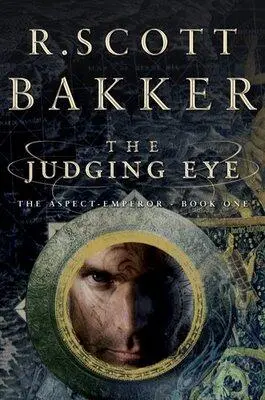
- Название:The Judging eye
- Автор:
- Жанр:
- Год:неизвестен
- ISBN:нет данных
- Рейтинг книги:5 / 5. Голосов: 1
-
Избранное:Добавить в избранное
- Отзывы:
-
Ваша оценка:
The Judging eye: краткое содержание, описание и аннотация
Предлагаем к чтению аннотацию, описание, краткое содержание или предисловие (зависит от того, что написал сам автор книги «The Judging eye»). Если вы не нашли необходимую информацию о книге — напишите в комментариях, мы постараемся отыскать её.
The Judging eye — читать онлайн бесплатно полную книгу (весь текст) целиком
Ниже представлен текст книги, разбитый по страницам. Система сохранения места последней прочитанной страницы, позволяет с удобством читать онлайн бесплатно книгу «The Judging eye», без необходимости каждый раз заново искать на чём Вы остановились. Поставьте закладку, и сможете в любой момент перейти на страницу, на которой закончили чтение.
Интервал:
Закладка:
This was how her mother's agents found her years ago, dressed like their Holy Empress, emptied save for a single sip. Apparently thousands had died, such was Anasыrimbor Esmenet's outrage. A whole swath of the Worm in Carythusal had been razed, the male population indiscriminately slaughtered.
But it was never clear just whom Mother was avenging.
Mimara knows what will happen. So rather than follow Achamian into the town, she circles around and climbs the escarpments instead. This time, she really does leave her mule, Foolhardy, to the wolves. She takes up a position well away from the eastward tracks-not a day passes, it seems, without some company trudging in from the horizon-and she watches the town the way an idle boy might study a termite-infested stump. It looks like a toy woven of rotted grass. The trees and bracken opening about a great lesion of open mud. The rows of swollen-wood structures ribbing the interior. The great white veils floating like some ghostly afterimage from the falls, encompassing the strings of fuzzing smoke…
From high above she watches the town and waits. Sometimes, when the wind blows just so, she can even smell the place's fetid halo. She watches the coming and going, the ebb and flow of miniature men and their miniature affairs, and she understands that the infinite variety of Men and their transactions is simply a trick of an earthbound vantage, that from afar, they simply are the mites they appear to be, doing the same things over and over. Same pains, same grievances, same joys, made novel by crippled memory and stunted perspective.
Finitude and forgetfulness, these are what grace Men with the illusion of the new. It seems something she has always known, but could never see; a truth obscured by the succession of close leaning faces.
She dares no fire. She hugs herself warm. From lips of high-hanging stone, she watches and waits for him. She has no other place to go. She is, she decides, every bit as rootless as he. Every bit as mad.
Every bit as driven.
CHAPTER SEVEN
…conquered peoples live and die with the knowledge that survival does not suffer honour.
They have chosen shame over the pyre, the slow flame for the quick.
— Triamis I, Journals and DialoguesEarly Spring, 19 New Imperial Year (4132 Year-of-the-Tusk), Sakarpus
It was a thing of wonder.
While the citadels and strong places of Sakarpus still smoked, innumerable storks began clotting the southern horizon, not the field-sized flocks that the Men of the Ordeal were accustomed to, but high-flying mountains of them, darkening the sky, settling like salt in water across the surrounding hills. Even for men familiar with momentous sights, it was remarkable to behold: the whooshing descent, the starved elegance, the twitch and turn of avian scrutiny, multiplied over and over across every sky. Since storks meant many different things to the many different nations of the Great Ordeal, few could agree what the bird's arrival augured. The Aspect-Emperor said nothing, save issuing an edict to protect the birds from becoming either food or ornament. Apparently the Sakarpi held them holy: The men guarded them against foxes and wolves, while the womenfolk gathered their guano for a concoction called char soot, a long-burning fuel they used in lieu of wood.
The Judges were kept busy. Several hangings were required, and one Ainoni sergeant, who had been killing birds to make and sell pillows, was even publicly flayed. But eventually the Men of the Ordeal became accustomed to the squawking, white-backed hills, and ceased heckling the conquered men and women who tended to them. In the parlance of the camp, "eating stork" became synonymous with any reckless and self-indulgent act. Soon it seemed obvious-even to those, like the Kianene, who thought storks were vermin-that these birds with their thin-necked conceit were in fact holy, and that the hills were a kind of natural temple.
Meanwhile, preparations for the ensuing march continued. In the Council of Names, the kings and generals of the Great Ordeal debated points of supply and strategy beneath the all-seeing eyes of their Aspect-Emperor. Even though flushed with pious excitement-a great number of them had spent years waiting for this very day-they harboured few illusions about the trials and perils that awaited them. Sakarpus stood at the very edge of the mannish world, the point where, as King Saubon of Enathpaneah would say, "Men are more lamb than lion." Sranc ruled the land beyond the northern horizon, scratching a vicious existence from the ruined cities of the long-dead High Norsirai. And that land, the Lords of the Ordeal knew, stretched for more than two thousand miles. Not since the wars of Far Antiquity had so many attempted such an arduous journey. "Between this march and the Consult," their Aspect-Emperor told them, "the march will prove far deadlier."
For more than a decade, a greater part of the New Empire's resources had been bent toward the arduous trek to Golgotterath. Even before Sakarpus had fallen, the Imperial Engineers had begun building a second city below the ancient first: barracks, smithies, lazarets, and dozens of sod-walled storehouses. Still others staked the course of the broad stone road that would, in a matter of weeks, connect the ancient city to faraway Oswenta. Even now, an endless train of supplies wound in from the southern horizon, bearing arms, wares, rations, and more rations. Infantrymen, no matter their rank, were limited to strict portions of amicut, the campaign fare of the wild Scylvendi peoples to the southwest. The caste-nobility could count on somewhat heartier provisions but were reduced to riding shaggy-maned ponies that required no grain to preserve their strength. Vast herds of sheep and cattle, bred solely to accompany the march, were also beaten across the horizon, so many that some Men of the Ordeal began calling themselves ka Koumiroi, or the Herdsmen-a name that would later become holy.
But even with all these preparations, there was simply no way the Great Ordeal could bear the food required to reach Golgotterath. The ponderous herds, the great packs borne by the infantrymen, and the mile-long mule trains would only take them so far. At some point, the columns would have to fan out and fend for themselves. The Lords of the Ordeal knew they could depend on game for their men and wild fodder for their horses: thousands of the now legendary Imperial Trackers had given their lives mapping the lands ahead. But foraging armies moved far more slowly than supplied ones, and if winter struck before the Ordeal could overcome Golgotterath, the result would be catastrophic. A second problem, and the point that was endlessly argued in the Councils, was that no one knew how many of the countless Sranc clans the Enemy would be able to rally. Despite the Imperial Bounty, despite collecting enough scalps to clothe entire nations, the number of Sranc remained beyond reckoning. But without the dread will of the No-God, the creatures were governed only by their terror, hatred, and hunger. Not even the Aspect-Emperor could say how many the Consult might recruit or enslave to oppose them. If the answer was many, then the day the Ordeal divided to begin foraging could very well be the day of its doom.
It was this that made Sakarpus so crucial, and not, as so many assumed, her famed Chorae Hoard. This was why Men of the Ordeal were killed so that birds might live. Where the hard rod of Imperial authority had been used to batter other nations into submission, only the soft hand of Imperial favour could be used here, where the people called themselves the Hoosverыl, or the Unconquered. The Lords of the Ordeal could ill-afford even a single week of riot and rebellion, let alone grinding months. Sakarpus was the nail from which their future would hang. After the public Councils, when the Aspect-Emperor retired to confer privately with his two Exalt-Generals, King Saubon of Enathpaneah and King Proyas of Conriya, Sakarpus and the temper of her people were often discussed.
Читать дальшеИнтервал:
Закладка:
Похожие книги на «The Judging eye»
Представляем Вашему вниманию похожие книги на «The Judging eye» списком для выбора. Мы отобрали схожую по названию и смыслу литературу в надежде предоставить читателям больше вариантов отыскать новые, интересные, ещё непрочитанные произведения.











Обсуждение, отзывы о книге «The Judging eye» и просто собственные мнения читателей. Оставьте ваши комментарии, напишите, что Вы думаете о произведении, его смысле или главных героях. Укажите что конкретно понравилось, а что нет, и почему Вы так считаете.