Terry Pratchett - Snuff
Здесь есть возможность читать онлайн «Terry Pratchett - Snuff» весь текст электронной книги совершенно бесплатно (целиком полную версию без сокращений). В некоторых случаях можно слушать аудио, скачать через торрент в формате fb2 и присутствует краткое содержание. Год выпуска: 2011, ISBN: 2011, Издательство: Doubleday, Жанр: Фэнтези, Юмористическая фантастика, Детектив, на английском языке. Описание произведения, (предисловие) а так же отзывы посетителей доступны на портале библиотеки ЛибКат.
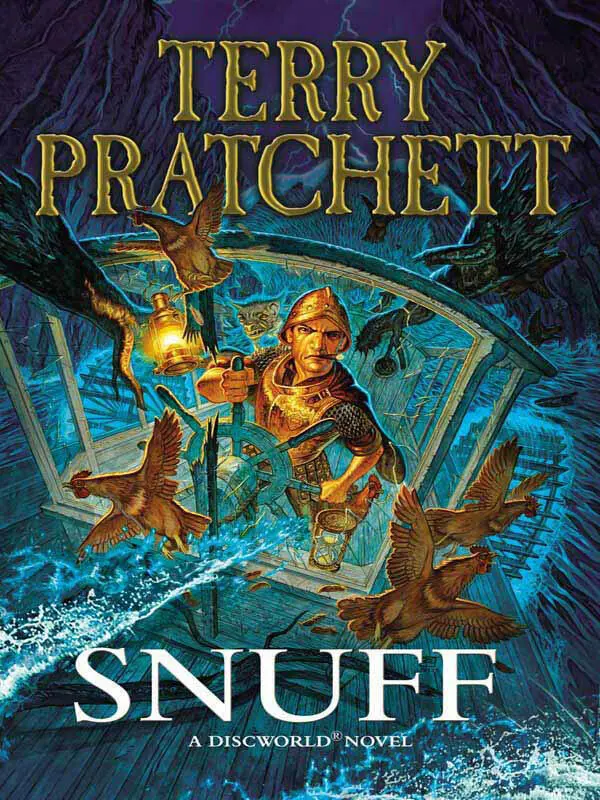
- Название:Snuff
- Автор:
- Издательство:Doubleday
- Жанр:
- Год:2011
- ISBN:9780385619264
- Рейтинг книги:4.5 / 5. Голосов: 2
-
Избранное:Добавить в избранное
- Отзывы:
-
Ваша оценка:
Snuff: краткое содержание, описание и аннотация
Предлагаем к чтению аннотацию, описание, краткое содержание или предисловие (зависит от того, что написал сам автор книги «Snuff»). Если вы не нашли необходимую информацию о книге — напишите в комментариях, мы постараемся отыскать её.
And Commander Sam Vimes of the Ankh-Morpork City Watch is on holiday in the pleasant and innocent countryside, but not for him a mere body in the wardrobe. There are many, many bodies and an ancient crime more terrible than murder.
He is out of his jurisdiction, out of his depth, out of bacon sandwiches, and occasionally snookered and out of his mind, but never out of guile. Where there is a crime there must be a finding, there must be a chase and there must be a punishment.
They say that in the end all sins are forgiven.
But not quite all …
Snuff — читать онлайн бесплатно полную книгу (весь текст) целиком
Ниже представлен текст книги, разбитый по страницам. Система сохранения места последней прочитанной страницы, позволяет с удобством читать онлайн бесплатно книгу «Snuff», без необходимости каждый раз заново искать на чём Вы остановились. Поставьте закладку, и сможете в любой момент перейти на страницу, на которой закончили чтение.
Интервал:
Закладка:
‘Well, of course,’ said Vimes, ‘I’m a simple man from the city who doesn’t know very much about these things, but I take it that a build-up of debris which ploughs its way downriver sweeping up or capsizing everything in its path all the way down to the sea is generally considered to be a bad thing?’
There was a long-drawn-out creak behind them as another tree was hit by a flash. ‘Yes, sir. You left out the word “mercilessly”, sir,’ said Feeney, carefully. ‘I think we really should try to catch up with the Fanny as quickly as possible.’
‘I think you’re right, lad, and right now I suggest—’
Whatever it was that Stinky was doing, and whatever it was that Stinky actually was, the horses were already becoming skittish to the point of bolting. There was so much water in the air and so little light left that the difference between the river and the shore could only be judged by seeing which one you fell into.
And there was solid rain now, rain that blew from every direction, including upwards, and the symphony of dark destruction was punctuated by the sound of banks slipping inexorably into the churning water. The horses were now frantic and direction had no meaning, and nor did warmth and the world was nothing but darkness, water, cold despair and two red eyes.
Feeney saw them first and then Vimes picked up the smell. It was the rich, desperate smell of oxen getting really worried and was thick enough to stink its way out of the turmoil. Amazingly, the boat was still churning the water, making progress of sorts despite the fact that its trailing flotilla of barges was jack-knifing, tangling and generally swishing across the river like the tail of an angry cat.
‘Why didn’t she tie up somewhere?’ shouted Feeney to the storm. It sounded like despair, but Vimes dismounted, grabbed the sticky shape of Stinky and slapped his horse on the rump. It certainly stood a better chance by itself now than it did with him, after all.
And then for a moment his inner eyes looked at Koom Valley. He had nearly died that day as water poured off the valley walls and thundered through the endless caves in the limestone, smacking him against the walls, banging him on the floors and ceilings and finally dropping him on a tiny beach of sand, in utter darkness. And the darkness had been his friend, and Vimes had floated on the face of the darkness, and there he had found enlightenment growing, and understood that fear and rage could be hammered into a sword, and the desire to once again read a book to a child could be forged into a shield and armour for a ragged dying castaway, who thereafter shook hands with kings.
After that, what could be frightening about rescuing goblins and who knew how many other people from a floundering boat on a black and treacherous river in thundering, streaming darkness?
He was running now along the squelching bank, water pouring down his neck. But running wasn’t enough. You had to think. You thought that the pilot of the boat knew the river and knew the boat. He could have moored at any time, couldn’t he? And he hadn’t done so, but he clearly wasn’t a fool, because even having known the river for only a few hours, Vimes could see that no fool would survive on it for more than a few journeys. It was built to be a trap for the stupid.
On the other hand, if you were not stupid then being an ox-boat pilot was a pretty good gig: you’d have prestige, respect, responsibility and a steady wage for a steady job, in addition to the envy of all the little boys on every landing stage. Sybil had told him all about them, with some enthusiasm, one evening. So why, in such a decent position, would a man pilot such a valuable boat with a valuable cargo down a river on an evening that promised annihilation around every snake-like bend when no blame would attach to mooring up for a while?
Money? No, Vimes thought. They call this river Old Treachery, and surely money wasn’t any good to you when you were sinking dreadfully in its muddy embrace. Besides, Vimes knew men like that, and they tended to be proud, self-reliant and impossible to bribe. He probably wouldn’t jeopardize the boat, even if you held a knife to his throat — But traditionally the family comes too; the pilot was always working from home, wasn’t he?
And what would a desperate pilot do then? What would he do if a knife was held to the throat of a wife, or a child? What else could he do but sail on, trusting a lifetime of experience to see them all to safety? And it wouldn’t be one unwelcome guest, no, because then you would try to run the boat heavily aground while you, muscles tensed, would rely on the confusion to leap at the fallen man and strangle him with your bare hands, but that would only work if he hadn’t brought along an ally. And so then you stayed at the wheel, hoping and praying, and expecting, at any moment, the rumble of the damn slam.
Feeney was sprinting along the bank after him now, and managed to pant, ‘What are we going to do, sir? Seriously, what are we going to do!’
Vimes ignored Feeney for a moment. Rain, boiling surf and fallen logs were enough to contend with, but he kept his eye on the line of barges. Right now there was a rhythm as they snaked back and forth, but it was constantly interrupted by bits of driftwood and whatever attempt at steering was happening along there in the wheelhouse. Every time the rearmost barge hit the bank there was a moment, one precious little moment, when a man might jump aboard, if that man were foolish.
So he jumped, and realized that a jump would have to beget another jump and failure to keep the rhythm would mean falling back into the torrent, but jumping on to the next barge, which was swinging and bucking in the swell, you just hoped that you didn’t get a foot stuck between the two of them, because two twenty-five-foot barges colliding as a sandwich with your foot in the middle would do more than just leave a bruise. But Stinky ran and jumped and pirouetted just ahead of him and Vimes was quick enough to get the message, landing squarely on the next barge, and so, surprisingly, did Feeney, who actually laughed, although you had to be within a foot of him to hear that.
‘Well done, sir! We did this when I was a lad … every boy did … the big ones were best …’
Vimes had got his breath back after the first two jumps. According to what Feeney had told him, the Wonderful Fanny was a bulk carrier, big and slow, but it could take any load. There could be anything in these barges, he thought, but there was no smell of goblins yet and there were two barges still to go and weather that was trying to get even worse.
With that thought, there was Stinky again, who apparently could come and go without ever being seen either coming or going. And he still glowed faintly. Vimes had to crouch to speak to him. ‘Where are they, Stinky?’
The goblin farted, quite probably as a clown does, more for entertainment than relief. Clearly happy at the response, he cracked, ‘Number one barge! Easy to get to! Easy to feed!’
Vimes eyed the distance to the barge immediately behind the Fanny . Surely there had to be some kind of walkway? Some means of getting into the barges so that the crew could access the cargo? He turned again to Feeney, dripping with rain and illumined by another flash of lightning. ‘How many crew, do you think?’
Even this close, Feeney had to shout. ‘Probably two men, or a man and boy, down below in what they call the cowshed! Along with the engineer, and generally a loadmaster or cargo captain! Sometimes a cook, if the captain’s wife doesn’t want to do the job, although mostly they do, and then one or two lads learning the business and acting as general lookouts and wharf rats!’
‘Is that all? No guards?’
Читать дальшеИнтервал:
Закладка:
Похожие книги на «Snuff»
Представляем Вашему вниманию похожие книги на «Snuff» списком для выбора. Мы отобрали схожую по названию и смыслу литературу в надежде предоставить читателям больше вариантов отыскать новые, интересные, ещё непрочитанные произведения.



Обсуждение, отзывы о книге «Snuff» и просто собственные мнения читателей. Оставьте ваши комментарии, напишите, что Вы думаете о произведении, его смысле или главных героях. Укажите что конкретно понравилось, а что нет, и почему Вы так считаете.