Simon Hawke - The Nomad
Здесь есть возможность читать онлайн «Simon Hawke - The Nomad» весь текст электронной книги совершенно бесплатно (целиком полную версию без сокращений). В некоторых случаях можно слушать аудио, скачать через торрент в формате fb2 и присутствует краткое содержание. Жанр: Фэнтези, на английском языке. Описание произведения, (предисловие) а так же отзывы посетителей доступны на портале библиотеки ЛибКат.
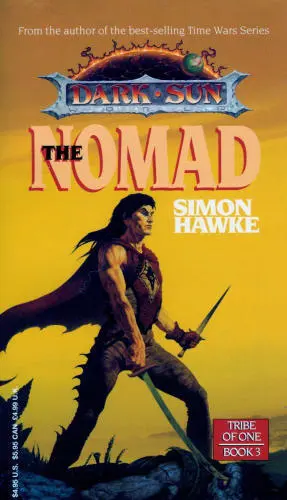
- Название:The Nomad
- Автор:
- Жанр:
- Год:неизвестен
- ISBN:нет данных
- Рейтинг книги:4 / 5. Голосов: 1
-
Избранное:Добавить в избранное
- Отзывы:
-
Ваша оценка:
The Nomad: краткое содержание, описание и аннотация
Предлагаем к чтению аннотацию, описание, краткое содержание или предисловие (зависит от того, что написал сам автор книги «The Nomad»). Если вы не нашли необходимую информацию о книге — напишите в комментариях, мы постараемся отыскать её.
The Nomad — читать онлайн бесплатно полную книгу (весь текст) целиком
Ниже представлен текст книги, разбитый по страницам. Система сохранения места последней прочитанной страницы, позволяет с удобством читать онлайн бесплатно книгу «The Nomad», без необходимости каждый раз заново искать на чём Вы остановились. Поставьте закладку, и сможете в любой момент перейти на страницу, на которой закончили чтение.
Интервал:
Закладка:
“Very well,” the gamemaster said, revealing absolutely nothing by his tone. “You proceed and come to the pile of rubble. Only one of you can get around it at a time. Even if you turn sideways, two cannot squeeze through together. So now, you must decide who will go first.”
Without hesitation, the other four players agreed that the fifth player, the one who had argued for the choice, should go through first. Suddenly, the fifth player seemed to find this choice much less attractive than he had moments earlier.
“And so it is decided that the thief goes first,” the gamemaster said, referring to the character of the fifth player. He gazed directly at the fifth player, once j again, revealing nothing in either his manner or his tone. “Your wager, Thief?” The gambling element entered the game with each new dramatic situation that the players were presented. Before they rolled the dice to see how the scenario would progress, depending on their characters’ strengths and abilities, they would first wager on the outcome. It was a game in which the players were pitted against the house, represented by the gamemaster. And even though the gamemaster knew what was coming up next, he had to work from a prepared script, and he could not control the roll of the dice that determined a character’s strengths and abilities, and the outcome of any given confrontation.
The fifth player swallowed nervously. “I will wager three ceramics,” he said, cautiously.
The gamemaster raised his eyebrows. “Is that all? You had argued so insistently for your choice, and yet now, suddenly you do not seem very confident.”
“Very well, then, curse you! Five ceramics!” said the thief.
The gamemaster smiled faintly. “Make your roll.”
The thief rolled, and the gamemaster noted the score. It was a low score, and the fifth player licked his lips nervously. “Very well, who goes next?” the gamemaster said. The other players would all complete their rolls before the gamemaster revealed the outcome, based on their scores and their strength and ability rolls at the beginning of the game.
One at a time, the other players wagered and then rolled. Each time, the gamemaster noted down the score to balance off against the strengths and abilities rolled earlier. When they had all finished, the gamemaster consulted the scores that he had written down, taking his time about it to allow the tension to build among the players, and many of the onlookers, as well.
“You have walked into a trap,” he said at last.
The thief swore in disgust. “The undead are often stupid,” the gamemaster continued, “but unfortunately, some of them can be quite clever. They had dug a pit in the space where you passed through, and then covered it with a woven mat of reeds that would support a thin layer of dirt, but not a person’s weight. At the bottom of that pit, they had placed long, sharpened wooden stakes. The thief went first, and he scored low, so he fell through and was impaled. The undead will feast upon his corpse tonight. Player Number Five has died, and the game is now over for him, unless he wishes to pay a new character fee, roll to determine strength and abilities, and then continue.”
“Bah!” said the fifth player, pushing his chair back from the table. “I have had enough of this! You tricked us into that trap!”
“The choice was yours,” the gamemaster pointed out, “and you had even argued for it. You should have listened instead to your fellow players. Better luck next time.”
| “Next time I will find a better game!” the fifth player said, then left the table angrily.
The gamemaster was unperturbed at this display, and continued smoothly. “The dwarf fighter went next,” he said. “However, his roll was high, as are his strength and ability scores, and therefore, he managed to avoid the pit by leaping over it as the thief fell j through. Player Number Four, you have passed through successfully and won your wager. You are now richer to the tune often ceramics. My congratulations.”
Player Number Four collected his winnings with a pleased expression on his face.
“Player Number Three, the merchant,” the gamemaster continued, “rolled only a four, and unfortunately, it was not enough to compensate for her low dexterity score at the beginning of the game. She was, therefore, unable to avoid the pit, and so also fell inside and was impaled. Player Number Three has died and lost her wager, and now has the option of paying a new character fee, rolling for strength and ability, and continuing in the game, or else leaving the table.”
Player Number Three chose to leave the table, sighing and shaking her head sadly at the outcome.
“Player Number Two, the cleric,” said the gamemaster. “You rolled high, and your skill rolls were also high, so you also managed to avoid the pit by leaping over it. You have survived and won your wager. Congratulations.”
Player One, the templar, had also passed through successfully, won her wager, and would continue in the game. That completed the round of the diverging streets scenario.
“There is now room at the table for two more players,” the gamemaster announced to those who had gathered around to watch. “Would anyone care to try their luck on the quest for ‘The Lost Treasure of Bodach?’”
“An interesting game,” Valsavis said. “I have never played this one before. I think I will try my luck and see what happens.”
The gamemaster waved him to a chair.
“I will play, as well,” said Sorak, taking the other empty chair. Ryana stood behind him and watched.
Before the game proceeded, Sorak and Valsavis chose their characters and rolled the dice for their strength and ability scores. Valsavis, not surprisingly, chose to be a fighter, and his character was a mercenary. Sorak followed his example of playing close to home and chose to be a druid. Valsavis rolled high on strength and only average on ability. Sorak rolled high on ability and average on strength.
“Very well,” the gamemaster said, when they were done. “Let us now proceed. You are all past the pit, though Players One, Two, and Four have accumulated more experience points, which will count toward their winnings if they successfully complete the quest. Player Number Three, the mercenary, and Player Number Five, the druid, have no experience points as yet. We shall continue.
“The street before you is one that twists and turns in serpentine fashion through the ancient, ruined buildings. Perhaps the treasure may be found in one of them, perhaps not. But daylight is quickly running out, and the shadows are lengthening. You must find a place of refuge, for before long, the streets of Bodach will be crowded with undead, searching to satisfy their lust for living flesh. As you gaze at your surroundings, you see that none of the buildings in your immediate vicinity look especially secure.
“However, farther down the street, around a bend, you see an old stone tavern. The walls look thick, and the door, which is still in place, appears stout. The windows are all heavily barred. The structure appears to offer a safe haven for the night. So, now you must decide. Do you proceed toward it?” The players all quickly agreed that they would. “Very well,” the gamemaster continued. “You have reached the stone tavern, but as you stand upon its threshold, you can now see farther down the twisting street, and at another bend, you see a walled enclosure that surrounds what was once the home of an Aristocrat. The walls are high and thick, and the gate is made of iron, once common in the ancient world, now rare. Beyond this gate, visible through its thick and heavy bars, you see a courtyard, and past this courtyard, you see the house itself. It is set back from the street, and has three stories, surmounted by a tower at each wing. The house is built of stone, and appears to be more or less intact. Its front door is thick agafari wood, banded with iron. This house seems to present a safe haven, as well. Do you choose to go inside the stone tavern, with the barred windows and the stout front door, or do you proceed to the towered house of the aristocrat, surrounded by the thickly walled enclosure? Only one will afford safe shelter for the night, but which? You must decide.”
Читать дальшеИнтервал:
Закладка:
Похожие книги на «The Nomad»
Представляем Вашему вниманию похожие книги на «The Nomad» списком для выбора. Мы отобрали схожую по названию и смыслу литературу в надежде предоставить читателям больше вариантов отыскать новые, интересные, ещё непрочитанные произведения.

Обсуждение, отзывы о книге «The Nomad» и просто собственные мнения читателей. Оставьте ваши комментарии, напишите, что Вы думаете о произведении, его смысле или главных героях. Укажите что конкретно понравилось, а что нет, и почему Вы так считаете.