Simon Hawke - The Nomad
Здесь есть возможность читать онлайн «Simon Hawke - The Nomad» весь текст электронной книги совершенно бесплатно (целиком полную версию без сокращений). В некоторых случаях можно слушать аудио, скачать через торрент в формате fb2 и присутствует краткое содержание. Жанр: Фэнтези, на английском языке. Описание произведения, (предисловие) а так же отзывы посетителей доступны на портале библиотеки ЛибКат.
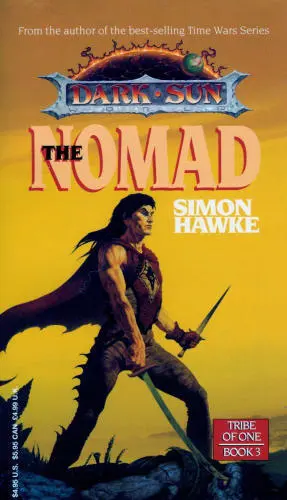
- Название:The Nomad
- Автор:
- Жанр:
- Год:неизвестен
- ISBN:нет данных
- Рейтинг книги:4 / 5. Голосов: 1
-
Избранное:Добавить в избранное
- Отзывы:
-
Ваша оценка:
The Nomad: краткое содержание, описание и аннотация
Предлагаем к чтению аннотацию, описание, краткое содержание или предисловие (зависит от того, что написал сам автор книги «The Nomad»). Если вы не нашли необходимую информацию о книге — напишите в комментариях, мы постараемся отыскать её.
The Nomad — читать онлайн бесплатно полную книгу (весь текст) целиком
Ниже представлен текст книги, разбитый по страницам. Система сохранения места последней прочитанной страницы, позволяет с удобством читать онлайн бесплатно книгу «The Nomad», без необходимости каждый раз заново искать на чём Вы остановились. Поставьте закладку, и сможете в любой момент перейти на страницу, на которой закончили чтение.
Интервал:
Закладка:
They went inside and came into a large, cavernous chamber. The entire first floor of the Desert Palace was one large open room. There was a partial second floor, open in the center, making a gallery running around on all four sides from which people could look down on the action at the tables below. The rooms up on the second floor were probably private rooms and offices for the management. Sorak noted that there were several elf archers stationed up on the gallery, armed with small, powerful crossbows. They walked slowly back and forth along the gallery, keeping a careful watch on the crowd below. Undoubtedly, they were fine marksmen, but Sorak made a mental note to keep an eye on them in case any trouble erupted on the gaming floor. He did not wish to be near such an outbreak and accidentally wind up with another arrow in his back. Even for a superior bowman, it would be difficult to shoot accurately under such crowded conditions. On the other hand, knowing that probably had a pacifying effect upon the clientele.
Light was provided by candles set in sconces mounted upon large, wooden wheels suspended from the beamed ceiling. There were also oil lamps and braziers adding illumination. A dimly lit gaming house, Sorak recalled from his days at the Crystal Spider, only made it easier for the patrons to attempt cheating. And, along with the archers on the upper gallery, there were also well-armed, burly guards stationed at various points throughout the main hall, making sure none of the customers got out of line.
They wandered through the gaming hall toward the long bar at the rear. This, too, was clever planning, Sorak thought. Many such establishments built their bars along the side, which afforded them more room to squeeze people in, but here, if one was thirsty, one first had to walk past all the tables to get to the bar, and that made it easier for patrons to be drawn into a Same, especially since attractive human and half-elf serving wenches constantly moved among the tables with their trays, bringing drinks to those at the tables.
And the tables seemed to offer every conceivable sort of game. There were roulette wheels and dice tables, round tables where patrons played cards against one another-with an attendant to make sure the house took a percentage of each pot-and U-shaped tables where people played against a dealer. There were even several tables where a game was played that Sorak had never seen before. They stopped on their way through to watch one of these curious new games.
The first thing that they noticed was that no cards were used, nor were there any playing pieces. There were no wheels or boards, and the players were in teams. Instead of a dealer, there was a sort of gamemaster who directed the play. Each player assumed a character at the beginning of the game and rolled dice to determine the character’s abilities. The gamemaster then presented them with an imaginary scenario through which they had to play, as teams, supporting one another with their respective skills. One character might be a thief, another might be a druid, still another a fighter or an adept, and so forth. And the game that they had stopped to watch just happened to be called, ironically, “The Lost Treasure of Bodach.”
The players had already chosen their characters and rolled to determine their strengths and abilities. They had already completed the preliminary rounds, and now the climax of the game was about to begin.
“You have just entered the lost city of Bodach,” said the gamemaster to the players. He proceeded to set the stage for them. “It has been a long and dusty journey on a hot, sweltering day, and you are all exhausted. You long to rest, but you cannot, because you know that in another hour’s time, the sun will go down, and then the undead will creep forth from i their lairs, where they molder throughout the day. i Therefore, your first priority must be to find a place to hide, a shelter that is defensible, where you may spend the night in safety-inasmuch as one can ever be safe in the city of the undead, of course. If you succeed in finding such a shelter, then perhaps the undead will not find you. On the other hand,” he paused dramatically “... perhaps they shall. There is no predicting what may happen in the city of doomed souls. But for now, remember that you have but one hour before the sun goes down. Consider what you choose to do next very carefully.”
Sorak and Ryana noticed that they were not the only ones who had stopped to watch and listen. A number of other people were standing around, observing the play with fascination. It was, in a way, much like watching a small, informal theatrical production of an improvisational nature. The players had to improvise, because they had no idea what the gamemaster would present them with next. He was die only one who had a script. And the players had to improvise in character, just like actors on a stage.
“As you stand inside the ancient city gates,” the gamemaster continued, “you see a narrow street stretching out before you, leading to a plaza with a large fountain that has been dry for countless generations. All around are ancient buildings, crumbling into ruin. Sand blows across the streets, piling up into small dunes against the ruined building walls. As you approach the plaza, you see that it is littered with hones, the skeletons of adventurers just like yourselves who came to Bodach in search of the lost treasure and found, instead, their deaths. As you approach still closer, you see that many of these bones are broken, snapped open so that the marrow could have been sucked out, and many of these bones also bear the marks of chewing.”
The players glanced at one another uneasily. The gamemaster had a deep, mellifluous and dramatic voice, and he knew how to use it to its best effect. They could all see in their minds’ eyes the image that he was constructing for them, and his presentation had them all caught up in the illusion he was spinning out.
“Beyond the ancient bones,” he continued, “on the opposite side of the fountain, three streets radiate outward from the plaza. One of these streets leads straight north and affords a clear and unobstructed view. One leads to the northwest, but it curves off sharply to the left after thirty or forty yards, so that you cannot see what lies beyond this curve. And the third street leads to the northeast. However, there is a pile of rubble from a collapsed building in the center of it, almost completely blocking the street. You cannot see what lies beyond this pile of rubble, but you can see that it does not block the street entirely. There is a very narrow passage to the right, just barely wide enough to allow one individual to pass through at a time. You must now choose which way you will go.”
The players huddled briefly in conference. One of them was in favor of taking the street in the middle, the one that led straight north and afforded them an unobstructed field of view. The others did not trust that choice, and they argued in character. They thought it was too easy and too tempting. The gamemaster seemed to want them to go that way. It could be a trap. Three of the players wanted to take the street to the left, the one that curved around. The fifth player argued in favor of the street to the right, the one that was almost completely blocked by the pile of rubble. His arguments were persuasive. It was clearly the most ominous choice, he said. They could not see what lay beyond the rubble, and only one of them could squeeze through the narrow opening at a time. There was every reason not to choose that path, the fifth player said, because it not only hid what lay beyond from view, but it also exposed them to the greatest danger, since they could only go through one at a time. The gamemaster had purposely designed the scenario in such a way as to make that the least attractive choice for them, the fifth player insisted, which was precisely why it was the choice that they should make. The fifth player convinced the others, and they all elected to take the street to the right, past the pile of rubble from the partially collapsed building.
Читать дальшеИнтервал:
Закладка:
Похожие книги на «The Nomad»
Представляем Вашему вниманию похожие книги на «The Nomad» списком для выбора. Мы отобрали схожую по названию и смыслу литературу в надежде предоставить читателям больше вариантов отыскать новые, интересные, ещё непрочитанные произведения.
Обсуждение, отзывы о книге «The Nomad» и просто собственные мнения читателей. Оставьте ваши комментарии, напишите, что Вы думаете о произведении, его смысле или главных героях. Укажите что конкретно понравилось, а что нет, и почему Вы так считаете.