Simon Hawke - The Nomad
Здесь есть возможность читать онлайн «Simon Hawke - The Nomad» весь текст электронной книги совершенно бесплатно (целиком полную версию без сокращений). В некоторых случаях можно слушать аудио, скачать через торрент в формате fb2 и присутствует краткое содержание. Жанр: Фэнтези, на английском языке. Описание произведения, (предисловие) а так же отзывы посетителей доступны на портале библиотеки ЛибКат.
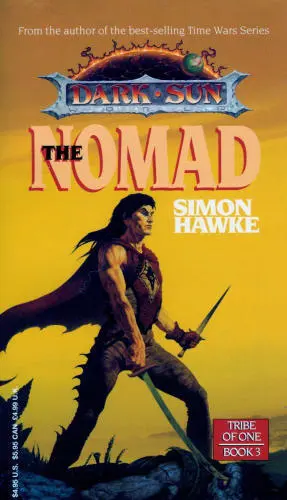
- Название:The Nomad
- Автор:
- Жанр:
- Год:неизвестен
- ISBN:нет данных
- Рейтинг книги:4 / 5. Голосов: 1
-
Избранное:Добавить в избранное
- Отзывы:
-
Ваша оценка:
The Nomad: краткое содержание, описание и аннотация
Предлагаем к чтению аннотацию, описание, краткое содержание или предисловие (зависит от того, что написал сам автор книги «The Nomad»). Если вы не нашли необходимую информацию о книге — напишите в комментариях, мы постараемся отыскать её.
The Nomad — читать онлайн бесплатно полную книгу (весь текст) целиком
Ниже представлен текст книги, разбитый по страницам. Система сохранения места последней прочитанной страницы, позволяет с удобством читать онлайн бесплатно книгу «The Nomad», без необходимости каждый раз заново искать на чём Вы остановились. Поставьте закладку, и сможете в любой момент перейти на страницу, на которой закончили чтение.
Интервал:
Закладка:
Frequently, there were more people in Salt View than the hotels and inns could easily accommodate, and so transient camps had sprung up on the outskirts of the village. They provided cheap if not comfortable or sanitary housing, and they were generally full. It was always possible to squeeze another body or two into a tent. Order was kept in the camps, after a fashion, by mercenary guards hired by the camp-masters, frequently among those who found themselves with empty purses and no way to get back home. And these jobs, too, often had high mortality rates.
Salt View was a wide-open town, but not a very forgiving one to those who could not pay their way. Xaynon had decreed that beggars would not be tolerated in Salt View, as they were a blight upon the village. When their numbers had grown so great that they had practically choked the streets, Xaynon had instituted the Law of Vagrancy, one of the few laws that was formally enforced in Salt View. If a beggar was caught upon the streets of the town, he was given a choice. Either accept a free waterskin and start walking out into the desert, or else find a job-any job-within twenty-four hours. If he then failed to do so, he would be put to work in the indentured labor force, performing whatever tasks the village council deemed required. This could entail being assigned to the sanitation detail, to keep the village streets clean and attractive, or working on construction details to build and maintain buildings. As a result, Salt View was always clean, and refuse was always picked up. Its buildings, while not large and opulent, were kept in good repair and regularly plastered and whitewashed. The brickyards never had a shortage of laborers, and the streets were all neatly paved with the dark, red, sunbaked bricks that they turned out. There were even gardens along the main street that were regularly tended and watered by workers hauling barrels from the springs on the slopes north of the town.
A vagrant would thus remain constructively employed by the village, provided with a tent to sleep in and two square meals a day, until such time as he managed to secure employment. And he was generously given some time at the end of every work day to look for it. If he was fortunate enough to find a job and save up enough money to buy passage back home, he would usually depart, never to return. And that suited the village council very well. They welcomed tourists, but they could do without those who were financially irresponsible and became a burden on the community.
Slowly, in this manner, the village grew a little larger every year. It was still known as a village, but it was more properly a small town. Someday, Xaynon hoped to see Salt View become a city-perhaps named after himself, which was only fitting considering his visionary leadership. He did not know if he would ever live to see that, though chances were excellent that he would, for the growth increased significantly every year. But he wanted to guide its course and leave it as his legacy. And, indeed, it would be quite a legacy for a former slave who had become a gladiator, fought in the arena, gained his freedom, and guided the development of a dirty little mudhole of a village into a handsome and well-organized oasis of entertainment in the desert.
Sorak, Ryana, and Valsavis passed through the gates of Salt View and onto the main street, which ran the entire length of the town. From inside the gates, it was quite a view, even more attractive than the town had looked as seen from the slopes of the foothills.
Before them stretched a wide street paved with clean red brick and lined by freshly whitewashed adobe buildings two or three stories in height. Each building was flat-roofed, and each had a covered walkway in front of it, supported by columns and roofed with rounded, overlapping, red ceramic tiles. Each arched entryway was decorated with a border of glazed tiles in various patterns and colors, as were the windows. Most of the buildings on the main street had covered balconies where people could sit outside, shaded from the sun. Along the street and in the center of it were raised, square planters constructed of plastered adobe brick and holding spreading agafari or pagafa trees, beneath which were planted various desert succulents, wildflowers, and cacti. All around these planters, merchants had set up covered booths with colorful cloth awnings. Here, one could buy food and drink, clothing, jewelry, and various others items.
The main street was crowded with pedestrians. It was not very long, and one could walk from one end to the other in thirty minutes or so, but there were various side streets and alleys leading off it on both sides, to where the other buildings of the town were tightly clustered together. Salt View was growing outward, with side streets radiating from the center like spokes from a wheel.
“Why, it’s beautiful!” Ryana said as she looked all around. “I had imagined an ordinary little village, much like any other, but this is like an aristocrat’s estate!”
“People come to Salt View and leave their money behind,” Valsavis said. “Xaynon puts it to good use. Most travelers arriving in Salt View for the first time have the same impression as you. But first impressions can often be deceptive.”
“How so?” asked Sorak.
“As the priestess said, during the day, Salt View resembles some wealthy aristocrat’s estate, well kept and inviting, but when night falls, its character changes dramatically, as you will soon see for yourselves. I would advise you to keep an eye to your purse, and a hand near your sword.”
“That is a good philosophy to follow no matter where one finds himself,” said Sorak.
“Then practice it here especially,” Valsavis said. “And be wary of temptation. You will find every sort imaginable here. Salt View will welcome you with open arms so long as you have plenty of money to spend. But when you have spent it all, or lost it, you will not find the place so friendly.”
“We have no money now,” said Sorak.
“That situation will be shortly remedied,” Valsavis said. “We will sell these kanks at the nearest stables, and as they are soldiers, they will be sure to fetch a decent price. Then we will dispose of the arms that our marauder friends have so thoughtfully provided us with, as well as their supplies and the game they were taking back to their camp. I imagine that should fill our purses well enough to see us comfortably through the next few days, if we do not spend profligately.”
“You said that there are gaming houses here?” said Sorak.
Valsavis snorted. “Every other building on this main street is a tavern or a gaming house,” he said. “And you can be sure that every tavern has at least a game or two. But I thought you came here to preach the preserver cause and not to game.”
“One does not win many converts by preaching to a multitude these days,” said Sorak. “Especially in a place such as this, where appetites are bound to be jaded and people can be easily distracted. I prefer to influence individuals, so that I can speak to them one on one and see their eyes.”
“And you hope to do this in a gaming house?” Valsavis said. “Good luck.”
“There are more ways than one to win people to your cause,” said Sorak. “And sometimes it helps to win some money, first. People always listen attentively to winners.”
“Suit yourself,” Valsavis said. “I came here for the entertainment, and it should prove very entertaining to watch you at the tables. Just remember this: I do not make loans.”
“I promise not to ask,” said Sorak. “Besides, I am not entirely inexperienced at gaming. I once worked in a gaming house in Tyr.”
“Indeed?” Valsavis said as they led their string of kanks to the stables by the walls around the town. “I once lived in Tyr and served in its city guard. Which house did you work in?”
Читать дальшеИнтервал:
Закладка:
Похожие книги на «The Nomad»
Представляем Вашему вниманию похожие книги на «The Nomad» списком для выбора. Мы отобрали схожую по названию и смыслу литературу в надежде предоставить читателям больше вариантов отыскать новые, интересные, ещё непрочитанные произведения.










Обсуждение, отзывы о книге «The Nomad» и просто собственные мнения читателей. Оставьте ваши комментарии, напишите, что Вы думаете о произведении, его смысле или главных героях. Укажите что конкретно понравилось, а что нет, и почему Вы так считаете.