Ким Робинсон - Red Moon
Здесь есть возможность читать онлайн «Ким Робинсон - Red Moon» весь текст электронной книги совершенно бесплатно (целиком полную версию без сокращений). В некоторых случаях можно слушать аудио, скачать через торрент в формате fb2 и присутствует краткое содержание. Город: New York, Год выпуска: 2018, ISBN: 2018, Издательство: Orbit, Жанр: Фантастика и фэнтези, на английском языке. Описание произведения, (предисловие) а так же отзывы посетителей доступны на портале библиотеки ЛибКат.
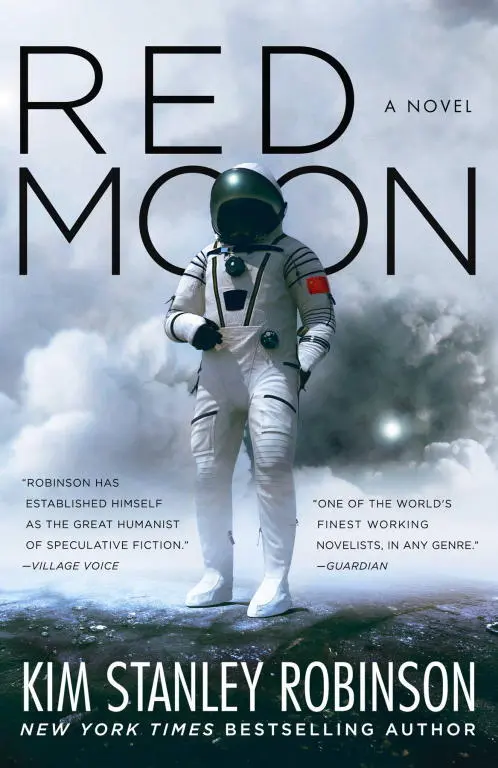
- Название:Red Moon
- Автор:
- Издательство:Orbit
- Жанр:
- Год:2018
- Город:New York
- ISBN:978-0-316-26237-8
- Рейтинг книги:3 / 5. Голосов: 1
-
Избранное:Добавить в избранное
- Отзывы:
-
Ваша оценка:
Red Moon: краткое содержание, описание и аннотация
Предлагаем к чтению аннотацию, описание, краткое содержание или предисловие (зависит от того, что написал сам автор книги «Red Moon»). Если вы не нашли необходимую информацию о книге — напишите в комментариях, мы постараемся отыскать её.
American Fred Fredericks is making his first trip, his purpose to install a communications system for China's Lunar Science Foundation. But hours after his arrival he witnesses a murder and is forced into hiding.
It is also the first visit for celebrity travel reporter Ta Shu. He has contacts and influence, but he too will find that the moon can be a perilous place for any traveler.
Finally, there is Chan Qi. She is the daughter of the Minister of Finance, and without doubt a person of interest to those in power. She is on the moon for reasons of her own, but when she attempts to return to China, in secret, the events that unfold will change everything - on the moon, and on Earth.
Red Moon is a magnificent novel of space exploration and political revolution from New York Times bestselling author Kim Stanley Robinson.
For more from Kim Stanley Robinson, check out:
New York 2140
2312
Aurora
Shaman
Red Moon — читать онлайн бесплатно полную книгу (весь текст) целиком
Ниже представлен текст книги, разбитый по страницам. Система сохранения места последней прочитанной страницы, позволяет с удобством читать онлайн бесплатно книгу «Red Moon», без необходимости каждый раз заново искать на чём Вы остановились. Поставьте закладку, и сможете в любой момент перейти на страницу, на которой закончили чтение.
Интервал:
Закладка:
“Where are we going again?”
“First a waffle shop.”
“Which is where?”
She didn’t even give him a look, being busy glancing around the street. She clutched his hand and pulled him along like a recalcitrant child. Past rows of bars and restaurants, down a dark alley—a hutong , Fred guessed, an old-style Beijing residential alley, which was only wide enough for one small car, if that. Low roofs of gray tile upcurved at the beam ends—everything mossy, dusty, ancient. Big red doorways with giant iron knobs on them, all recessed into the walls fronting the alley. No obvious cameras here, though of course tiny cameras could be tucked anywhere, and probably were.
They emerged from the hutong onto another broad busy highway. A sea of trucks and cars passed before them, all humming quietly on their own, and only en masse creating a buzz like a vast refrigerator, or a beehive. Articulated buses had dedicated lanes of their own, they were like subways on the land. It was amazing to see bike riders out in the middle of this traffic trundling stubbornly along. Qi led Fred between two buildings, then across a street as wide as two American highways, after waiting a long time for a pedestrian light. After that down another narrow street, Fred trying to lengthen his stride as Qi had suggested. It made him clumsy, she tugged on his hand. The heavy gravity, or his recent poisoning, or some combination of the two, was really hammering him.
Finally she pulled him into a two-story glass-fronted restaurant; it had a big open interior, with a small balcony at the back overlooking everything. The tall airy space was crowded with old chandeliers hanging at different levels, most of them ornate crystal antiquated things, but also a few big wooden rings, black glass mobiles, and dusty faceted mirror balls. All of them hanging in the air together made for a weird kind of magnificence.
Qi said something to the young woman at the front, who looked shocked and then hurried to the back. Qi led Fred up broad glass stairs to the balcony, where she sat them at a long table. Everyone in the restaurant could look up and see them, and this exposure caused Fred to look at people even less than usual. Qi ordered from a waitress, and when waffles came for both of them, she poured green syrup over hers and ate. Fred had his with maple syrup and whipped cream, feeling suddenly famished. He tried to think and failed.
“Do you feel the gravity?” he asked her.
She nodded, swallowed. “It’s pretty bad,” she allowed.
The table they were sitting at was long and communal. After about half an hour, a young couple sat down next to them. Qi ignored them and kept eating. Then she began to talk to them in Chinese, as if introducing herself, and they chatted for a while, as if about inconsequential things. Just a matter of being polite to tablemates. Possibly it was a Beijing custom, Fred thought. Despite the crowds everywhere, people seemed friendly. Was this a Beijing thing, or China in general? Strangers just talking to each other out of the blue, it was kind of amazing.
On the other hand, Fred suddenly saw that the people Qi was conversing with, though acting like strangers, were actually quivering a little. Suddenly he saw their nervous exhilaration. They glanced at Qi in sidelong flickers, as if to look at her too long might burn their retinas. What did it mean? Who was she?
The young couple took off their wristpads. One of them held a wristpad up to Fred’s face and took a picture, it looked like, and then plugged it into a small box in her jacket pocket. After that she slid both wristpads across the table to Qi, who scooped them up and put them in the pocket of her jacket. Abruptly she got up and said something, then led Fred down through the cloud of chandeliers and back onto the street. They left without paying, as far as Fred could tell. He asked Qi about that as they hurried down another crowded sidewalk, and impatiently she shook her head. “My friends will pay,” she said.
“So those were friends?”
“Yes. They’re arranging our train trip.”
“Train trip?”
“I told you. We need to get to a good hiding place.”
“Why weren’t they scared to be around you, like the people you talked into letting us go?”
“Maybe they were.”
“So why did they help you?”
“We’re part of a group. We work together.” She looked at him curiously. “Don’t you work with other people?”
“Yes?”
He had to think about that as he followed her down the sidewalk, under broad dusty trees. His employers gave him things to ponder and tasks to attempt, and he did what he could. They took his efforts and gave him more things to try. He brainstormed with colleagues and commented on their work, and occasionally he was sent out to activate a quantum phone, mostly when all the other facilitators were busy, but he could do it and he did. So was that what she meant by working with other people? He wasn’t sure.
Again it was crowded on the streets, though by now it was late at night, the moon gleaming between clouds wafting in from the west. It was impossible to believe they had been up there on that white ball just a few days before. Now its light shone on a broad pedestrian mall of some kind, filled with couples and small knots of families, people out on a nice summer evening. They came to a curving canal, where moonlight lay in a squiggling line over black water.
“This used to be part of the Second Ring Road,” Qi said as they hurried by the canal. “Before it was a road it was a river, connecting to the great canal. Now this part is a canal again.”
“It looks good.”
For a moment she paused and looked down at the water. “They’ve brought back some canals, anyway. It’s part of the Green Beijing movement. Liang Sicheng would be pleased. He fought for the canals and lost.”
“It looks nice.”
“It’s more than looks. When I was a child it was like being poisoned to live here. The air was black by day, white by night. You could chew it. You could feel it eating your eyes. Lots of people died from it. So they cleaned it up. It was a case of make a new China or die.”
Fred looked at her face in the moonlight, trying to understand her expression: proud but melancholy? Bitter? Fred was never good at reading faces, but now under the weight of circumstances things were blurring in his head, and it was hopeless. “Why are you on the run again?” he said.
“I want things,” she said.
Okay, hopeless. Fred gave up. They stood by the wall for a long time, so long that eventually the moon shone down on them entirely from the west side of the branch that had been bisecting it.
“We’re waiting for someone,” Fred guessed.
“For the right train.”
“A train to where?”
She didn’t answer. He suppressed all his questions, tried to content himself with the sight of her. Part of the unexpected beauty of old Beijing at night. In his previous visits he had only ever been to the city outside the Sixth Ring Road, where high rises and industrial parks dominated. Now, with lit paper globes strung through the trees and reflecting off the still water, and a paper dragon draped along the stone dragon that topped the canal wall, it seemed as if he had been transported to a China out of legend.
Qi was looking across the canal.
“What’s wrong?” Fred said.
“There’s a chaoyangqunzhong over there,” she said.
“Is that police?”
“No, just an ordinary person being a public security volunteer. They use an app on their wrists to make anonymous tips to the police.”
“How do you know?”
“I can tell by the glasses they’re wearing. Here, hug me.”
She moved against him and buried her head against his shoulder. Startled, he put his face in her hair, breathed it in. Faint scent of jasmine or some other flowery shampoo.
Читать дальшеИнтервал:
Закладка:
Похожие книги на «Red Moon»
Представляем Вашему вниманию похожие книги на «Red Moon» списком для выбора. Мы отобрали схожую по названию и смыслу литературу в надежде предоставить читателям больше вариантов отыскать новые, интересные, ещё непрочитанные произведения.






![Ким Робинсон - Годы риса и соли [litres]](/books/394367/kim-robinson-gody-risa-i-soli-litres-thumb.webp)




Обсуждение, отзывы о книге «Red Moon» и просто собственные мнения читателей. Оставьте ваши комментарии, напишите, что Вы думаете о произведении, его смысле или главных героях. Укажите что конкретно понравилось, а что нет, и почему Вы так считаете.