Рафаэль Лафферти - The Best of R. A. Lafferty
Здесь есть возможность читать онлайн «Рафаэль Лафферти - The Best of R. A. Lafferty» весь текст электронной книги совершенно бесплатно (целиком полную версию без сокращений). В некоторых случаях можно слушать аудио, скачать через торрент в формате fb2 и присутствует краткое содержание. Год выпуска: 2019, Издательство: Tom Doherty Associates, Жанр: Фантастика и фэнтези, на английском языке. Описание произведения, (предисловие) а так же отзывы посетителей доступны на портале библиотеки ЛибКат.
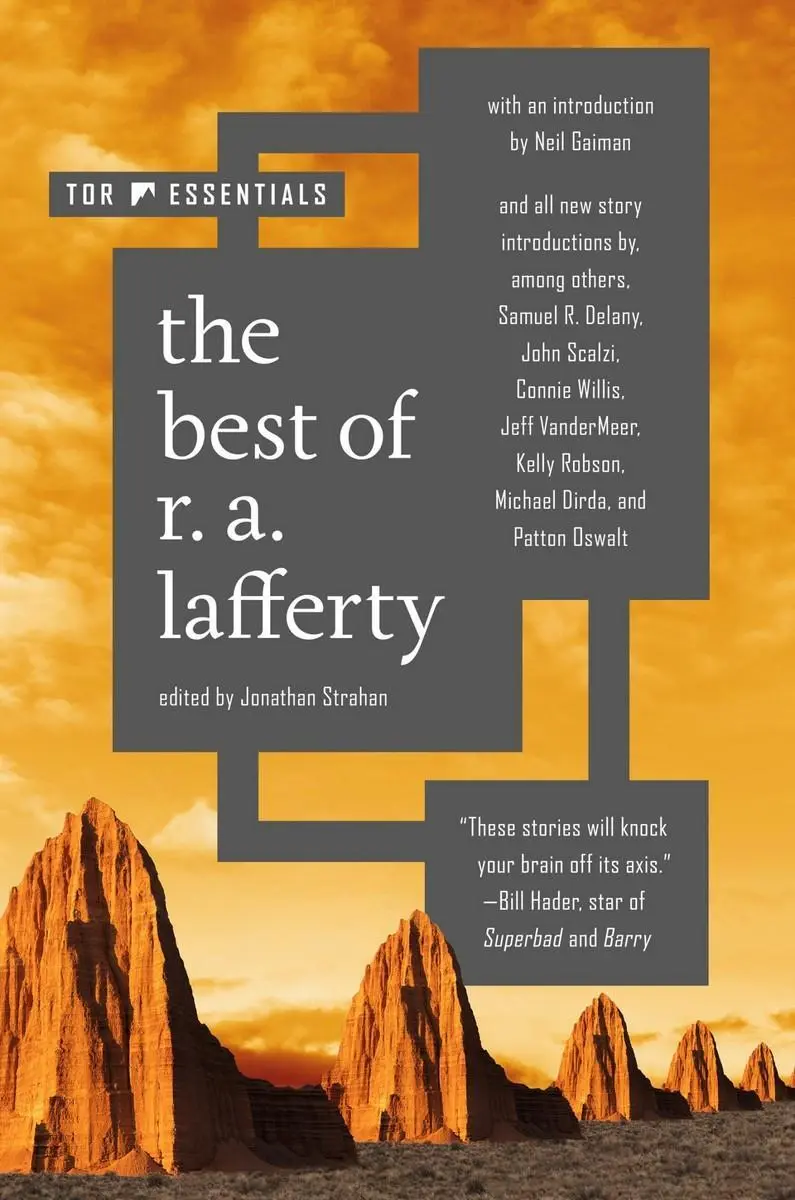
- Название:The Best of R. A. Lafferty
- Автор:
- Издательство:Tom Doherty Associates
- Жанр:
- Год:2019
- ISBN:нет данных
- Рейтинг книги:3 / 5. Голосов: 1
-
Избранное:Добавить в избранное
- Отзывы:
-
Ваша оценка:
The Best of R. A. Lafferty: краткое содержание, описание и аннотация
Предлагаем к чтению аннотацию, описание, краткое содержание или предисловие (зависит от того, что написал сам автор книги «The Best of R. A. Lafferty»). Если вы не нашли необходимую информацию о книге — напишите в комментариях, мы постараемся отыскать её.
Acclaimed as one of the most original voices in modern literature, a winner of the World Fantasy Award for lifetime achievement, Raphael Aloysius Lafferty (1914-2002) was an American original, a teller of acute, indescribably loopy tall tales whose work has been compared to that of Avram Davidson, Flannery O'Connor, Flann O'Brien, and Gene Wolfe. The Best of R. A. Lafferty presents 22 of his best flights of offbeat imagination, ranging from classics like "Nine-Hundred Grandmothers" (basis for the later novel) and "The Primary Education of the Cameroi," to his Hugo Award-winning "Eurema's Dam." Introduced by Neil Gaiman, the volume also contains story introductions and afterwords by, among many others, Michael Dirda, Samuel R. Delany, John Scalzi, Connie Willis, Jeff VanderMeer, Kelly Robson, Harlan Ellison...
The Best of R. A. Lafferty — читать онлайн бесплатно полную книгу (весь текст) целиком
Ниже представлен текст книги, разбитый по страницам. Система сохранения места последней прочитанной страницы, позволяет с удобством читать онлайн бесплатно книгу «The Best of R. A. Lafferty», без необходимости каждый раз заново искать на чём Вы остановились. Поставьте закладку, и сможете в любой момент перейти на страницу, на которой закончили чтение.
Интервал:
Закладка:
The story shifts then to various small scenes of people speaking various dialects of Romani, Punjabi, Hindi—in each it’s clear that someone with Romany blood is feeling the pull of Diz Boro Grai. Some are Romani Rai, gypsy gentlemen; some are dukkerin -women, that is, fortune-tellers; some perhaps Athinganoi, considered to be the ancestral tribe of the Roma. And so it goes as various people with some percentage of gypsy blood pull up stakes and head “home” because “the rez has riser’ d,” and it tugs at them, smells like rain, cannot be ignored. Home is the Land of Great Horses, which became a mirage for thousands of years but now is no longer.
To reveal more would be to spoil the story for the reader. Suffice it to say that once you understand what is going on, Lafferty still has a coda to deliver—one that plays on the “Diz” of “Diz Boro Grai” and “dizz” in a newly coined dialect that refers in all probability to Disneyland.
In “Narrow Valley,” where, Michael Swanwick tells me, Lafferty is having his little joke with the Pawnee language, here he effortlessly tosses off terms and phrases in various Romany dialects … all of which leads to a final, signature jape that can only exist because of his skill with those dialects.
As so often happens in a story by R. A. Lafferty, you are turned and turned and turned again, but always within the framework of the remarkable story itself. As a reader, I’m agog. As a writer, I’m forever asking, “How does he do this?”
EUREMA’S DAM
Introduction by Robert Silverberg
This is a story about a schlemiel, to use a word probably not too often heard in Raphael Aloysius Lafferty’s hometown of Tulsa, Oklahoma. The schlemiel story is a genre I always thought I’d avoid, if I were an editor, for it has seemed to me that stories about schlemiels, losers, twerps, dullards, or schnooks would be of interest only to an audience of schlemiels, losers, twerps, dullards, or schnooks, at best, and no such people would be reading anything I edited. Well, never mind all that. R. A. Lafferty was a cunning and tricky writer and—as can quickly be seen—the schlemiel he created for us here is of an extraordinary sort.
“Eurema’s Dam” won a Hugo in 1973 at Toronto. I am not all that awed by stories that win awards, nor all that scornful of those that don’t, but Lafferty’s feat of winning a Hugo for “Eurema’s Dam” deserves some commemoration. Virtually all Hugo-winning stories then were first published in science fiction magazines or in paperback anthologies easily available to a wide segment of the electorate, but my anthology New Dimensions II had appeared only in an expensive hardcover edition that had sold perhaps six thousand copies. How, given that handicap, Lafferty’s story had ever reached enough people to get the required number of votes, I have no idea. Yet it won, beating out, among other things, a story of mine. I will not pretend that I would not have preferred it the other way around, but I was undilutedly delighted that so fine and special a writer as Lafferty had carried off his first trophy with a story I had published.
Eurema’s Dam
He was about the last of them.
What? The last of the great individualists? The last of the true creative geniuses of the century? The last of the sheer precursors?
No. No. He was the last of the dolts.
Kids were being born smarter all the time when he came along, and they would be so forever more. He was about the last dumb kid ever born.
Even his mother had to admit that Albert was a slow child. What else can you call a boy who doesn’t begin to talk till he is four years old, who won’t learn to handle a spoon till he is six, who can’t operate a doorknob till he is eight? What else can you say about one who put his shoes on the wrong feet and walked in pain? And who had to be told to close his mouth after yawning?
Some things would always be beyond him—like whether it was the big hand or the little hand of the clock that told the hours. But this wasn’t something serious. He never did care what time it was.
When, about the middle of his ninth year, Albert made a breakthrough at telling his right hand from his left, he did it by the most ridiculous set of mnemonics ever put together. It had to do with the way a dog turns around before lying down, the direction of whirlpools and whirlwinds, the side a cow is milked from and a horse is mounted from, the direction of twist of oak and sycamore leaves, the maze patterns of rock moss and of tree moss, the cleavage of limestone, the direction of a hawk’s wheeling, of a shrike’s hunting, and of a snake’s coiling (remembering that the mountain boomer is an exception, and that it isn’t a true snake), the lay of cedar fronds and of balsam fronds, the twist of a hole dug by a skunk and by a badger (remembering pungently that skunks sometimes use old badger holes). Well, Albert finally learned to remember which was right and which was left, but an observant boy would have learned his right hand from his left without all that nonsense.
Albert never learned to write a readable hand. To get by in school he cheated. From a bicycle speedometer, a midget motor, tiny eccentric cams, and batteries stolen from his grandfather’s hearing aid, Albert made a machine to write for him. It was small as a doodlebug and fitted onto a pen or pencil so that Albert could conceal it with his fingers. It formed the letters beautifully as Albert had set the cams to follow a copybook model. He triggered the different letters with keys no bigger than whiskers. Sure it was crooked, but what else can you do when you’re too dumb to learn how to write passably?
Albert couldn’t figure at all. He had to make another machine to figure for him. It was a palm-of-the-hand thing that would add and subtract and multiply and divide. The next year when he was in the ninth grade they gave him algebra, and he had to devise a flipper to go on the end of his gadget to work quadratic and simultaneous equations. If it weren’t for such cheating Albert wouldn’t have gotten any marks at all in school.
He had another difficulty when he came to his fifteenth year. People, that is an understatement. There should be a stronger word than “difficulty” for it. Albert was afraid of girls.
What to do?
“I will build me a machine that is not afraid of girls,” Albert said. He set to work on it. He had it nearly finished when a thought came to him: “But no machine is afraid of girls. How will this help me?”
His logic was at fault and analogy broke down. He did what he always did. He cheated.
He took the programming rollers out of an old player piano in the attic, found a gear case that would serve, used magnetized sheets instead of perforated music rolls, fed a copy of Wormwood’s Logic into the matrix, and he had a logic machine that would answer questions.
“What’s the matter with me that I’m afraid of girls?” Albert asked his logic machine.
“Nothing the matter with you,” the logic machine told him. “It’s logical to be afraid of girls. They seem pretty spooky to me too.”
“But what can I do about it?”
“Wait for time and circumstances. They sure are slow. Unless you want to cheat—”
“Yes, yes, what then?”
“Build a machine that looks just like you, Albert, and talks just like you. Only make it smarter than you are, and not bashful. And, ah, Albert, there’s a special thing you’d better put into it in case things go wrong. I’ll whisper it to you. It’s dangerous.”
So Albert made Little Danny, a dummy who looked like him and talked like him, only he was smarter and not bashful. He filled Little Danny with quips from Mad Magazine and from Quip, and then they were set.
Читать дальшеИнтервал:
Закладка:
Похожие книги на «The Best of R. A. Lafferty»
Представляем Вашему вниманию похожие книги на «The Best of R. A. Lafferty» списком для выбора. Мы отобрали схожую по названию и смыслу литературу в надежде предоставить читателям больше вариантов отыскать новые, интересные, ещё непрочитанные произведения.


![Рафаэль Лафферти - Дни, полные любви и смерти. Лучшее [сборник litres]](/books/385123/rafael-lafferti-dni-polnye-lyubvi-i-smerti-luchshe-thumb.webp)
![Рафаэль Лафферти - Лучшее [Сборник фантастических рассказов]](/books/401500/rafael-lafferti-luchshee-sbornik-fantasticheskih-ra-thumb.webp)
Обсуждение, отзывы о книге «The Best of R. A. Lafferty» и просто собственные мнения читателей. Оставьте ваши комментарии, напишите, что Вы думаете о произведении, его смысле или главных героях. Укажите что конкретно понравилось, а что нет, и почему Вы так считаете.