Stephen Baxter - The Time Ships
Здесь есть возможность читать онлайн «Stephen Baxter - The Time Ships» — ознакомительный отрывок электронной книги совершенно бесплатно, а после прочтения отрывка купить полную версию. В некоторых случаях можно слушать аудио, скачать через торрент в формате fb2 и присутствует краткое содержание. Год выпуска: 1995, ISBN: 1995, Издательство: HarperCollins, Жанр: Фантастика и фэнтези, на английском языке. Описание произведения, (предисловие) а так же отзывы посетителей доступны на портале библиотеки ЛибКат.
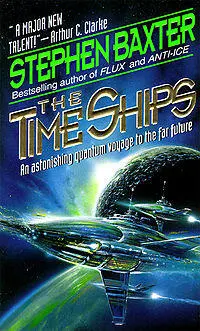
- Название:The Time Ships
- Автор:
- Издательство:HarperCollins
- Жанр:
- Год:1995
- ISBN:0-002-24609-0
- Рейтинг книги:5 / 5. Голосов: 1
-
Избранное:Добавить в избранное
- Отзывы:
-
Ваша оценка:
The Time Ships: краткое содержание, описание и аннотация
Предлагаем к чтению аннотацию, описание, краткое содержание или предисловие (зависит от того, что написал сам автор книги «The Time Ships»). Если вы не нашли необходимую информацию о книге — напишите в комментариях, мы постараемся отыскать её.
by H. G. Wells, it was officially authorized by the Wells estate to mark the centenary of the original’s publication.
Won:
British SF Association Award in 1995
John W. Campbell Memorial Award for Best SF Novel in 1996
Philip K. Dick Award in 1996
Nominated for:
Hugo Award for Best Novel in 1996
Locus Award for Best SF Novel in 1996
Arthur C. Clarke Award in 1996
The Time Ships — читать онлайн ознакомительный отрывок
Ниже представлен текст книги, разбитый по страницам. Система сохранения места последней прочитанной страницы, позволяет с удобством читать онлайн бесплатно книгу «The Time Ships», без необходимости каждый раз заново искать на чём Вы остановились. Поставьте закладку, и сможете в любой момент перейти на страницу, на которой закончили чтение.
Интервал:
Закладка:
“Nevertheless,” I said, refusing to be goaded, “the objection is valid — isn’t it?”
“In a sense,” he said. “But only in a narrow, single-History sort of way.
“The Universal Constructors have been studying these paradoxes of time travel for centuries now,” he said. “Or rather, apparent paradoxes. And they have formulated a type of Conservation Law which works in the higher Dimension of the Multiplicity of Histories.
“Start with an object like yourself. If, at any given moment, you add in a copy of yourself which may be absent because you have traveled away into past or future — and then subtract any copies doubly present because one of you has traveled to the past then you will find that the sum, overall, stays constant there is ’really’ only one of you — no matter how many times you travel up and down through time. So there is Conservation, of a sort — even though, at any moment in any given History, it may seem that Conservation Laws are broken, because there are suddenly two of you, or none of you.”
I saw it, on thinking it through. “There is only a paradox if you restrict your thinking to a single History,” I observed. “The paradox disappears, if you think in terms of Multiplicity.”
“Exactly. Just as problems of causality are resolved, within the greater frame of the Multiplicity.
“It is the power of this table, you see,” he told me, “that it is able to demonstrate these extraordinary possibilities to us… It is able to use Time Machine technology to show us the possibility — no, the existence — of Multiple, divergent Histories at the macroscopic level. Indeed, it can pick out particular Histories of interest: it has a very subtle design.”
He told me more of the Constructors’ Laws of the Multiplicity.
“One can imagine situations,” he said, “in which the Multiplicity of Histories is zero, one, or many. It is zero if that History is impossible — if it is not self consistent. A Multiplicity of one is the situation imagined by your earlier philosophers — of Newton’s generation, perhaps — in which a single course of events unfolds out of each point in time, consistent and immovable.”
I understood him to be describing my own original — and naive! — view of History, as a sort of immense Room, more or less fixed, through which my Time Machine would let me wander at will.
“A ’dangerous’ path for an object — like you, or our billiard ball — is one which can reach a Time Machine,” he said.
“Well, that’s clear enough,” I said. “It’s been obvious that I’ve been splitting off new Histories right, left and center since the moment the Time Machine was first switched on. Dangerous indeed!”
“Yes. And as the machine, and its successors, delve ever deeper into the past, so the Multiplicity generated tends towards infinity, and the divergence of the new copies of History grows wider.”
“But,” I said, a little frustrated, “coming back to the matter at hand — what is the purpose of this table? Is it just a trick? — Why have the Constructors given it to us? What are they trying to tell us?”
“I do not know,” he said. “Not yet. It is difficult… The Information Sea is wide, and there are many factions among the Constructors. Information is not offered freely to me — do you understand? — I have to pick up what I can, make the best understanding of it, and so build up an interpretation that way…
I think there is a faction of them who have some scheme — an immense Project whose outlines I can barely make out.”
“What is the nature of this Project?”
Nebogipfel said for answer, “Look: we know that there are many — perhaps an infinite number — of Histories emerging from each event. Imagine yourself, in two such neighboring Histories, separated by — let us say — the details of the rebound of your billiard ball. Now: could those two copies of you communicate with each other?”
I thought about that. “We have discussed this before. I don’t see how. A Time Machine would take me up and down a single History branch. If I’d gone back to change the rebound of the ball, then I would expect to travel forward and observe a difference, because, it seems, if the machine causes a bifurcation, it then tends to follow the newly generated History. No,” I said confidently. “The two versions of me could not communicate.”
“Not even if I allow you any conceivable machine, or measuring device?”
“No. There would be two copies of any such device — each as disconnected from its twin as I was.”
“Very well. That is a reasonable, and defensible, position. It is based on an implicit assumption that twin Histories, after their split, do not affect each other in any way. Technically speaking, you are assuming that Quantum-Mechanical Operators are linear… But,” and now that note of excitement returned to his voice, “it turns out there may be a way to talk to the other History — if, on some fundamental level, the universe and its twin do remain entangled. If there is the smallest amount of Nonlinearity in the Quantum Operators — almost too small to detect—”
“Then such communication would be possible?”
“I have seen it done… in the Sea, I mean… the Constructors have managed it, but only on the smallest of experimental scales.”
Nebogipfel described to me what he called an “Everett phonograph” — “after the twentieth-century scientist, of your History, who first dreamed up the idea. Of course the Constructors have another label — but it is not easily rendered into English.”
The Nonlinearities of which Nebogipfel spoke worked at the most subtle of levels.
“You must imagine that you perform a measurement — perhaps of the spin of an atom.” He described a “Nonlinear” interaction between an atom’s spin and its magnetic field. “The universe splits in two, of course, depending on the experiment’s outcome. Then, after the experiment, you allow the atom to pass through your Nonlinear field. This is the anomalous Quantum Operator I mentioned. Then — it turns out you can arrange affairs so that your action in one History depends on a decision taken in the second History…”
He went into a great deal of detail about this, involving the technicalities of what he called a “Stem-Gerlach device,” but I let this wash past me; my concern was to grasp the central point.
“So,” I interrupted him, “is it possible? Are you telling me that the Constructors have invented such inter-History communication devices? Is our table one such?” I began to feel excitement at the thought. All this chatter of billiard balls and spinning atoms was all very well; but if I could talk, by some Everett phonograph, to my selves in other Histories — perhaps to my home in Richmond in 1891…
But Nebogipfel was to disappoint me. “No,” he said. “Not yet. The table utilizes the Nonlinear effect, but only to — ah — to highlight particular Histories. At least some selection, some control, over the processes is displayed, but… The effects are so small, you see. And the Nonlinearities are suppressed by time evolution.”
“Yes,” I said with impatience, “but what is your guess? By placing this table here, is our Constructor trying to tell us that all this stuff — Nonlinearity, and communication between Histories — that it’s all important to us?”
“Perhaps,” Nebogipfel said. “But it is certainly important to him.”
[7]
The Mechanical Heirs of Man
Nebogipfel reconstructed something of the history of Humanity, across fifty million years. Much of this picture was tentative, he warned me — an edifice of speculation, founded on the few unambiguous facts he had been able to retrieve from the Information Sea.
Читать дальшеИнтервал:
Закладка:
Похожие книги на «The Time Ships»
Представляем Вашему вниманию похожие книги на «The Time Ships» списком для выбора. Мы отобрали схожую по названию и смыслу литературу в надежде предоставить читателям больше вариантов отыскать новые, интересные, ещё непрочитанные произведения.






Обсуждение, отзывы о книге «The Time Ships» и просто собственные мнения читателей. Оставьте ваши комментарии, напишите, что Вы думаете о произведении, его смысле или главных героях. Укажите что конкретно понравилось, а что нет, и почему Вы так считаете.