Charles Sheffield - Starfire
Здесь есть возможность читать онлайн «Charles Sheffield - Starfire» весь текст электронной книги совершенно бесплатно (целиком полную версию без сокращений). В некоторых случаях можно слушать аудио, скачать через торрент в формате fb2 и присутствует краткое содержание. Год выпуска: 2000, ISBN: 2000, Издательство: Bantam Spectra, Жанр: Фантастика и фэнтези, на английском языке. Описание произведения, (предисловие) а так же отзывы посетителей доступны на портале библиотеки ЛибКат.
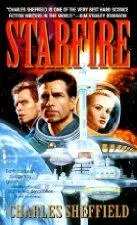
- Название:Starfire
- Автор:
- Издательство:Bantam Spectra
- Жанр:
- Год:2000
- ISBN:0553577395
- Рейтинг книги:3 / 5. Голосов: 1
-
Избранное:Добавить в избранное
- Отзывы:
-
Ваша оценка:
Starfire: краткое содержание, описание и аннотация
Предлагаем к чтению аннотацию, описание, краткое содержание или предисловие (зависит от того, что написал сам автор книги «Starfire»). Если вы не нашли необходимую информацию о книге — напишите в комментариях, мы постараемся отыскать её.
,
subjects planet Earth to yet another cosmic blast from the Alpha Centauri supernova. But while the blast that hit Earth in
simply cooked the Southern hemisphere and knocked out unshielded technology with a flash of gamma rays, this wave promises to do some real damage, with a sleet of trillion-nuclei bundles moving at one-tenth the speed of light.
Warned by the first catastrophe, Earth began building an electromagnetic shield out of the orbiting
station to divert the incoming apocalypse. But not only will the storm come earlier than expected, the carnage may be worse than anyone imagined — preliminary data shows that the supernova was no accident, and that the wave of particles may in fact be a beam. Crackerjack hard-SF author Charles Sheffield brings back much of the cast of
for this suspenseful, well-paced follow-up, the two most satisfying returnees being sociopath-savant Oliver Guest and his former patient Seth Parsigian. In the book’s subplot, the brilliant Guest and gruff Parsigian must team up to solve a string of grisly child murders on
that threatens to push the shield project even further behind schedule.
Starfire — читать онлайн бесплатно полную книгу (весь текст) целиком
Ниже представлен текст книги, разбитый по страницам. Система сохранения места последней прочитанной страницы, позволяет с удобством читать онлайн бесплатно книгу «Starfire», без необходимости каждый раз заново искать на чём Вы остановились. Поставьте закладку, и сможете в любой момент перейти на страницу, на которой закончили чтение.
Интервал:
Закладка:
“Which are?” Nick could imagine some pretty unpleasant possibilities, none of which seemed beyond Gordy’s limits.
“Answering what-if questions. Nature was unkind to the dinosaurs. They existed in the same era as the mammals, but I don’t think the two forms ever had a real head-to-head competition. All the mammals were small when the asteroid hit Chicxulub and the dinosaurs became extinct. Flying reptiles went away at the same time, but I’ve not done any work with them yet. What I have done, though, is absolutely fascinating. It’s getting too dark to track in the habitat with visible light. Later we’ll watch the nocturnal forms, but meanwhile let me show you some of my results.”
Rolfe stood up and did something invisible at the console, then moved back to stand directly in front of the ten-foot holograph. The natural light had faded to a deeper gloom, and Gordy Rolfe became a small, dark figure, hopping about against the background of the three-dimensional display. When he spoke again, his voice matched the animation of his manner.
“Fourteen years ago I set up my first full-scale simulation. The habitat was self-contained and isolated except for the water supply and simulated solar radiation. I put in a mixture of plants from today and those found in this region a hundred million years ago — see, I didn’t want to tilt the odds one way or the other. I put in floor and ceiling sensors that can identify, track, and inventory every animal species, so there would be a continuous census of habitat contents. And I seeded the habitat like this.”
A big group of animals stood frozen in holographic relief. Nick recognized four large meat-eating dinosaurs, which he thought from their size were Allosaurus. They, together with four lumbering specimens of Diplodocus, dwarfed everything else in the holo frame.
Gordy moved around on the edge of the holograph. “This is shown at one-quarter scale, but everything I put into the habitat was full-sized. See, here are the big modern predators — I chose tigers, because they function better than lions in a jungle environment. I didn’t want to use zoo specimens, they might be bred for docility, so I went to the Indian genome bank for original DNA templates. And here are hypsilophodons — small, fast herbivores, according to the books, but these seem more like omnivores, they’ll eat anything. And here’s a bunch of little saurischian plant-eaters, and these are wolves — no, I’m wrong, they’re hyenas — and if you look at the bottom, we have the smallest forms, shrews and mice and some of the saurornithoids that are not much bigger.”
Nick was listening, but with only half his attention. While Gordy Rolfe spoke with such enthusiasm about his simulation, the rover rolfe was still out in the real habitat. So were the meat-eating minisaurs. It was too dark to see anything, but the rover’s audio system was working. Unpleasant crunching sounds were interrupted by grunts and snorts and once by a startled, high-pitched squeal.
“Release them into the habitat all at once,” Rolfe went on. He waved his short arms. With a little imagination, the stooped, big-headed form silhouetted against the display could itself be one of the dwarf meat-eaters. “Provide water and light in realistic weather patterns, stay away, and see what happens. I did that, not once, but many times, and I let nature take its course. Do you know what happened, every single time?”
Nick was thinking of other things. He and Gordy Rolfe had formed their alliance because they needed each other to achieve a common goal: a world crippled by a space shield that would be only partially effective in deflecting the coming particle storm. The weak and the foolish would die, but Nick had his own personal hideaways dug deep beneath New Rio and the mountains of the Canadian Rockies. He did not begrudge Gordy Rolfe his secret headquarters. And beyond the particle storm lay the real goal, of ultimate personal power unimagined by most humans.
But the alliance carried its own price. Rolfe now held the stronger position. It was in part the power of a man indifferent to public opinion and support, versus one like Nick, who occupied a public and highly visible position.
There was also another, more important, difference between them. If you want to understand a man, find out what he does for recreation. Nick pursued men and women as well as power. Gordy was above — or below — the passions of the flesh. Gordy played God, and he was, in Nick’s opinion, becoming steadily more deranged. The lack of personal ties decreased his vulnerability and increased his megalomania.
“Did you hear me, Lopez?” Rolfe came closer, into the more brightly lit area beyond the holograph display.
“Do you know what happens when I seed the habitat with a variety of forms, dinosaurs and mammals, and let it run?”
“No. What happens?” Nick’s skin prickled with apprehension. The circular wall of the room seemed closer. He imagined he could smell a rank odor from the jungle beyond.
“The end mix of species in the habitat is different each time, depending on starting conditions and on random variations in food supply and weather.” Rolfe moved to stand next to where Nick was sitting. His head was level with Nick’s and he leaned close, gray eyes glittering with excitement behind the big lenses. “Sometimes the dinosaurs seem to have the upper hand, sometimes the mammals win out. But in every case, the small mammals do well. They never become extinct, and they always increase in numbers. Do you hear me, Lopez? Not big mammals. Small mammals win out, every time.”
Nick was six feet five inches tall. Presumably he did not qualify as a small mammal. Rolfe, stretched up to his full height in elevator shoes, was perhaps five feet two. Yet he was talking down to Nick — and loving it.
Nick nodded. “I take your point. That’s very interesting.”
There was one particular small mammal that he would like to see extinct. Not yet, though. This was a necessary partnership. He and Gordy Rolfe needed what only the other could provide: technological wizardry and industrial power from Gordy and the Argos Group, political savvy and clout from Nick and the WPF. The world’s greatest inventor and entrepreneur, teamed with the world’s savviest politician: a marriage made in heaven.
But in the long run? That was different. Nick knew very well that he and Gordy were two people as different as you could get, drawn together only by a shared desire for power and wealth. Somewhere in the undefined future, on an Earth ravaged by the particle storm, only one of the two would survive.
The competition between small and large mammals had yet to be decided.
10
From the private diary of Oliver Guest.
I am not one to derogate the efforts of others, but Seth Parsigian’s “solution” to my problems of acrophobia and agoraphobia was at first sight absurd beyond words.
“You imagine,” I said to him, “that I will sit here in the castle, while you and your associates wander Sky City and send me such facts and scenes as your Baker Street Irregulars deem important; and that I will then, like some improbable Mycroft, sit in my armchair and deduce from those rags and tatters of information the identity of the killer. Your faith in my powers would be touching, were it not so improbable.”
He scowled at me out of the screen; one-way video, of course, since I permit no outgoing images from Otranto Castle. Seth was annoyed with me, and not without reason. If it be true that there is an appropriate era and place for every person, then Seth Parsigian would have fitted well into the Victorian London of Sherlock Holmes to which I had just made reference. He was not, of course, a model for the most famous midnight wanderer of those fog-shrouded streets. I myself, in many people’s minds, form a far better match for Whitechapel Jack. Seth, however, had well-developed powers of observation and self-preservation that made him far more than a casual onlooker. What he would see and report from Sky City would doubtless be useful and probably necessary.
Читать дальшеИнтервал:
Закладка:
Похожие книги на «Starfire»
Представляем Вашему вниманию похожие книги на «Starfire» списком для выбора. Мы отобрали схожую по названию и смыслу литературу в надежде предоставить читателям больше вариантов отыскать новые, интересные, ещё непрочитанные произведения.
Обсуждение, отзывы о книге «Starfire» и просто собственные мнения читателей. Оставьте ваши комментарии, напишите, что Вы думаете о произведении, его смысле или главных героях. Укажите что конкретно понравилось, а что нет, и почему Вы так считаете.