Greg Bear - Darwin's Radio
Здесь есть возможность читать онлайн «Greg Bear - Darwin's Radio» — ознакомительный отрывок электронной книги совершенно бесплатно, а после прочтения отрывка купить полную версию. В некоторых случаях можно слушать аудио, скачать через торрент в формате fb2 и присутствует краткое содержание. Год выпуска: 1999, ISBN: 1999, Издательство: Del Rey, Жанр: Фантастика и фэнтези, на английском языке. Описание произведения, (предисловие) а так же отзывы посетителей доступны на портале библиотеки ЛибКат.
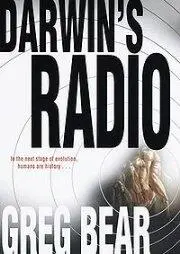
- Название:Darwin's Radio
- Автор:
- Издательство:Del Rey
- Жанр:
- Год:1999
- ISBN:0-345-42333-X
- Рейтинг книги:4 / 5. Голосов: 1
-
Избранное:Добавить в избранное
- Отзывы:
-
Ваша оценка:
Darwin's Radio: краткое содержание, описание и аннотация
Предлагаем к чтению аннотацию, описание, краткое содержание или предисловие (зависит от того, что написал сам автор книги «Darwin's Radio»). Если вы не нашли необходимую информацию о книге — напишите в комментариях, мы постараемся отыскать её.
Won Nebula Award for Best Novel in 2000.
Nominated for Hugo, Locus and Campbell awards in 2000.
Darwin's Radio — читать онлайн ознакомительный отрывок
Ниже представлен текст книги, разбитый по страницам. Система сохранения места последней прочитанной страницы, позволяет с удобством читать онлайн бесплатно книгу «Darwin's Radio», без необходимости каждый раз заново искать на чём Вы остановились. Поставьте закладку, и сможете в любой момент перейти на страницу, на которой закончили чтение.
Интервал:
Закладка:
Kaye bused her tray and dishes to the kitchen conveyer belt. She glanced at her watch. She needed a strong dose of the personal, the face-to-face; she wanted to speak with Luella Hamilton. She could make it out to NIH and be back before the meeting.
At the floor security desk, she called for a company car.
58
Beresford, New York
Mitch stepped out under the soaring white tent pavilion that covered the antique train station of the small town of Beresford. He shaded his eyes against the morning sun and glanced at a planter loud with yellow daffodils, near a bright red garbage can. He was the only one getting off the train.
The air smelled of hot grease and pavement and fresh-cut grass. He looked for someone to meet him, expecting Merton. The town, visible across the tracks, accessible by a pedestrian bridge, was little more than a row of shops and the Amtrak parking lot.
A black Lexus pulled into the parking lot, and Mitch saw a redheaded man step out, look through the chicken-wire fencing at the station, and wave.
“His name is William Daney. He owns most of Beresford — his family does, that is. They have an estate about ten minutes from here that rivals Buckingham Palace. I was nai’ve enough to forget what kind of royalty America cherishes — old money spent in strange ways.”
Mitch listened to Merton as the journalist drove him down a winding two-lane road between splendid hardwood trees, maple and oak, new leaves so intensely green he felt as if he were in a movie. The sun threw dazzles of gold across the road. They hadn’t seen another car in five minutes.
“Daney used to be a yachtsman. Spent millions perfecting a graceful big boat, lost a few races. That was more than twenty years ago. Then he discovered anthropology. Problem is, he hates dirt. Loves water, hates dirt, hates to dig. I love driving in America. But this is almost like driving in England. I could even” — Merton swerved briefly over the center line into the left lane—”Follow my instincts.” He quickly corrected, smiled at Mitch. “Pity about the riots. England’s still relatively calm, but I’m expecting a change of government any minute. Dear old PM doesn’t get it yet. Still thinks switching to the Euro is his biggest worry. Hates the gynecological aspect of this whole mess. How’s Mr. Dicken? Ms. Lang?”
“They’re fine,” Mitch said, unwilling to talk much until he saw what he was being dragged into. He liked Merton well enough, found him interesting, but did not trust him one bit. He resented that the man seemed to know so much about his private life.
Daney’s mansion made a three-story, gray stone curve at the end of a redbrick drive flanked by beautifully manicured lawns, perfect as a putting green. A few gardeners were out trimming hedges, and an elderly woman in jodhpurs and a broad and ragged straw hat waved at them as Merton drove past. “Mrs. Daney, our host’s mum,” Merton said, waving out the window. “Lives in the housekeeper’s cottage. Nice old woman. Doesn’t go into her son’s rooms very often.”
Merton parked in front of the brownstone steps leading to the huge, double-door entrance.
“Everybody’s here,” he said. “You, me, Daney, and Herr Professor Friedrich Brock, formerly of the University of Innsbruck.”
“Brock?”
“Yes.” Merton smiled. “He says he met you once.”
“He did,” Mitch said. “Once.”
The entry way of the Daney mansion was shadowy, a huge hall paneled with dark wood. Three parallel beams of sun dropped through a skylight onto the age-darkened limestone floor, cutting over a huge Chinese silk rug, in the middle of which rose a round table covered with a hemisphere of flowers. Just to one side of the table, in shadow, stood a man.
“William, this is Mitch Rafelson,” Merton said, taking Mitch’s elbow and leading him forward.
The man in shadow stuck out his hand into one of the shafts of sun, and three gold rings gleamed on thick, strong fingers. Mitch shook the hand firmly. Daney was in his early fifties, tanned, with yellow-white hair receding from a Wag-nerian forehead. He had small, perfect lips quick to smile, dark brown eyes, baby-smooth cheeks. His shoulders were broadened by a padded gray blazer, but his arms looked well-muscled.
“It’s an honor to meet you, sir,” Daney said. “I’d have bought them from your friends if they had been offered, you know. And then I would have turned them over to Innsbruck. I’ve told this to Herr Professor Brock, and he has given me absolution.”
Mitch smiled to be polite. He was here to meet Brock.
“Actually, William doesn’t own any human remains,” Merton said.
“I’m happy with duplicates, casts, sculptures,” Daney said. “I’m not a scientist, merely a hobbyist, but I hope I honor the past by trying to understand it.”
“Into the Hall of Humanity,” Merton said with a flourish of his hand. Daney tossed his head proudly and led the way.
The hall filled a former ballroom in the eastern curve of the mansion. Mitch had seen nothing like it outside of a museum: dozens of glass cases arranged in rows, with carpeted aisles in between, each case containing casts and replicas of every major specimen of anthropology. Australopithecus afarensis and robustus; Homo habilis and erectus. Mitch counted sixteen different Neandertal skeletons, all professionally mounted, and six of them had waxwork reconstructions of how the individuals might have looked in life. There was no attempt to avoid offending modesty: All the models were nude and hairless, avoiding any speculation on clothing or hair patterns.
Row upon row of hairless apes, illuminated by elegant and respectfully softened spotlights, stared blankly at Mitch as he walked past.
“Incredible,” Mitch said, despite himself. “Why have I never heard of you before, Mr. Daney?”
“I only talk to a few people. The Leakey family, Bjorn Kurten, a few others. My close friends. I’m eccentric, I know, but I don’t like to flaunt it.”
“You’re among the elect now,” Merton said to Mitch.
“Professor Brock is in the library.” Daney pointed the way. Mitch would have enjoyed spending more time in the hall. The wax sculptures were superb and the reproductions of the specimens first rate, almost indistinguishable from the specimens themselves.
“No, actually, I am here. I couldn’t wait.” Brock stepped around a case and advanced. “I feel as if I know you, Dr. Rafelson. And we do have mutual acquaintances, do we not?”
Mitch shook hands with Brock, under Daney’s beaming and approving inspection. They walked several dozen yards to an adjacent library, furnished in the epitome of Edwardian elegance, three levels with railed walkways connected by two wrought-iron bridges. Huge paintings of Yosemite and the Alps in dramatic moods flanked the single high north-facing window.
They took seats around a large, low round table in the middle of the room. “My first question,” Brock said, “is, do you dream of them, Dr. Rafelson? Because I do, and frequently.”
Daney served the coffee himself, after it was rolled into the library by a stout, somber young woman in a black suit. He poured each of them a cup in Flora Danica china, botanical patterns in this series displaying the microscopic plants native to Denmark, based on nineteenth-century scientific art. Mitch examined his saucer, adorned with three beautifully rendered dinoflagellates, and wondered what he would do if he had all the money he could ever hope to spend.
“I myself do not believe these dreams,” Brock picked up the conversation. “But these individuals do haunt me.”
Mitch looked around the group, completely unsure what was expected of him. It seemed distinctly possible that associating with Daney, Brock, and even Merton, could somehow be turned to his disadvantage. Perhaps he had been battered once too often in this arena.
Читать дальшеИнтервал:
Закладка:
Похожие книги на «Darwin's Radio»
Представляем Вашему вниманию похожие книги на «Darwin's Radio» списком для выбора. Мы отобрали схожую по названию и смыслу литературу в надежде предоставить читателям больше вариантов отыскать новые, интересные, ещё непрочитанные произведения.





Обсуждение, отзывы о книге «Darwin's Radio» и просто собственные мнения читателей. Оставьте ваши комментарии, напишите, что Вы думаете о произведении, его смысле или главных героях. Укажите что конкретно понравилось, а что нет, и почему Вы так считаете.