John Ringo - Against the Tide
Здесь есть возможность читать онлайн «John Ringo - Against the Tide» весь текст электронной книги совершенно бесплатно (целиком полную версию без сокращений). В некоторых случаях можно слушать аудио, скачать через торрент в формате fb2 и присутствует краткое содержание. Год выпуска: 2005, ISBN: 2005, Издательство: Baen Books, Жанр: Фантастика и фэнтези, Боевая фантастика, Фэнтези, на английском языке. Описание произведения, (предисловие) а так же отзывы посетителей доступны на портале библиотеки ЛибКат.
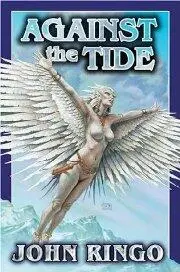
- Название:Against the Tide
- Автор:
- Издательство:Baen Books
- Жанр:
- Год:2005
- ISBN:978-0-7434-9884-5
- Рейтинг книги:4 / 5. Голосов: 1
-
Избранное:Добавить в избранное
- Отзывы:
-
Ваша оценка:
Against the Tide: краткое содержание, описание и аннотация
Предлагаем к чтению аннотацию, описание, краткое содержание или предисловие (зависит от того, что написал сам автор книги «Against the Tide»). Если вы не нашли необходимую информацию о книге — напишите в комментариях, мы постараемся отыскать её.
Against the Tide — читать онлайн бесплатно полную книгу (весь текст) целиком
Ниже представлен текст книги, разбитый по страницам. Система сохранения места последней прочитанной страницы, позволяет с удобством читать онлайн бесплатно книгу «Against the Tide», без необходимости каждый раз заново искать на чём Вы остановились. Поставьте закладку, и сможете в любой момент перейти на страницу, на которой закончили чтение.
Интервал:
Закладка:
“No,” Megan admitted. “Frankly, I don’t want to piss him off.”
“You might find it enlightening,” Mirta said. “I doubt he recalls but I’ve met him before. He was one of the local dukes in the Society. Never quite made it to king, but he’s a pretty dab hand with a claymore or battle-axe. Nice guy. I don’t recognize Flora; he wasn’t married back then. But he wasn’t one of the very old-fashioned chauvinists you sometimes ran into in the Society. And a serious student of history. So, you have to ask yourself, why’d he change?”
“I don’t know,” Megan admitted. “Even in Ropasa it wasn’t this bad. And from what I hear of Norau they’ve really maintained a very straightforward equality system. This is just so… -medieval!”
“And there you put your finger upon it,” Mirta pointed out, tying off a knot. “Let me ask you something: Why were women in preindustrial societies considered second-class citizens?”
“Because…” Megan paused and thought about it. “Because the men of the society kept them that way?”
“To an extent,” Mirta replied. “To an extent. But you have to ask why it started . Did men and women wake up one morning and say: ‘Okay, the guys are in charge?’ Which came first, the chicken or the egg? More to the point, the human race went through a few hundred thousand year process of evolving a society where women were, almost invariably , chattel and second-class citizens. Even in most hunter-gatherer societies, despite the various tracts trying to disprove that unpleasant fact. Then, when technology started to dominate, women were suddenly empowered. What does that tell you?”
“That you know the answers and aren’t willing to just give them,” Megan said, frowning.
“The way to true understanding is to answer the question yourself,” Mirta replied, smiling as she sewed.
“And the journey of a thousand miles often ends very badly,” Megan said with a grin. “But I get your point; that the difference was technology. But I don’t like the answer.”
“Okay, let’s take a look at the current situation,” Mirta said. “Think in terms purely of economic value. The basis of the economy around here is small farming and sheep herding. What do small farmers do?”
“Plow and harvest?” Megan asked.
“Far more than that. But that will do. What do both require?”
“An ox?” Megan laughed, taking a sip of herbal tea then thinking about it. “I don’t know, I’ve never done either.”
“They require a good bit of upper body strength is the answer,” the seamstress replied. “To keep a plow straight requires constant adjustment, which means pointing, and often lifting, a huge chunk of wood and metal. And the faster you can plow the more you can plow and the more likely you are to get your crops in the ground at the right time. Or at least more crops. Now, despite genetic tinkering, women are weaker than men in upper body strength. We also don’t have the stamina for long-endurance, high-energy efforts that males do. Men can keep plowing or swinging a scythe long after women of equivalent condition and mass have dropped to the ground. Women are better in both, today, than males prior to genetic tinkering. But men are equivalently stronger. Sheep farming also requires a good bit of strength: You haven’t lived until you’ve tried to shear a sheep. Lifting bales of fodder or wool, throwing a bull to make it a steer, cutting with a scythe, these are all things that men can do better than women. A farm can be run by one woman and two or three men, but the same farm would require six or seven women alone. And they require the equivalent food level of the males. The work that women do in the culture is important, but, frankly, anything they can do, except making babies, can be done by a man. Women get the jobs they do, caring for the hearth, cooking food, sewing, because they cannot do the jobs men do as well as men. By and large, as an average.”
“I don’t like that,” Megan said. “I don’t like it one bit.”
“Don’t like it all you’d like.” Mirta sighed. “It’s truth. Now in some societies, Ropasa to an extent and from what I’ve heard Norau to a greater extent, it’s possible to mitigate the effects of the relative… worthlessness, and I chose that word precisely, of women. They have economically important jobs, clerks, managers, designers, that women can do as well as men. If they’re permitted to. Ropasa was well on its way to forcing women out of such jobs, though. With Sheida as queen of Norau they’re not going to start forcing women out very soon. I have no idea what it will be like in the long-run. But here it’s different. They are on the ragged edge of survival; they don’t have clerks and factory workers. And the most important people are not farmers or sheepshearers, but fighters , people who can hold a shield and swing a sword and stand up to the attack of Changed. To hold on to the land that they do have for farming and sheep raising.
“Now, there are a few women, even here, who could probably do the job. But, by and large, the men can do it better. I suspect there were a few women at the beginning who told everyone they were just as good as any man. And I suspect that most of them died on some battlefield or another. Men died, too, but not in the same numbers. Because men are pretty well designed for fighting and women just aren’t . You could kill Paul because you used smarts and took him by surprise. Try to take on a male of equivalent strength, training and size in the middle of a battle and what will happen?”
“He’ll kick my ass,” Megan admitted, looking over at Baradur who was watching with calm and unreadable eyes. “I still don’t like it.”
“Again, don’t like it all you want,” Mirta grinned. “There’s more and it’s worse, but I’ll let someone else cover that one. But that’s some of the reasons that this group fell into ‘traditional’ roles so fast.”
“How do you stop it?” Megan asked. “I don’t want my granddaughters as drudges to some man!”
“You don’t even have daughters, yet, dear,” Mirta pointed out. “Bit early to worry. But I know what you mean. Well, I’ll be interested to see what Norau is like. I’m sure that Sheida has thought of this and if she hasn’t I’m sure that Edmund will have brought it up. I know both of them, by the way, and they will remember old Mirta,” she added with a chuckle. “Oh, the stories I could tell about those two!”
“You never told me you knew them,” Megan said, cocking her head to the side. “When was this?”
“Long time ago, girlie,” Mirta replied. “Back in the old days when they were just king and queen of the Society in Norau. They were quite the item for a while. Then Sheida made the mistake of introducing Edmund to her sister and that was all she wrote.”
“How old are you?” Megan asked. The woman had always been reticent about her age. In the harem it had made sense; Paul tended to prefer young women and Mirta looked to be in her early twenties. And she could act like a teenager on cue.
“One hundred and forty-seven,” Mirta replied. “Don’t look it, do I?”
“Not a bit,” Megan admitted. “And you’re still fertile?”
“Didn’t start ovulating until the Fall,” Mirta pointed out, tying off a last knot and holding up the dress. “Better?”
“Very nice,” Megan admitted. The seamstress had taken the basic shapeless dress and brought in the waistline, added material to the sleeves so they fell in a V, cut down the front and embroidered the edges. “Very nice.”
“I can’t wait to get decent fabrics again,” Mirta said with a sigh. “It’s the one thing I miss about the harem. But I could only make those dreadful lingerie outfits there. I’m looking forward to making real dresses again. Crinolines and ruffs and properly formed bodices!”
Читать дальшеИнтервал:
Закладка:
Похожие книги на «Against the Tide»
Представляем Вашему вниманию похожие книги на «Against the Tide» списком для выбора. Мы отобрали схожую по названию и смыслу литературу в надежде предоставить читателям больше вариантов отыскать новые, интересные, ещё непрочитанные произведения.



![John Stieber - Against the Odds - Survival on the Russian Front 1944-1945 [2nd Edition]](/books/405234/john-stieber-against-the-odds-survival-on-the-russian-front-1944-1945-2nd-edition-thumb.webp)

Обсуждение, отзывы о книге «Against the Tide» и просто собственные мнения читателей. Оставьте ваши комментарии, напишите, что Вы думаете о произведении, его смысле или главных героях. Укажите что конкретно понравилось, а что нет, и почему Вы так считаете.