Orson Card - Maps in a Mirror - The Short Fiction of Orson Scott Card
Здесь есть возможность читать онлайн «Orson Card - Maps in a Mirror - The Short Fiction of Orson Scott Card» весь текст электронной книги совершенно бесплатно (целиком полную версию без сокращений). В некоторых случаях можно слушать аудио, скачать через торрент в формате fb2 и присутствует краткое содержание. Город: New York, Год выпуска: 2004, ISBN: 2004, Издательство: Tom Doherty Associates, Жанр: Фантастика и фэнтези, на английском языке. Описание произведения, (предисловие) а так же отзывы посетителей доступны на портале библиотеки ЛибКат.
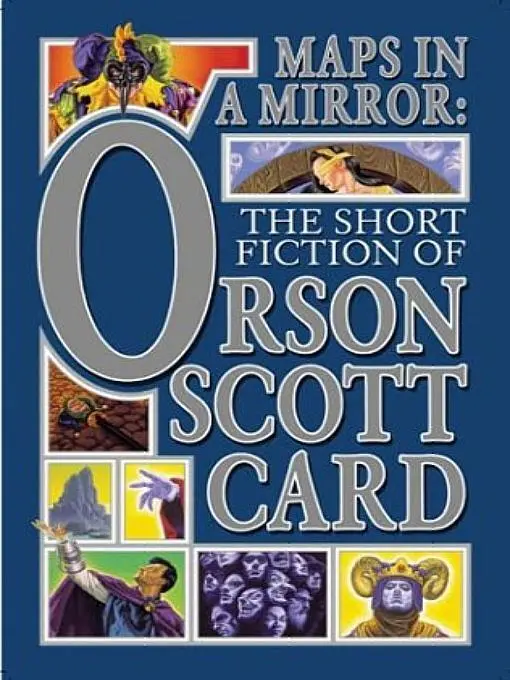
- Название:Maps in a Mirror: The Short Fiction of Orson Scott Card
- Автор:
- Издательство:Tom Doherty Associates
- Жанр:
- Год:2004
- Город:New York
- ISBN:9780765308405, 0-312-85047-6
- Рейтинг книги:4 / 5. Голосов: 1
-
Избранное:Добавить в избранное
- Отзывы:
-
Ваша оценка:
Maps in a Mirror: The Short Fiction of Orson Scott Card: краткое содержание, описание и аннотация
Предлагаем к чтению аннотацию, описание, краткое содержание или предисловие (зависит от того, что написал сам автор книги «Maps in a Mirror: The Short Fiction of Orson Scott Card»). Если вы не нашли необходимую информацию о книге — напишите в комментариях, мы постараемся отыскать её.
In this enormous volume are forty-six stories, plus ten long, intensely personal essays, unique to this volume. In them the author reveals some of his reasons and motivations for writing, with a good deal of autobiography into the bargain.
THE SHORT FICTION OF ORSON SCOTT CARD brings together nearly all of Card’s stories, from his first publications in 1977 to work as recent as last year. For those readers who have followed this remarkable talent since the beginning, here are all those amazing stories gathered together in one place, with some extra surprises as well. For the hundreds of thousands who are newly come to Card, here is a chance to experience the wonder of a writer so talented, so versatile that he can handle everything from traditional narrative poetry to modern experimental fiction with equal ease and grace. The brilliant story-telling of the Alvin Maker books is no accident; the breathless excitement evoked by ENDER’S GAME is riot a once-in-a-lifetime experience.
In this enormous volume are 46 stories, broken into five books: Ten fables and fantasies, fairy tales that sometimes tell us truths about ourselves; eleven tales of dread—and commentary that explains why dread is a much scarier emotion than horror; seven tales of human futures—science fiction from a master of extrapolation and character; six tales of death, hope, and holiness, where Card explores the spiritual side of human nature; and twelve lost songs.
The Lost Songs are a special treat for readers of this hardcover volume, for here are gathered tales which will not see print again. Here are Card’s stories written for Mormon children, a pair that were published in small literary magazines, a thoughtful essay on the writing of fiction, and three major works which have, since their original publication, been superseded by novel-, or more than novel-length works. First, there is the original novella-length version of Card’s Hugo and Nebula Award-winning novel, ENDER’S GAME. Then there is “Mikal’s Songbird”, which was the seed of the novel SONGMASTER; “Mikal’s Songbird” will never be published again. And finally, the narrative poem “Prentice Alvin and the No-Good Plow”—here is the original inspiration for the Alvin Maker series, an idea so powerful that it could not be contained in a single story, or a hundred lines of verse, but is growing to become the most original American fantasy ever written.
MAPS IN A MIRROR is not just a collection of stories, however complete. This comprehensive collection also contains nearly a whole book’s worth of
material. Each section begins and ends with long, intensely personal introductions and afterwords; here the author reveals some of his reasons and motivations for writing what he writes—and a good deal of autobiography into the bargain.
ORSON SCOTT CARD grew up in Utah and attended Brigham Young University, where he studied drama. Card’s early writing career was devoted to plays; he had his own theater company, which was successful for a number of years. Card spent his missionary years in Brazil, learning to speak fluent Portuguese. He now lives in Greensboro, North Carolina, with his wife and three children. From book flaps:
Maps in a Mirror: The Short Fiction of Orson Scott Card — читать онлайн бесплатно полную книгу (весь текст) целиком
Ниже представлен текст книги, разбитый по страницам. Система сохранения места последней прочитанной страницы, позволяет с удобством читать онлайн бесплатно книгу «Maps in a Mirror: The Short Fiction of Orson Scott Card», без необходимости каждый раз заново искать на чём Вы остановились. Поставьте закладку, и сможете в любой момент перейти на страницу, на которой закончили чтение.
Интервал:
Закладка:
“Just leave me alone,” says I.
“You’re not like them,” she says. “Don’t you see that? They love the killing. They use the killing. Only they’re not as strong as you. They have to be touching, for one thing, or close to it. They have to keep it up longer. They’re stronger than I am, but not as strong as you. So they’ll want you, that’s for sure, Mick, but they’ll also be scared of you, and you know what’ll scare them most? That you didn’t kill me, that you can control it like that.”
“I can’t always. That bus driver today.”
“So you’re not perfect. But you’re trying. Trying not to kill people. Don’t you see, Mick? You’re not like them. They may be your blood family, but you don’t belong with them, and they’ll see that, and when they do—”
All I could think about was what she said, my blood family. “My mama and daddy, you telling me I’m going to meet them?”
“They’re calling you now, and that’s why I had to warn you.”
“Calling me?”
“The way I called you up this hill. Only it wasn’t just me, of course, it was a bunch of us.”
“I just decided to come up here, to get off the road.”
“You just decided to cross the highway and climb this hill, instead of the other one? Anyway, that’s how it works. It’s part of the human race for all time, only we never knew it. A bunch of people kind of harmonize their bio-electrical systems, to call for somebody to come home, and they come home, after a while. Or sometimes a whole nation unites to hate somebody. Like Iran and the Shah, or the Philippines and Marcos.”
“They just kicked them out,” I says.
“But they were already dying, weren’t they? A whole nation, hating together, they make a constant interference with their enemy’s bio-electrical system. A constant noise. All of them together, millions of people, they are finally able to match what you can do with one flash of anger.”
I thought about that for a few minutes, and it came back to me all the times I thought how I wasn’t even human. So maybe I was human, after all, but human like a guy with three arms is human, or one of those guys in the horror movies I saw, gigantic and lumpy and going around hacking up teenagers whenever they was about to get laid. And in all those movies they always try to kill the guy only they can’t, he gets stabbed and shot and burned up and he still comes back, and that’s like me, I must have tried to kill myself so many times only it never worked.
No. Wait a minute.
I got to get this straight, or you’ll think I’m crazy or a liar. I didn’t jump off that highway overpass like I said. I stood on one for a long time, watching the cars go by. Whenever a big old semi came along I’d say, this one, and I’d count, and at the right second I’d say, now. Only I never did jump. And then afterward I dreamed about jumping, and in all those dreams I’d just bounce off the truck and get up and limp away. Like the time I was a kid and sat in the bathroom with the little gardening shears, the spring-loaded kind that popped open, I sat there thinking about jamming it into my stomach right under the breastbone, and then letting go of the handle, it’d pop right open and make a bad wound and cut open my heart or something. I was there so long I fell asleep on the toilet, and later I dreamed about doing it but no blood ever came out, because I couldn’t die.
So I never tried to kill myself. But I thought about it all the time. I was like those monsters in those movies, just killing people but secretly hoping somebody would catch on to what was going on and kill me first.
And so I says to her, “Why didn’t you just kill me?”
And there she was with her face close to mine and she says, just like it was love talk, she says, “I’ve had you in my rifle sights, Mick, and then I didn’t do it. Because I saw something in you. I saw that maybe you were trying to control it. That maybe you didn’t want to use your power to kill. And so I let you live, thinking that one day I’d be here like this, telling you what you are, and giving you a little hope.”
I thought she meant I’d hope because of knowing my mama and daddy were alive and wanted me.
“I hoped for a long time, but I gave it up. I don’t want to see my mama and daddy, if they could leave me there all those years. I don’t want to see you, neither, if you didn’t so much as warn me not to get mad at Old Peleg. I didn’t want to kill Old Peleg, and I couldn’t even help it! You didn’t help me a bit!”
“We argued about it,” she says. “We knew you were killing people while you tried to sort things out and get control. Puberty’s the worst time, even worse than infancy, and we knew that if we didn’t kill you a lot of people would die—and mostly they’d be the people you loved best. That’s the way it is for most kids your age, they get angriest at the people they love most, only you couldn’t help killing them, and what does that do to your mind? What kind of person do you become? There was some who said we didn’t have the right to leave you alive even to study you, because it would be like having a cure for cancer and then not using it on people just to see how fast they’d die. Like that experiment where the government left syphilis cases untreated just to see what the final stages of the disease were like, even though they could have cured those people at any time. But some of us told them, Mick isn’t a disease, and a bullet isn’t penicillin. I told them, Mick is something special. And they said, yes, he’s special, he kills more than any of those other kids, and we shot them or ran them over with a truck or drowned them, and here we’ve got the worst one of all and you want to keep him alive.”
And I was crying cause I wished they had killed me, but also because it was the first time I ever thought there was people arguing that I ought to be alive, and even though I didn’t rightly understand then or even now why you didn’t kill me, I got to tell you that knowing somebody knew what I was and still chose not to blast my head off, that done me in, I just bawled like a baby.
One thing led to another, there, my crying and her holding me, and pretty soon I figured out that she pretty much wanted to get laid right there. But that just made me sick, when I knew that. “How can you want to do that!” I says to her. “I can’t get married! I can’t have no kids! They’d be like me!”
She didn’t argue with me or say nothing about birth control, and so I figured out later that I was right, she wanted to have a baby, and that told me plain that she was crazy as a loon. I got my pants pulled back up and my shirt on, and I wouldn’t look at her getting dressed again, neither.
“I could make you do it,” she says to me. “I could do that to you. The ability you have that lets you kill also makes you sensitive. I can make you lose your mind with desire for me.”
“Then why don’t you?” I says.
“Why don’t you kill if you can help it?” she says.
“Cause nobody has the right,” says I.
“That’s right,” she says.
“Anyway you’re ten years older than me,” I tell her.
“Fifteen,” she says. “Almost twice your age. But that don’t mean nothing.” Or I guess she actually said, “That doesn’t mean nothing,” or probably, “That doesn’t mean anything.” She talks better than I do but I can’t always remember the fancy way. “That doesn’t mean a thing,” she says. “You’ll go to your folks, and you can bet they’ll have some pretty little girl waiting for you, and she’ll know how to do it much better than me, she’ll turn you on so your pants unzip themselves, cause that’s what they want most from you. They want your babies. As many as they can get, because you’re the strongest they’ve produced in all the years since Grandpa Jake realized that the cursing power went father to son, mother to daughter, and that he could breed for it like you breed dogs or horses. They’ll breed you like a stud, but then when they find out that you don’t like killing people and you don’t want to play along and you aren’t going to take orders from whoever’s in charge there now, they’ll kill you. That’s why I came to warn you. We could feel them just starting to call you. We knew it was time. And I came to warn you.”
Читать дальшеИнтервал:
Закладка:
Похожие книги на «Maps in a Mirror: The Short Fiction of Orson Scott Card»
Представляем Вашему вниманию похожие книги на «Maps in a Mirror: The Short Fiction of Orson Scott Card» списком для выбора. Мы отобрали схожую по названию и смыслу литературу в надежде предоставить читателям больше вариантов отыскать новые, интересные, ещё непрочитанные произведения.


Обсуждение, отзывы о книге «Maps in a Mirror: The Short Fiction of Orson Scott Card» и просто собственные мнения читателей. Оставьте ваши комментарии, напишите, что Вы думаете о произведении, его смысле или главных героях. Укажите что конкретно понравилось, а что нет, и почему Вы так считаете.