Arthur Clarke - The Last Theorem
Здесь есть возможность читать онлайн «Arthur Clarke - The Last Theorem» — ознакомительный отрывок электронной книги совершенно бесплатно, а после прочтения отрывка купить полную версию. В некоторых случаях можно слушать аудио, скачать через торрент в формате fb2 и присутствует краткое содержание. Город: New York, Год выпуска: 2008, ISBN: 2008, Издательство: Del Rey Books, Жанр: Фантастика и фэнтези, на английском языке. Описание произведения, (предисловие) а так же отзывы посетителей доступны на портале библиотеки ЛибКат.
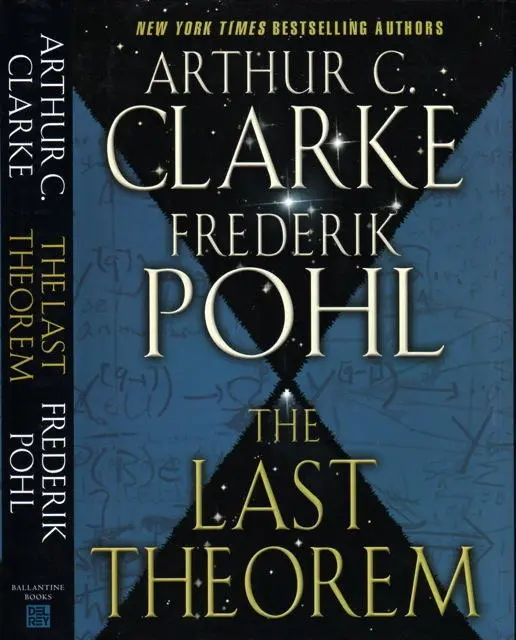
- Название:The Last Theorem
- Автор:
- Издательство:Del Rey Books
- Жанр:
- Год:2008
- Город:New York
- ISBN:9780345470218
- Рейтинг книги:3 / 5. Голосов: 1
-
Избранное:Добавить в избранное
- Отзывы:
-
Ваша оценка:
The Last Theorem: краткое содержание, описание и аннотация
Предлагаем к чтению аннотацию, описание, краткое содержание или предисловие (зависит от того, что написал сам автор книги «The Last Theorem»). Если вы не нашли необходимую информацию о книге — напишите в комментариях, мы постараемся отыскать её.
.
The Last Theorem In 1637, the French mathematician Pierre de Fermat scrawled a note in the margin of a book about an enigmatic theorem: “I have discovered a truly marvelous proof of this proposition which this margin is too narrow to contain.” He also neglected to record his proof elsewhere. Thus began a search for the Holy Grail of mathematics—a search that didn’t end until 1994, when Andrew Wiles published a 150-page proof. But the proof was burdensome, overlong, and utilized mathematical techniques undreamed of in Fermat’s time, and so it left many critics unsatisfied—including young Ranjit Subramanian, a Sri Lankan with a special gift for mathematics and a passion for the famous “Last Theorem.”
When Ranjit writes a three-page proof of the theorem that relies exclusively on knowledge available to Fermat, his achievement is hailed as a work of genius, bringing him fame and fortune. But it also brings him to the attention of the National Security Agency and a shadowy United Nations outfit called Pax per Fidem, or Peace Through Transparency, whose secretive workings belie its name. Suddenly Ranjit—together with his wife, Myra de Soyza, an expert in artificial intelligence, and their burgeoning family—finds himself swept up in world-shaking events, his genius for abstract mathematical thought put to uses that are both concrete and potentially deadly.
Meanwhile, unbeknownst to anyone on Earth, an alien fleet is approaching the planet at a significant percentage of the speed of light. Their mission: to exterminate the dangerous species of primates known as homo sapiens.
The Last Theorem — читать онлайн ознакомительный отрывок
Ниже представлен текст книги, разбитый по страницам. Система сохранения места последней прочитанной страницы, позволяет с удобством читать онлайн бесплатно книгу «The Last Theorem», без необходимости каждый раз заново искать на чём Вы остановились. Поставьте закладку, и сможете в любой момент перейти на страницу, на которой закончили чтение.
Интервал:
Закладка:
Gamini looked offended. “Of course I read it. My father was a big Orwell fan. Are you trying to suggest we sound like Big Brother? Because, don’t forget, the secretary-general had the unanimous approval of the Security Council for everything we did!”
“That’s not what I mean, dear Gamini. What I’m thinking about is the way Orwell had the world divided in his book. There were only three powers, because they’d conquered everything else. Oceania, by which Orwell meant mostly America; Eurasia—that was Russia, then still the Soviet Union; and Eastasia. China.”
Now Gamini was visibly annoyed. “Now, really, Myra! You don’t think that the countries that created Pax per Fidem are going to try to divide the world among them, do you?”
And again Myra replied with a question of her own. “What any of them are planning I don’t know, Gamini. I hope that’s not it. But if they were, what could stop them?”
And when Gamini was gone—still a friend, a very dear friend, but now a friend they would not be seeing very often—Ranjit turned to his wife. “So,” he said, “what do we do now? The president has fired me from the job here. I’ve turned down the job he—and Gamini—wanted me to take.” He frowned at a thought. “His father wanted me to take it, too,” he added. “I imagine he’s not happy that I turned it down. I wonder if that offer of a job at the university is still open.”
28
MAKING A LIFE
Well, the job was. Whatever faults Dr. Dhatusena Bandara might be charged with, vindictiveness was not among them. The university would be delighted to welcome Dr. (if only honorary) Ranjit Subramanian to the faculty as a full and tenured professor, with his employment (and thus his pay) to begin at once, actual work to start when the professor found it quite convenient. More than that, the university would be pleased to find a faculty position for Dr. (this time not honorary but fully earned) Myra de Soyza Subramanian as well. Of course, it went without saying, her title wouldn’t be as elevated as her husband’s, and neither would her pay scale. But still…
But still, they were going back to Sri Lanka!
If the president of the United States objected to Ranjit’s walking out on the job offer, he didn’t say anything about it. Neither did anyone else. Ranjit cleared out his few personal belongings at the office; true, there was a maintenance man, who happened also to be a security man, to help him pack everything up. True, he was required to turn in his passes and badges and IDs. But no one bothered them in their apartment, or at the air terminal, or on the planes they took. And Natasha rode in her cradle-seat between the two of them without a whimper.
Mevrouw Vorhulst, of course, was waiting for them at the Colombo airport, since it was obvious that the best thing was for them all to stay at her house again. “Just until we find an apartment,” Myra said, while being hugged by her.
“As long as you like,” said Mevrouw Vorhulst. “Joris wouldn’t have it any other way.”
There was a strange thing about those classrooms at the university, Ranjit found. When his principal dearest wish had been to get out of them, they had seemed oppressively small. Not now, not to a brand-new professor who had never faced a class before. Now the room was a vast jury box, packed with young men and women sitting in judgment on him. Their eyes were unerringly focused on his every move, their ears impatient for the great revelations Professor Subramanian would have for them of the innermost secrets of the world of mathematicians.
It wasn’t just how to nurture this nest of hungry hatchlings that baffled Ranjit. It was what to nurture them with. When the university’s search committee had welcomed him to the faculty, they had generously left the exact nature of his duties to his own good plan.
He didn’t have one.
Ranjit was aware that he needed help. He even had a hope of finding it in the person of Dr. Davoodbhoy, the man who had behaved so exemplarily in the matter of the stolen math teacher’s password.
He was not only still at the university. He had, in the natural attrition of deaths and retirements, already moved up a terrace or two along the slope of authority. All the same, when Ranjit applied to him for help, there wasn’t much available. “Oh, Ranjit,” he said. “May I still call you Ranjit? You know how it is. Our little university doesn’t have many world-famous stars. The search committees want you here very much, but they don’t have a clue about what to do with you. You do realize that you don’t actually have to do much teaching? We don’t have many faculty members who specialize in research instead, but that is a possibility.”
“Huh,” Ranjit said thoughtfully. He went on thinking for a moment, then said, “I suppose I might take a look at some of the famous old problems like Riemann, Goldbach, Collatz—”
“Certainly,” Davoodbhoy said, “but don’t give up on teaching until you try it. Why don’t we set up a couple of quick seminars for practice? That sort of thing we can do on short notice.” And then as Ranjit prepared to leave, turning that idea over in his mind, Davoodbhoy said, “Oh, and one more thing, Ranjit. You were right about Fermat and I was wrong. I haven’t had to say that very often in my life. It leads me to want to trust your judgment.”
It was pleasing for Ranjit to know that the provost trusted his judgment. Ranjit himself, however, was not quite as trusting. His first seminar was called Foundations of Number Theory. “I’ll give them a sort of overview of the whole subject,” he promised Davoodbhoy, who immediately started the wheels in motion. It would run for six weeks, four-hour classes, limited to juniors, seniors, and graduate students and a class size no larger than twenty-five.
The subject, of course, was one Ranjit had paid little attention to since he was fourteen and just beginning his fascination with Fermat’s jotting. So he mined the university library for texts and taught out of them, trying to keep at least a dozen pages ahead of the dismayingly bright and worrisomely quick students who had signed up for the seminar.
Unfortunately, it didn’t take them long to figure out what he was doing. That night he confessed to Myra, “I’m boring them. They can read from the book as well as I can.”
“That,” she said loyally, “is ridiculous.” But then, as he repeated some of the quite respectful but unimpressed comments students had made, she thought more carefully. “I know,” she said. “You need to make a little more personal contact with them. Do some of those binary arithmetic tricks for them, why don’t you?”
Ranjit, having no better idea of his own, did. He did the Russian multiplication and the finger-counting and the one where he wrote down the heads-tails permutations of a row of coins of unknown length—he used actual coins, and let the students blindfold him while someone covered up a part of the row. Myra had been right. The students were amused. One or two of them begged for more, which sent Ranjit to the library’s stacks, where he found an ancient copy of a Martin Gardner book on mathematical games and puzzles, and so he got through the six weeks of the seminar unscathed.
Or so he thought.
Then Dr. Davoodbhoy invited him to drop by for a chat. “I hope you won’t mind, Ranjit,” he said, pouring them each a stemmed glass of sherry, “but now and then, especially when we’re trying something new, we ask the students themselves for comments. I’ve just been going over the comment sheets on your seminar.”
“Huh,” said Ranjit. “I hope they’re all right.”
The provost sighed. “Not entirely, I’m afraid,” he said.
Indeed they were not entirely all right, Ranjit admitted that night at dinner. “Some of them said I was giving them nightclub magician tricks instead of math,” he told his wife and Mevrouw. “And nearly all of them didn’t like being taught right out of the book.”
Читать дальшеИнтервал:
Закладка:
Похожие книги на «The Last Theorem»
Представляем Вашему вниманию похожие книги на «The Last Theorem» списком для выбора. Мы отобрали схожую по названию и смыслу литературу в надежде предоставить читателям больше вариантов отыскать новые, интересные, ещё непрочитанные произведения.


Обсуждение, отзывы о книге «The Last Theorem» и просто собственные мнения читателей. Оставьте ваши комментарии, напишите, что Вы думаете о произведении, его смысле или главных героях. Укажите что конкретно понравилось, а что нет, и почему Вы так считаете.