Rachel Maddow - Drift
Здесь есть возможность читать онлайн «Rachel Maddow - Drift» весь текст электронной книги совершенно бесплатно (целиком полную версию без сокращений). В некоторых случаях можно слушать аудио, скачать через торрент в формате fb2 и присутствует краткое содержание. Город: New York, Год выпуска: 2012, ISBN: 2012, Издательство: Crown Publishers, Жанр: Публицистика, на английском языке. Описание произведения, (предисловие) а так же отзывы посетителей доступны на портале библиотеки ЛибКат.
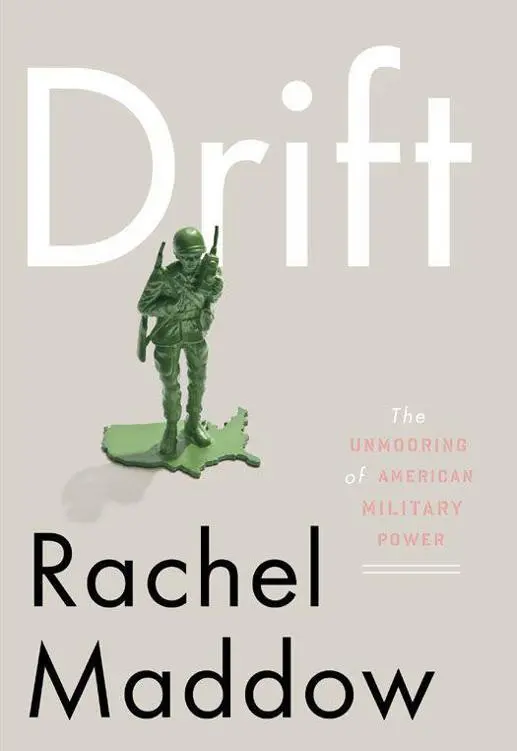
- Название:Drift
- Автор:
- Издательство:Crown Publishers
- Жанр:
- Год:2012
- Город:New York
- ISBN:978-0-307-46100-1
- Рейтинг книги:4 / 5. Голосов: 1
-
Избранное:Добавить в избранное
- Отзывы:
-
Ваша оценка:
Drift: краткое содержание, описание и аннотация
Предлагаем к чтению аннотацию, описание, краткое содержание или предисловие (зависит от того, что написал сам автор книги «Drift»). Если вы не нашли необходимую информацию о книге — напишите в комментариях, мы постараемся отыскать её.
Written with bracing wit and intelligence, Rachel Maddow’s
argues that we’ve drifted away from America’s original ideals and become a nation weirdly at peace with perpetual war, with all the financial and human costs that entails. To understand how we’ve arrived at such a dangerous place, Maddow takes us from the Vietnam War to today’s war in Afghanistan, along the way exploring the disturbing rise of executive authority, the gradual outsourcing of our war-making capabilities to private companies, the plummeting percentage of American families whose children fight our constant wars for us, and even the changing fortunes of G.I. Joe. She offers up a fresh, unsparing appraisal of Reagan’s radical presidency. Ultimately, she shows us just how much we stand to lose by allowing the priorities of the national security state to overpower our political discourse.
Sensible yet provocative, dead serious yet seriously funny,
will reinvigorate a “loud and jangly” political debate about how, when, and where to apply America’s strength and power—and who gets to make those decisions.
http://www.youtube.com/watch?v=Y9xoM7TMiTA
Drift — читать онлайн бесплатно полную книгу (весь текст) целиком
Ниже представлен текст книги, разбитый по страницам. Система сохранения места последней прочитанной страницы, позволяет с удобством читать онлайн бесплатно книгу «Drift», без необходимости каждый раз заново искать на чём Вы остановились. Поставьте закладку, и сможете в любой момент перейти на страницу, на которой закончили чтение.
Интервал:
Закладка:
The private sector is the primary source of creativity, innovation, and efficiency in our society, and is more likely than government organizations to provide cost-effective support to the Nation’s military forces.
The grand-scale cotillion debut for the privateers would be the Balkans. Private for-profit companies had provided food service, garbage collection, and water bearing for previous missions, but in Bosnia they’d do almost everything, and in huge numbers. When twenty thousand US soldiers were sent to help keep a fragile peace among the Serbs, Bosniaks, and Croats, who had been fighting a bloody three-way war in the former Yugoslavia, an equal number of private company employees went with. They were employees of DynCorp and Brown & Root Services Corporation (whose parent company, Halliburton, was run by former secretary of defense Dick Cheney), corporations that were themselves under contract with the United States Department of Defense. Brown & Root employees built the barracks where US soldiers bunked, made sure they were fed, their clothes and bedding laundered, their recreational needs seen to, their mail delivered, their e-mail working. DynCorp’s biggest contract was from the State Department, to provide a private police force to support the larger UN mission and to train the local constabulary in Western law enforcement. But DynCorp also had a smaller contract with Defense for things like maintaining US military aircraft in Bosnia.
Brown & Root proved wanting in the “innovation” department when it came to the procurement of construction materials for the barracks. It turned out they were flying sheets of plywood into Bosnia from the United States, thus transforming each $14 sheet into an $85.98 sheet. Not that this hurt their bottom line. The company did show itself to be remarkably agile (if not timely) in fiscal reporting; overruns had raised the payout on their Army contract from $350 million to $461 million. One of the big drivers in the cost overrun was their “Management and Administration” line item, which came in $69 million over budget, an impressive 80 percent overrun. It apparently took a lot of layers of Brown & Root management and administration to turn a $14 sheet of plywood into an $86 sheet of plywood.
Brown & Root might not have been all that cost-effective, but it did fulfill its contractual obligations. The soldiers at the thirty-four base camps the company serviced in Bosnia, Croatia, and Hungary were generally well pleased with the PXs stocked with American grocery items, and the cafeterias’ twenty-four-hour food options. “Sandwiches, soups, and beverages are always available,” the General Accounting Office crowed a few years into the big Balkan contract. “Unit officials in Bosnia said that the quantity and quality of the food is so good that personnel are gaining weight.” Oh, good!
For a full appreciation of the “innovation and creativity” that a private American company was able to bring to bear in Bosnia, DynCorp is worth considering. In the field of contractor support of overseas US military operations, DynCorp’s reputation for ingenuity was already separating it from the pack. Consider, for instance, the portrait painted by the employees of the aircraft maintenance hangar that DynCorp operated at Camp Comanche in Dubrave, Bosnia. Ben Johnston, a helicopter mechanic who retired from the military into a much higher paycheck for doing the same job under the DynCorp contract, was pretty quickly disturbed by what he saw. As he recounted to a reporter from Insight magazine:
There was this one guy who would hide parts so we would have to wait for parts. They’d [DynCorp foremen] have us replace windows in helicopters that weren’t bad just to get paid. They had one kid over there who was right out of high school and he didn’t even know the names and purposes of the basic tools. Soldiers that are paid $18,000 a year know more than this kid, but this is the way they [DynCorp] grease their pockets. What they say in Bosnia is that DynCorp just needs a warm body—that’s the DynCorp slogan. Even if you don’t do an eight-hour day, they’ll sign you in for it because that’s how they bill the government. It’s a total fraud….
It was a rougher crowd than I’d ever dealt with. It’s not like I don’t drink or anything, but DynCorp employees would come to work drunk. A DynCorp van would pick us up every morning and you could smell the alcohol on them.
And picture this scene: a fellow DynCorp maintenance man, a trencherman, nearly four hundred pounds by Johnston’s estimate, at work on a Black Hawk helicopter. He “would stick cheeseburgers in his pockets and eat them while he worked,” Johnston said. “He would literally fall asleep every five minutes. One time he fell asleep with a torch in his hand and burned a hole through the plastic on an aircraft.”
“The bottom line is that DynCorp has taken what used to be a real positive program that has very high visibility with every Army unit in the world and turned it into a bag of worms,” the site supervisor told the same Insight reporter.
And yet general corporate malfeasance and pedestrian bilking was not what truly bothered Johnston; what truly bothered him was the slimiest bag of worms in the DynCorp locker: it was a common practice among the contract workers at Comanche to buy themselves live-in sex slaves from the local Serbian mafia. The men boasted about it openly around the hangar and invited coworkers home to meet their new “girls.” Some of these girls were said to be as young as twelve. By the time Johnston was hip to what was going on, a few sex slavers in the Camp Comanche crew had already been caught by local cops, but it hadn’t changed anything. The Army asked DynCorp to remove the workers whose crimes had been uncovered, and DynCorp management hustled the men out of Bosnia within forty-eight hours and then back to the States, asserting its “zero-tolerance policy” for this sort of criminal behavior.
The manager of DynCorp’s European operations seemed certain that the company’s quick and decisive action was a feather in its cap with their favorite new client, the US Army. “We were able to turn this into a marketing success,” he bragged, as the company took pains to make sure the unsightly news never became public.
A DynCorp manager sent to suss out the damage the sex-trafficking scandal had done to the company’s reputation found the Army supervisors mainly worried about the quality of the work being done. Whatever the morons on the DynCorp payroll were doing off-hours was a DynCorp problem. Outsourcing maintenance meant outsourcing the headaches that come with maintenance workers too, right? Besides, the Army lawyers had told military investigators that neither Bosnian law nor US law applied to the contractors, so the Department of Defense had no authority to prosecute any crimes private contract workers committed over there, and therefore no responsibility for them either. Thank God.
And so nothing changed. A few of their colleagues had been shipped out, but DynCorp workers on the Comanche crew still bought sex slaves and talked openly about it on the shop floor. One starred in a sex tape on which two young girls were heard to plead with him to leave them alone. DynCorp management looked the other way. When one of the DynCorp police monitors working for the United Nations insisted on investigating the rampant sex-trafficking in the Balkans, she was reassigned to a desk job, and when she refused to back off, she was fired without cause. At the Comanche hangar, DynCorp employees bragged, according to Johnston, about “how good it was to have a sex slave at home,” and about selling them back to Serbian mafia bosses at a discount when they got tired of the same girl night after night.
According to a later UN investigation, one worker at DynCorp’s Camp Comanche readily admitted to buying a young woman at a nightclub run by a Serbian mob boss named De Beli (“the Fat Boy”). The worker told the US Army investigators that he bought the Moldovan teenager for $740. And the Fat Boy had thrown in an Uzi as a parting gift. This girl was pretty typical of the sex-trafficking victims in Bosnia. She’d left home on the promise of a job as a waitress in Italy and then found herself sold into prostitution in Hungary and later in Bosnia. That relationship was fairly tame among the foreign nationals buying sex slaves in Bosnia. The Moldovan girl said she woke up at his house every day with a new toy and 20 deutschemarks on her pillow. The DynCorp guy even gave her back her passport before he dumped her and left the country.
Читать дальшеИнтервал:
Закладка:
Похожие книги на «Drift»
Представляем Вашему вниманию похожие книги на «Drift» списком для выбора. Мы отобрали схожую по названию и смыслу литературу в надежде предоставить читателям больше вариантов отыскать новые, интересные, ещё непрочитанные произведения.











Обсуждение, отзывы о книге «Drift» и просто собственные мнения читателей. Оставьте ваши комментарии, напишите, что Вы думаете о произведении, его смысле или главных героях. Укажите что конкретно понравилось, а что нет, и почему Вы так считаете.