Rachel Maddow - Drift
Здесь есть возможность читать онлайн «Rachel Maddow - Drift» весь текст электронной книги совершенно бесплатно (целиком полную версию без сокращений). В некоторых случаях можно слушать аудио, скачать через торрент в формате fb2 и присутствует краткое содержание. Город: New York, Год выпуска: 2012, ISBN: 2012, Издательство: Crown Publishers, Жанр: Публицистика, на английском языке. Описание произведения, (предисловие) а так же отзывы посетителей доступны на портале библиотеки ЛибКат.
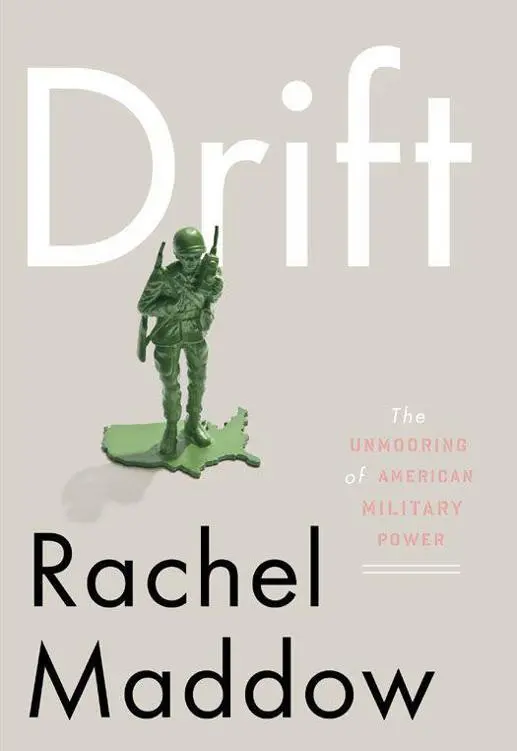
- Название:Drift
- Автор:
- Издательство:Crown Publishers
- Жанр:
- Год:2012
- Город:New York
- ISBN:978-0-307-46100-1
- Рейтинг книги:4 / 5. Голосов: 1
-
Избранное:Добавить в избранное
- Отзывы:
-
Ваша оценка:
Drift: краткое содержание, описание и аннотация
Предлагаем к чтению аннотацию, описание, краткое содержание или предисловие (зависит от того, что написал сам автор книги «Drift»). Если вы не нашли необходимую информацию о книге — напишите в комментариях, мы постараемся отыскать её.
Written with bracing wit and intelligence, Rachel Maddow’s
argues that we’ve drifted away from America’s original ideals and become a nation weirdly at peace with perpetual war, with all the financial and human costs that entails. To understand how we’ve arrived at such a dangerous place, Maddow takes us from the Vietnam War to today’s war in Afghanistan, along the way exploring the disturbing rise of executive authority, the gradual outsourcing of our war-making capabilities to private companies, the plummeting percentage of American families whose children fight our constant wars for us, and even the changing fortunes of G.I. Joe. She offers up a fresh, unsparing appraisal of Reagan’s radical presidency. Ultimately, she shows us just how much we stand to lose by allowing the priorities of the national security state to overpower our political discourse.
Sensible yet provocative, dead serious yet seriously funny,
will reinvigorate a “loud and jangly” political debate about how, when, and where to apply America’s strength and power—and who gets to make those decisions.
http://www.youtube.com/watch?v=Y9xoM7TMiTA
Drift — читать онлайн бесплатно полную книгу (весь текст) целиком
Ниже представлен текст книги, разбитый по страницам. Система сохранения места последней прочитанной страницы, позволяет с удобством читать онлайн бесплатно книгу «Drift», без необходимости каждый раз заново искать на чём Вы остановились. Поставьте закладку, и сможете в любой момент перейти на страницу, на которой закончили чтение.
Интервал:
Закладка:
Which is why we probably should have had a real debate—or at least thought twice—before we got rid of that, too.
CHAPTER 7
Doing More with Less (Hassle)
IT WAS THE TODDLERS WHO DID IT… TEETHING, SLOBBERING, paste-eating, ungovernable, ever-dependent tots. In the decade that followed the Gulf War, preschool kids ended up being among the most effective shock troops in the assault on the last remaining constraints keeping us from going to war all the time. The little darlings were terribly dear. Not dear as in cuddly, but dear as in expensive. They demanded resources. A Pentagon study in 1995 figured it cost $6,200 per toddler, per year, to provide day care for the youngest military dependents. And there were 575,000 preschool children in US military households around the world. As an employer, the military had to accept all those dependents as its responsibility; they were an enormous chapped-bottom drag.
The demographics of our Army, Navy, Air Force, and Marine Corps had changed drastically since the Vietnam War. By the mid-1990s, twenty years after we had gotten rid of the draft, the all-volunteer military was steadier, more professional, more able, more educated; it was also more reflective of the civilian world at large. The number of women in uniform, for example, had increased exponentially. Well over half of the nation’s servicemen and -women were married. And like the rest of the country, which by the mid-’90s had been enjoying relative peace and ample prosperity, the military was part of a national wave of fecundity.
But as in the country at large, having kids didn’t automatically give military families an Ozzie and Harriet makeover. The number of single parents raising children alone had trended up on military bases as it had all over. Two of every three soldiers had spouses who worked full-time outside the home. And so something like 80 percent of the preschoolers on the military’s dependent list needed full-time day care so Mom and Dad could keep the family afloat. Not only that, but military parents had come to expect a reasonable safety net for their children. “Military people stay in the service because they like being part of something special,” said the chairman of the Joint Chiefs, John M. Shalikashvili, in May 1995. “They won’t stay long, however, if families aren’t treated well.”
Long experience taught that open-ended deployment could be crushing to military families: instances of child abuse, substance abuse, divorce, and check kiting at commissaries all increased. It didn’t take the broad survey by researchers at the US Army Research Institute for Behavioral Sciences to convince commanders that “family separation” was a main reason for enlisted troops and officers alike to leave the service.
“Sir,” one Air Force sergeant stationed in Germany told a Pentagon researcher, “we are ready to go anywhere as long as you take care of our families.”
The House and Senate had passed legislation that set up all sorts of standards for how the military was supposed to handle its tots, but then they badly underfunded the provision of those services. Much of the money needed to make up the gap came from base commanders raiding their tiny pots of nonappropriated funds, leaving unmarried soldiers to bitch and moan that the kiddies were stealing the money intended to keep up bowling alleys, golf courses, and other recreational goodies. If the best hope for commanders was robbing from the base bowling alley, the Pentagon’s stated aim of meeting 80 percent of the military-family child-care demand by 1999 (up from a mere 52 percent in 1995) was clearly beyond reach.
And these goals took into account only the troops on active duty. What about all those Guard members and reservists? In the Gulf War, more than a quarter million had been called up; 105,000 had been shipped to the Saudi desert for months. And thirty-one days into active-duty deployment, the benefits kicked in for those soldiers: health care, housing allowances, employer reimbursements, tuition credits… day care!
This was a tremendous headache to the Pentagon planners. The operative budgetary mandate in the 1990s was to reprioritize the shrinking defense budget to get back to the important business of weapons procurement and modernization. In the ten years after 1985, the procurement budget had dropped from $126 billion to $39 billion and represented a paltry 18 percent of total defense expenditures. Sure, the active-duty force had been pared by nearly 30 percent and a few bases had been closed, but that didn’t come close to solving the problem. How were we supposed to ensure our Last-Superpower-on-Earth superiority when just the overhead cost of keeping our standing army milling around was swallowing between 40 and 50 percent of the Pentagon’s annual cash allotment? The budget gurus still couldn’t find the money for really great new bombs and invisible planes and impenetrable tanks, not to mention some sprucing up of the greatest and most expensive unusable arsenal the universe had ever known—our nukes. “In other words,” yet another Pentagon-sponsored task force lamented in 1996, “Department of Defense support infrastructure has remained largely impervious to downsizing.”
There was only one glimmer of hope for peeling away some of this impervious-to-downsizing overhead. It was a technocratic little solution that had morphed in just a few scant years—and without much forethought—from a slightly distasteful option of last resort to the last viable remedy: Outsourcing. Privatization. Civilian Augmentation. In other words, can’t we get someone in here who doesn’t come with day-care costs? “Without such an initiative,” said the Pentagon Task Force study, “DoD may not be able to procure the new weapons systems and technological edge needed to ensure the continuing military preeminence of the United States in the coming century.”
In fact, the privatization idea became so alluring to the military in the mid-’90s that they even tried it on day care itself. The Navy funded pilot programs to use private contractors to provide day care in Norfolk, Virginia, and at Pearl Harbor in Hawaii. The private sector was always better at controlling costs, wasn’t it?
In dozens of studies commissioned and funded by the Pentagon or the separate branches of services in the early ’90s, it was generally taken as an article of faith that the private sector did things cheaper. Those task forces, after all, were manned by a rotating phalanx of corporate executives (many retired military) from companies like Boeing and Westinghouse and General Electric and Perot Systems and Bear Stearns and Military Personnel Resources Inc. (a generic-sounding name, but one worth remembering), salted with some active-duty generals and maybe a few think tankers. After small-scale private-contractor deployments to accompany US military missions in the early 1990s in places like Haiti, Somalia, and Rwanda, the Pentagon was looking to go big. The 1996 Defense Science Board Task Force on Outsourcing and Privatization, to take the most important example, didn’t waste a lot of energy weighing the question of private versus public cost consciousness, they just went for the hard sell:
The Task Force believes that all Department of Defense support functions should be contracted out to private vendors except those functions which are inherently governmental, are directly involved in warfighting, or for which no adequate private sector capability exists or can be expected to be established…. The Task Force is convinced that an aggressive Department of Defense outsourcing initiative will improve the quality of support services at significantly reduced costs… could generate savings of up to $7 to $12 billion annually by fiscal year 2002—resources which then would be available for equipment modernization.
Читать дальшеИнтервал:
Закладка:
Похожие книги на «Drift»
Представляем Вашему вниманию похожие книги на «Drift» списком для выбора. Мы отобрали схожую по названию и смыслу литературу в надежде предоставить читателям больше вариантов отыскать новые, интересные, ещё непрочитанные произведения.












Обсуждение, отзывы о книге «Drift» и просто собственные мнения читателей. Оставьте ваши комментарии, напишите, что Вы думаете о произведении, его смысле или главных героях. Укажите что конкретно понравилось, а что нет, и почему Вы так считаете.