Rachel Maddow - Drift
Здесь есть возможность читать онлайн «Rachel Maddow - Drift» весь текст электронной книги совершенно бесплатно (целиком полную версию без сокращений). В некоторых случаях можно слушать аудио, скачать через торрент в формате fb2 и присутствует краткое содержание. Город: New York, Год выпуска: 2012, ISBN: 2012, Издательство: Crown Publishers, Жанр: Публицистика, на английском языке. Описание произведения, (предисловие) а так же отзывы посетителей доступны на портале библиотеки ЛибКат.
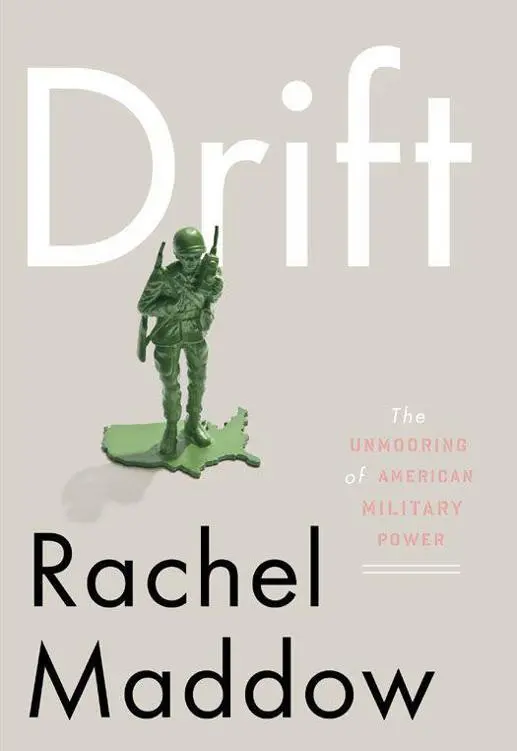
- Название:Drift
- Автор:
- Издательство:Crown Publishers
- Жанр:
- Год:2012
- Город:New York
- ISBN:978-0-307-46100-1
- Рейтинг книги:4 / 5. Голосов: 1
-
Избранное:Добавить в избранное
- Отзывы:
-
Ваша оценка:
Drift: краткое содержание, описание и аннотация
Предлагаем к чтению аннотацию, описание, краткое содержание или предисловие (зависит от того, что написал сам автор книги «Drift»). Если вы не нашли необходимую информацию о книге — напишите в комментариях, мы постараемся отыскать её.
Written with bracing wit and intelligence, Rachel Maddow’s
argues that we’ve drifted away from America’s original ideals and become a nation weirdly at peace with perpetual war, with all the financial and human costs that entails. To understand how we’ve arrived at such a dangerous place, Maddow takes us from the Vietnam War to today’s war in Afghanistan, along the way exploring the disturbing rise of executive authority, the gradual outsourcing of our war-making capabilities to private companies, the plummeting percentage of American families whose children fight our constant wars for us, and even the changing fortunes of G.I. Joe. She offers up a fresh, unsparing appraisal of Reagan’s radical presidency. Ultimately, she shows us just how much we stand to lose by allowing the priorities of the national security state to overpower our political discourse.
Sensible yet provocative, dead serious yet seriously funny,
will reinvigorate a “loud and jangly” political debate about how, when, and where to apply America’s strength and power—and who gets to make those decisions.
http://www.youtube.com/watch?v=Y9xoM7TMiTA
Drift — читать онлайн бесплатно полную книгу (весь текст) целиком
Ниже представлен текст книги, разбитый по страницам. Система сохранения места последней прочитанной страницы, позволяет с удобством читать онлайн бесплатно книгу «Drift», без необходимости каждый раз заново искать на чём Вы остановились. Поставьте закладку, и сможете в любой момент перейти на страницу, на которой закончили чтение.
Интервал:
Закладка:
But this was one hot potato that congressional leaders clearly did not wish to handle. One Republican senator summed it up nicely on that opening day of the 102nd Congress: “A lot of people here want it both ways. If it works, they want to be with the president. If not, they want to be against him.”
The president might have seized the reins from Congress on war making, but Congress wasn’t exactly fighting to seize them back. The country was split and every member of the House and Senate knew it. Polling data showed that about half the country was for a full-out military invasion in the Persian Gulf, and about half against it. Closer inspection showed ambivalence on either side of the ledger. A woman whose husband had already been deployed told a newspaper reporter in the first week of January 1991 that she was torn. “I’m not sure we have negotiated enough,” she said. “I support our troops, and I certainly support my husband. And I keep to myself in my letters and our few phone calls what I really feel.”
“I want to be a good citizen and support our country,” a cleaning lady in Mississippi told the same reporter. “But I keep waiting for somebody to explain to me why we are over there and whether it’s worth it. I still don’t know, and it’s been going on for months. I’m afraid we might be headed for another Vietnam.”
Anecdotal evidence like that, and a mountain of polling data, made clear that calculating the politics of the Gulf War was as complicated as calculating its merits. But that made things simple for much of Congress; they were hoping to stay on the sidelines and pick a side after the fact. They were willing to cede the decision to Bush, and let him take the heat (or the greater share of the glory)—willing, in effect, to allow the country to once again drift into war without the constitutionally required debate and a formal national declaration. “Congress in recent decades has avoided its responsibility,” the Pulitzer Prize–winning columnist and longtime student of the Constitution Anthony Lewis wrote the day after Mitchell and Dole kicked the can down the road. “We have come very far toward the monarchical Presidency that Hamilton and Madison and the others feared. If a President on his own can take us into a war in the gulf, George III will be entitled to smile—wherever he is. The United States has lasted this long, free and strong, by respecting the constraints of law—of the Constitution. For President Bush to disrespect them now in the name of world order would be a disaster, for him and for us.”
Finally, at the eleventh hour, when war was all but inevitable anyway, the president and the Congress did the right thing in spite of themselves. Against the advice of Secretary of Defense Dick Cheney, who insisted that asking for any kind of congressional approval for a war in the Persian Gulf would set a “dangerous precedent” and “diminish the power” of the presidency, Bush made the ask… sort of. He didn’t want a formal declaration of war, but a congressional vote supporting the UN resolution to use “all means necessary” to remove Saddam from Kuwait—in other words, to support his war. “Such action would send the clearest possible message to Saddam Hussein that he must withdraw without condition or delay from Kuwait,” Bush wrote in his letter to Congress on January 8, 1991. “I am determined to do whatever is necessary to protect America’s security. I ask Congress to join with me in this task. I can think of no better way than for Congress to express its support for the President at this critical time.”
So in the few days before the UN deadline for Saddam to leave Kuwait (or else), Congress got down to business and formally considered the wisdom of unleashing a massive half-a-million-Americans-on-the-ground war in the Persian Gulf. With the president deriding their work as nothing more than a decision about whether or not to express support for him, our elected representatives nevertheless fought out the decision to go to war on the floor of the House and the floor of the Senate, in the wells of democracy, before the shooting started. And it wasn’t all just preening and posturing and pandering. It was real, and heartfelt, and raucous, and public.
There is broad agreement in the Senate that Iraq must fully and unconditionally withdraw its forces from Kuwait. The issue is how best to achieve that goal .
Without a credible military threat, our alternative is sanctions followed by nothing at all. This is why I cannot vote for sanctions alone. This is why I cannot vote to deprive the president of the credible threat of force .
Saddam Hussein… seeks control over one of the world’s vital resources, and he ultimately seeks to make himself the unchallenged anti-Western dictator of the Middle East .
We are not in an international crisis. Nothing large happened. A nasty little country invaded a littler, but just as nasty, country .
Solidarity, we need it now, not division, but solidarity .
I reject the argument that says Congress must support the president, right or wrong. We have our own responsibility to do what is right, and I believe that war today is wrong. At this historic moment, it may well be that only Congress can stop this senseless march toward war .
I think it’s time for Congress to help rather than hinder the president. I think it’s time for the Congress to join with the president and get behind him and our young men and women over there sitting in the sand and show that we’re willing to back the use of force .
If we do nothing, and Saddam pays no price for swallowing up the country of Kuwait, destroying people’s property, torturing, raping, and killing innocent men and women and children, we are as guilty as he is .
War is about fire and steel and people dying. If the sons and daughters of all of us, of the president, the vice president, the Cabinet were all over there in the Persian Gulf right now, right up on the front line and were going to be part of that first assault wave that would go on into Kuwait, I think we’d be taking more time. I think we’d be working harder on the sanctions policy. I think we’d be trying to squeeze Saddam Hussein in every other way that we could, short of a shooting war .
If we fail to act, there will be inevitably a succession of dictators, of Saddam Husseins—of which around this globe there are an abundance, either in reality or would-be. And those dictators will see a green light, a green light for aggression, a green light for annexation of its weaker neighbors. And, indeed, over time a threat to the stability of this entire globe .
When the talking was over, virtually every member of Congress stood up and was counted as being for a war in the Persian Gulf or against it. It was a narrow margin—the Senate was 52–47—but Congress (which is to say the nation) voted to go to war.
Agree or disagree with the outcome, the system had worked. Our Congress had its clangorous and open debate and then took sides. We decided to go to war, as a country. This in itself was kind of a miracle, given how dismissive the Bush White House was of Congress’s responsibility for such decisions, and congressional leaders’ inclination to shirk those responsibilities. What forced this national debate was not humble respect for the Constitution or the founders’ intent to make any decision to go to war difficult, deliberate, wrenching, and collective. No, what forced us to do the right thing was the last surviving structural barrier to war making—the Abrams Doctrine. The sheer need to call up a huge number of troops to mount any military operation of any significance anywhere in the world. Even in the face of radically reimagined presidential power and the precedent of secret war and congressional irrelevance, the call-up had fixed the country’s eyes on the real possibility of war, had made it all but impossible for the president to conduct any serious war business alone, and had ultimately forced Congress to shoulder its burden. By the time of the George H. W. Bush presidency, the Abrams Doctrine was doing a lot of work in keeping the country from drifting too easily into war.
Читать дальшеИнтервал:
Закладка:
Похожие книги на «Drift»
Представляем Вашему вниманию похожие книги на «Drift» списком для выбора. Мы отобрали схожую по названию и смыслу литературу в надежде предоставить читателям больше вариантов отыскать новые, интересные, ещё непрочитанные произведения.







Обсуждение, отзывы о книге «Drift» и просто собственные мнения читателей. Оставьте ваши комментарии, напишите, что Вы думаете о произведении, его смысле или главных героях. Укажите что конкретно понравилось, а что нет, и почему Вы так считаете.