Rachel Maddow - Drift
Здесь есть возможность читать онлайн «Rachel Maddow - Drift» весь текст электронной книги совершенно бесплатно (целиком полную версию без сокращений). В некоторых случаях можно слушать аудио, скачать через торрент в формате fb2 и присутствует краткое содержание. Город: New York, Год выпуска: 2012, ISBN: 2012, Издательство: Crown Publishers, Жанр: Публицистика, на английском языке. Описание произведения, (предисловие) а так же отзывы посетителей доступны на портале библиотеки ЛибКат.
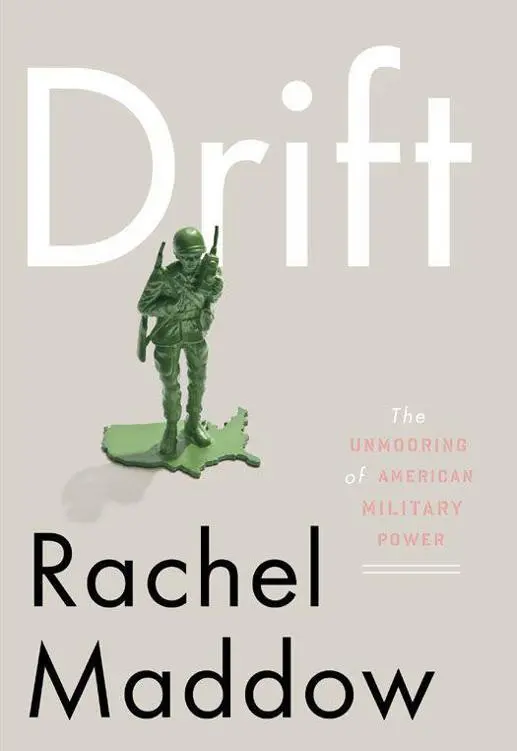
- Название:Drift
- Автор:
- Издательство:Crown Publishers
- Жанр:
- Год:2012
- Город:New York
- ISBN:978-0-307-46100-1
- Рейтинг книги:4 / 5. Голосов: 1
-
Избранное:Добавить в избранное
- Отзывы:
-
Ваша оценка:
Drift: краткое содержание, описание и аннотация
Предлагаем к чтению аннотацию, описание, краткое содержание или предисловие (зависит от того, что написал сам автор книги «Drift»). Если вы не нашли необходимую информацию о книге — напишите в комментариях, мы постараемся отыскать её.
Written with bracing wit and intelligence, Rachel Maddow’s
argues that we’ve drifted away from America’s original ideals and become a nation weirdly at peace with perpetual war, with all the financial and human costs that entails. To understand how we’ve arrived at such a dangerous place, Maddow takes us from the Vietnam War to today’s war in Afghanistan, along the way exploring the disturbing rise of executive authority, the gradual outsourcing of our war-making capabilities to private companies, the plummeting percentage of American families whose children fight our constant wars for us, and even the changing fortunes of G.I. Joe. She offers up a fresh, unsparing appraisal of Reagan’s radical presidency. Ultimately, she shows us just how much we stand to lose by allowing the priorities of the national security state to overpower our political discourse.
Sensible yet provocative, dead serious yet seriously funny,
will reinvigorate a “loud and jangly” political debate about how, when, and where to apply America’s strength and power—and who gets to make those decisions.
http://www.youtube.com/watch?v=Y9xoM7TMiTA
Drift — читать онлайн бесплатно полную книгу (весь текст) целиком
Ниже представлен текст книги, разбитый по страницам. Система сохранения места последней прочитанной страницы, позволяет с удобством читать онлайн бесплатно книгу «Drift», без необходимости каждый раз заново искать на чём Вы остановились. Поставьте закладку, и сможете в любой момент перейти на страницу, на которой закончили чтение.
Интервал:
Закладка:
The president was aware of the political risks in going to war without some show of congressional support. His best ally in the Senate, Bob Dole, had publicly said that this was “make or break time” for the Bush presidency. But Dole hadn’t exactly been clamoring for Congress to take any of the burden of decision on themselves. “If we in Congress want to participate, then we owe our boys and the president support for policy.” If we want to participate? There’s a choice? Bush hoped not. “Is there a way for the president to fulfill all his responsibilities to Congress by saying, a few days before any fighting was to begin, ‘hostilities are imminent—period!’ ” Bush asked his White House counsel. “Is there something short of ‘declaring’ war that satisfies Congress yet doesn’t risk tying the president’s hands?… Please hand carry your reply to Brent for ‘Eyes Only’ transmission to me.”
Bush did take the time to write a personal and private letter asking for advice from Sen. Bob Byrd, a Democrat, but a fair one, Bush thought, and a stickler for constitutional correctness. When Byrd told the president he was obligated to ask for a declaration of war, Bush waved it off. The president was in a muddle. He was concerned enough about Congress to ask the counsel of one of the wisest solons of the Senate, then miffed by the idea that the Senate had something to say.
Bush wrote about his war decision in his diary over and over again, in tones halfway between confession and pep talk. “I’m getting older but does that make it easier to send someone’s son to die, or does that make it more difficult? All I know is that it’s right… and I know what will happen if we let the 15th slide by and we look wimpish, or unwilling to do what we must… and I keep thinking of the… Marines and the Army guys—young, young, so very young…. They say I don’t concentrate on domestic affairs, and I expect that charge is true: but how can you when you hold the life and death of a lot of young troops in your hand?”
As Bush psyched himself up for what he had decided was his grave and lone responsibility, he talked himself well beyond a president’s normal resentment of congressional meddling and toward a real emotional rage that the Congress might insinuate themselves into this at all. This was getting personal. Even years later, he could still work himself into a state remembering it. “They had none of the responsibility or the worries that go with a decision to take military action yet they felt free to attack us,” Bush wrote in his 1998 book, A World Transformed . “They did not have to contend with the morale of the forces, the difficulty of holding the coalition together, or the fact that time was running out. Above all, they had no responsibility for the lives of our soldiers, sailors, and airmen.”
No responsibility? Only a president had that responsibility? To the president’s mind, a war was not the country’s or even the government’s, but the president’s alone. And woe be unto that lonely man.
It is my decision. My decision to send these kids into battle, my decision that may affect the lives of innocence [ sic ]. It is my decision to step back and let sanctions work. Or to move forward. And in my view, help establish the New World Order. It is my decision to stand, and take the heat, or fall back and wait and hope. It is my decision that affects [the] husband, the girlfriend, or the wife that is waiting, or the mother that writes, “Take care of my son.” And yet I know what I have to do.
I have never felt a day like this in my life. I am very tired. I didn’t sleep well and this troubles me because I must go to the nation at 9 o’clock. My lower gut hurts, nothing like when I had the bleeding ulcer. But I am aware of it, and I take a couple of Mylantas. I come over to the house about twenty of four to lie down. Before I make my calls at 5, the old shoulders tighten up. My mind is a thousand miles away. I simply can’t sleep. I think of what other Presidents went through. The agony of war.
In mid-December, at the orders of the president and his secretary of defense, the United States military was conducting an air- and sea-lift operation larger and more costly than the one at the height of the Vietnam War. Nearly two hundred freighters were hauling men and matériel—trucks, jeeps, tanks, and bombs—into the Gulf in preparation for something big. And that was when Federal District Judge Harold H. Greene weighed in with his ruling in the case of Dellums v. Bush .
The judge’s decision is worth framing:
Article I, Section 8, Clause 11, of the Constitution grants to the Congress the power “To declare War.” To the extent that this unambiguous direction requires construction or explanation, it is provided by the framers’ comments that they felt it would be unwise to entrust the momentous power to involve the nation in a war to the President alone; Jefferson explained that he desired “an effectual check to the Dog of war”; James Wilson similarly expressed the expectation that this system would guard against hostilities being initiated by a single man. Even Abraham Lincoln, while a Congressman, said more than half a century later that “ no one man should hold the power of bringing” war upon us.
The judge, in his decision, waved off as spurious Bush administration arguments that it was for the president to decide whether or not a military action constituted war.
If the Executive had the sole power to determine that any particular offensive military operation, no matter how vast, does not constitute war-making but only an offensive military attack, the congressional power to declare war will be at the mercy of a semantic decision by the Executive. Such an “interpretation” would evade the plain language of the Constitution, and it cannot stand….
Here [in the Persian Gulf], the forces involved are of such magnitude and significance as to present no serious claim that war would not ensue if they became engaged in combat, and it is therefore clear that congressional approval is required if Congress desires to become involved….
The Court has no hesitation in concluding that an offensive entry into Iraq by several hundred thousand United States servicemen under the conditions described above could be described as a “war” within the meaning of Article I, Section 8, Clause 11, of the Constitution. To put it another way: the Court is not prepared to read out of the Constitution the clause granting to the Congress, and to it alone, the authority “to declare war.”
But Judge Greene also refused to issue an injunction preventing the president from taking the country to war in the Persian Gulf. “The majority [of Congress] is the only one competent to declare war, and therefore also the one with the ability to seek an order from the courts to prevent anyone else, i.e., the Executive, from in effect declaring war. In short, unless the Congress as a whole, or by a majority, is heard from, the controversy here cannot be deemed ripe.”
In other words, it was up to Congress to get off its ass and do its job. The court wasn’t going to do it for them. A minority of a few dozen members of Congress bringing a lawsuit made for a splendid legal argument. But to stop a war (or start one) Congress needed to act as a whole, as an institution, by majority vote.
When Congress reconvened the first week in January, the two leaders in the Senate, Democrat George Mitchell and Republican Bob Dole, agreed that it would be best if they didn’t bring up a war resolution until January 23, eight days after the deadline for Saddam to leave—likely after the president had given the orders for our Air Force and Navy to begin bombing Iraq. There were angry floor statements from a handful of senators, such as Tom Harkin, who cautioned patience and sanctions. “The best time to debate this issue is before this country commits itself to war and not after,” said Harkin. “Our constitutional obligations are here and now.”
Читать дальшеИнтервал:
Закладка:
Похожие книги на «Drift»
Представляем Вашему вниманию похожие книги на «Drift» списком для выбора. Мы отобрали схожую по названию и смыслу литературу в надежде предоставить читателям больше вариантов отыскать новые, интересные, ещё непрочитанные произведения.






Обсуждение, отзывы о книге «Drift» и просто собственные мнения читателей. Оставьте ваши комментарии, напишите, что Вы думаете о произведении, его смысле или главных героях. Укажите что конкретно понравилось, а что нет, и почему Вы так считаете.