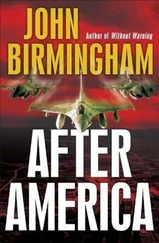
Mark Steyn - After America
Здесь есть возможность читать онлайн «Mark Steyn - After America» весь текст электронной книги совершенно бесплатно (целиком полную версию без сокращений). В некоторых случаях можно слушать аудио, скачать через торрент в формате fb2 и присутствует краткое содержание. Город: Washington, DC, Год выпуска: 2011, ISBN: 2011, Издательство: Regnery Publishing, Жанр: Публицистика, Политика, на английском языке. Описание произведения, (предисловие) а так же отзывы посетителей доступны на портале библиотеки ЛибКат.

- Название:After America
- Автор:
- Издательство:Regnery Publishing
- Жанр:
- Год:2011
- Город:Washington, DC
- ISBN:978-1-59698-100-3
- Рейтинг книги:4 / 5. Голосов: 1
-
Избранное:Добавить в избранное
- Отзывы:
-
Ваша оценка:
After America: краткое содержание, описание и аннотация
Предлагаем к чтению аннотацию, описание, краткое содержание или предисловие (зависит от того, что написал сам автор книги «After America»). Если вы не нашли необходимую информацию о книге — напишите в комментариях, мы постараемся отыскать её.
bestseller,
, Mark Steyn predicted collapse for the rest of the Western World. Now, he adds, America has caught up with Europe on the great rush to self-destruction.
It’s not just our looming financial collapse; it’s not just a culture that seems on a fast track to perdition, full of hapless, indulgent, childish people who think government has the answer for every problem; it’s not just America’s potential eclipse as a world power because of the drunken sailor policymaking in Washington—no, it’s all this and more that spells one word for America: Armageddon.
What will a world without American leadership look like? It won’t be pretty—not for you and not for your children. America’s decline won’t be gradual, like an aging Europe sipping espresso at a café until extinction (and the odd Greek or Islamist riot). No, America’s decline will be a wrenching affair marked by violence and possibly secession.
With his trademark wit, Steyn delivers the depressing news with raw and unblinking honesty—but also with the touch of vaudeville stand-up and soft shoe that makes him the most entertaining, yet profound, columnist on the planet. And as an immigrant with nowhere else to go, he offers his own prescription for winning America back from the feckless and arrogant liberal establishment that has done its level best to suffocate the world’s last best hope in a miasma of debt, decay, and debility. You will not read a more important—or more alarming, or even funnier—book all year than
. Praise for “Mark Steyn is a modern day Jeremiah with a quiverful of devastating one-liners, nailing what the liberals have done to our country. He presents an alarming—and frighteningly convincing—prophecy of where we’re headed. The choice is stark—we either listen to Steyn and act on his recommendations or face economic and cultural armageddon.”
—Mark Levin “Mark Steyn has done it again. In his new book,
, he clearly defines the dangerous signals which show America is embracing the same doomed path as the failed European economies, and how vital it is to implement and avoid policies right now to prevent us from the same fate.”
—Sean Hannity “Only Mark Steyn can write about the decline of America and leave you laughing.”
—Ann Coulter
After America — читать онлайн бесплатно полную книгу (весь текст) целиком
Ниже представлен текст книги, разбитый по страницам. Система сохранения места последней прочитанной страницы, позволяет с удобством читать онлайн бесплатно книгу «After America», без необходимости каждый раз заново искать на чём Вы остановились. Поставьте закладку, и сможете в любой момент перейти на страницу, на которой закончили чтение.
Интервал:
Закладка:
One of my favorite lines from the Declaration of Independence never made it into the final text. They were Thomas Jefferson’s parting words to his fellow British subjects across the ocean: “We might have been a free and great people together.” 4But ultimately, when it mattered, they were. Britain’s eclipse by its transatlantic offspring, by a nation with the same language, same legal inheritance, and same commitment to liberty, is one of the least disruptive transfers of global dominance ever.
Think it’s likely to go that way next time ’round? By 2027 (according to Goldman Sachs) or 2016 (according to the IMF), the world’s leading economy will be a Communist dictatorship whose legal, political, and cultural traditions are as foreign to its predecessors as could be devised. 5Even more civilizationally startling, unlike the Americans, British, Dutch, and Italians before them, the pre-eminent economic power will be a country that doesn’t use the Roman alphabet.
They have our soul who have our bonds—and the world was more fortunate in who had London’s bonds than America is seventy years later.
Britain’s eclipse by its wayward son was a changing of the guard, not a razing of the palace. By contrast, the fall of America would mark the end of a two-century anglophone dominance of geopolitics, of trade, of the global currency (sterling, and then the dollar), and of a world whose order and prosperity most people think of as part of a broad universal march of progress but which, in fact, derive from a very particular cultural inheritance and may well not survive it.
According to Lawrence Summers, America and China exist in a financial “balance of terror”—or, in Cold War terms, on a trigger of Mutually Assured Destruction. 6You could have said the same for London and Washington in March of 1941, nine months before Pearl Harbor, back when Lend-Lease began. Without American money and materiel, Britain and the Commonwealth would have been defeated. On the other hand, if Britain and the Commonwealth had collapsed, German-Japanese world domination would not have proved terribly congenial to the United States, not least the Vichy regimes in Ottawa and the Caribbean. But, as the British learned, any balance shifts over time—and so does influence: by 1950, for Britannia’s lion cubs in Canada and Australia, getting a friendly ear in Washington mattered more than one in London.
The Sino-American “balance of terror” is already shifting, and fast.
By 2010, China was funding and building ports in Burma, Sri Lanka, Bangladesh, and Pakistan. 7They, too, are Britannia’s lion cubs, part of London’s Indian Empire. Yet all four went from outposts of the British Raj to pit-stops on Chinese manufacturing’s globalization superhighway within a mere sixty years. Ascendant powers take advantage of declining ones: FDR and his successors used Lend-Lease and the wartime alliance to appropriate much of the geopolitical infrastructure built by Britain.
China, in turn, will do the same to the United States—initially for trade purposes, but eventually for much more. Here’s just a few things London didn’t have to worry about Washington doing: In recent years, Beijing has engaged in widespread intellectual-property theft and industrial espionage against the West; 8attempted multiple cyber-attacks on America’s military and commercial computer systems; 9blinded U.S. satellites with lasers; 10supplied arms to the Taliban; 11helped North Korea deliver missiles to Iran and Pakistan; 12assisted Teheran with its nuclear program; 13and actively cooperated in a growing worldwide nuclear black market. 14
In response, American “realists” keep telling themselves: Never mind, economic liberalization will force China to democratize. Lather, rinse, repeat.
If there is any single event that marked the end of Britain as an imperial power of global reach, it’s the Suez Crisis of 1956. Egypt nationalized the Suez Canal and London intervened militarily, with the French and Israelis, to protect what it saw as a vital strategic interest, a critical supply line to and from the Asian and Pacific members of the Commonwealth.
In the biggest single disagreement between Britain and America since the Second World War, Washington opposed the invasion. We can argue another day about what prompted Nasser to seize the canal and whether the American reading of the situation helped lead to the late twentieth-century fetid “stability” of the Middle East and, among other things, 9/11.
But for now just concentrate on one single feature—what Eisenhower opted to do to the Brits once he’d decided to scuttle the Suez operation.
He ordered his Treasury Secretary to prepare to sell part of the U.S. Government’s Sterling Bond holdings (that is, the World War II debt).
In London, the Chancellor of the Exchequer, Harold Macmillan, reported to the Prime Minister, Anthony Eden, that Britain could not survive such an action by Washington. The sell-off would prompt a run on the pound, and economic collapse, very quickly. Britain, humiliated, withdrew from Suez, and from global power.
It starts with the money. But it won’t end there. It never does.
And this was the friendliest shift of global hegemony—the one between family, from an elderly patriarch to its greatest scion, two great powers speaking the same language and with a compatible worldview. Its leaders were not just allies, but chums, wartime comrades, Sir Anthony as Churchill’s deputy and Foreign Secretary, Ike as Supreme Allied Commander in London.
But Eisenhower had the money, so he called the shots. Eden’s widow, the Countess of Avon, told me years ago that Ike came to regret his actions over Suez. Too late.
Britain accepted its diminished status with as much grace as it could muster. Like an old failing firm, its directors had identified the friendliest bidder and arranged, as best they could, for a succession in global leadership that was least disruptive to their interests and would ensure the continuity of their brand—the English language, English law, English trade, English liberties. It was such an artful transfer it’s barely noticed and little discussed.
But we’ll notice the next one.
“Next time ’round” is already under way. And one day Washington will be on the receiving end of Beijing’s Suez moment.

AFTER THE BALL
To point out how English the globalized world is, is, of course, a frightfully unEnglish thing to do. One risks sounding like the old Flanders and Swann number:
The English, the English, the English are best.
I wouldn’t give tuppence for all of the rest.
Which is the point of the song: English braggadocio is a contradiction in terms. You need some sinister rootless colonial oik like me to do it. No true Englishman would ever descend to anything so vulgar. But there’s a difference between genial self-effacement and contempt for one’s own inheritance. In 2009, Geert Wilders, the Dutch parliamentarian and soidisant Islamophobe, flew into London and promptly got shipped back to the Netherlands as a threat to public order. 15After the British Government had reconsidered its stupidity, he was permitted to return and give his speech at the House of Lords—and, as foreigners often do, he quoted the Winston Churchill, under the touchingly naive assumption that this would endear him to the natives. 16Whereas, of course, to almost all members of Britain’s current elite, quoting Churchill approvingly only confirms that you’re an extremist lunatic. I had the honor a couple of years back of visiting President Bush in the White House and seeing the bust of Sir Winston on display in the Oval Office. When Barack Obama moved in, he ordered it removed and returned to the British. 17Its present whereabouts are unclear. But given what Churchill had to say about Islam in his book on the Sudanese campaign, the bust was almost certainly arrested upon landing at Heathrow and deported as a threat to public order.
Читать дальшеИнтервал:
Закладка:
Похожие книги на «After America»
Представляем Вашему вниманию похожие книги на «After America» списком для выбора. Мы отобрали схожую по названию и смыслу литературу в надежде предоставить читателям больше вариантов отыскать новые, интересные, ещё непрочитанные произведения.





Обсуждение, отзывы о книге «After America» и просто собственные мнения читателей. Оставьте ваши комментарии, напишите, что Вы думаете о произведении, его смысле или главных героях. Укажите что конкретно понравилось, а что нет, и почему Вы так считаете.