George Friedman - The Next Decade
Здесь есть возможность читать онлайн «George Friedman - The Next Decade» весь текст электронной книги совершенно бесплатно (целиком полную версию без сокращений). В некоторых случаях можно слушать аудио, скачать через торрент в формате fb2 и присутствует краткое содержание. Город: New York, Год выпуска: 2011, ISBN: 2011, Издательство: Doubleday, Жанр: Публицистика, Политика, на английском языке. Описание произведения, (предисловие) а так же отзывы посетителей доступны на портале библиотеки ЛибКат.

- Название:The Next Decade
- Автор:
- Издательство:Doubleday
- Жанр:
- Год:2011
- Город:New York
- ISBN:978-0-385-53295-2
- Рейтинг книги:5 / 5. Голосов: 1
-
Избранное:Добавить в избранное
- Отзывы:
-
Ваша оценка:
The Next Decade: краткое содержание, описание и аннотация
Предлагаем к чтению аннотацию, описание, краткое содержание или предисловие (зависит от того, что написал сам автор книги «The Next Decade»). Если вы не нашли необходимую информацию о книге — напишите в комментариях, мы постараемся отыскать её.
bestseller
now focuses his geopolitical forecasting acumen on the next decade and the imminent events and challenges that will test America and the world, specifically addressing the skills that will be required by the decade’s leaders. The next ten years will be a time of massive transition. The wars in the Islamic world will be subsiding, and terrorism will become something we learn to live with. China will be encountering its crisis. We will be moving from a time when financial crises dominate the world to a time when labor shortages will begin to dominate. The new century will be taking shape in the next decade.
In
, George Friedman offers readers a provocative and endlessly fascinating prognosis for the immediate future. Using Machiavelli’s
as a model, Friedman focuses on the world’s leaders—particularly the American president—and with his trusted geopolitical insight analyzes the complex chess game they will all have to play. The book also asks how to be a good president in a decade of extraordinary challenge, and puts the world’s leaders under a microscope to explain how they will arrive at the decisions they will make—and the consequences these actions will have for us all.
The Next Decade — читать онлайн бесплатно полную книгу (весь текст) целиком
Ниже представлен текст книги, разбитый по страницам. Система сохранения места последней прочитанной страницы, позволяет с удобством читать онлайн бесплатно книгу «The Next Decade», без необходимости каждый раз заново искать на чём Вы остановились. Поставьте закладку, и сможете в любой момент перейти на страницу, на которой закончили чтение.
Интервал:
Закладка:
Of course, this is all window dressing for the core policy of simply allowing the balance of power to be reestablished. Israel was of great value to the United States during the second part of the Cold War. After the Cold War, the benefits to the United States of the relationship have declined while the costs have risen. The equation does not call for a break in relations with Israel. It calls for a recalibration based on current realities. Israel does not need foreign aid and is not in strategic danger from conventional forces. There is a mutual need for intelligence sharing and weapons development, but that is by definition a fairly quiet development.
There is no moral challenge here. No democratic ally is being abandoned, and Israel’s survival is not at issue. At the same time, while settlement in the West Bank may be a fundamental national interest to Israel, it is not of interest to the United States. These are two sovereign nations, which means that both get to define the relationship. And every relationship has to be viewed in terms of its value to the broadest sense of the national interest. What the United States needed from Israel thirty-five years ago is not what it needs today.
From the Israeli side, the primary pressure to reach an agreement with the Palestinians comes from concerns that they will find themselves alienated from the United States and particularly Europe over their treatment of the Palestinians. Economic relations are important to Israel, but so are cultural ties. But the Israelis have internal pressures. Given the Palestinian disarray, the idea of reaching a settlement with a Palestinian state that is unable or unwilling to control terrorist attacks from its territory has limited support. Any settlement would require concessions to the Palestinians that the Israelis would not want to make and that, given the weakness of the Palestinians, they are not inclined to make.
The Arab-Israeli balance of power is out of kilter. Egypt and Jordan have opted out of the balance, and Israel is free to create realities on the ground. It is not in the interest of the United States for Israel, or any country, to have freedom of action in the region. As I have said, the balance of power must be the governing principle of the United States. The United States must reshape the regional balance of power partly by moving closer to Arab states, partly by drawing back from Israel. This does not pose an existential threat to Israel, which would pose a moral challenge. Israel is in no danger of falling and does not depend on the United States to survive. That was in the past. It is not the case in the next decade. The United States needs distance. It will take it. There will be domestic political resistance. There will also be domestic political support. This is not an abandonment of Israel, but relations between two nations can’t be frozen in an outdated mode.
The complicating factor in this analysis is the rest of the Islamic world, particularly Iran and Turkey. The former threatens to become a nuclear power, and the latter will become a powerful force in the region, shifting away from close ties with Israel. Having begun with a narrow focus on Israel, we need to switch to a broader lens. And that is how, as a case study, the balance of power of an empire works.
Chapter 7
STRATEGIC REVERSAL: THE UNITED STATES, IRAN, AND THE MIDDLE EAST
Beyond the special case of Israel, the area between the eastern Mediterranean and the Hindu Kush remains the current focus of U.S. policy. As we’ve noted, the United States has three principal interests there: to maintain a regional balance of power; to make certain that the flow of oil is not interrupted; and to defeat the Islamist groups centered there that threaten the United States. Any step the United States takes to address any one of these objectives must take into account the other two, which significantly increases the degree of difficulty for achieving even one.
Adding to this challenge is that of maintaining the balance of power in three regions of the area: the Arabs and the Israelis, the Indians and the Pakistanis, and the Iraqis and the Iranians. Each of these balances is in disarray, but the most crucial one, that between the Iranians and the Iraqis, collapsed completely with the disintegration of the Iraqi state and military after the U.S. invasion of 2003. The distortion of the India-Pakistan balance is not far behind, as the war in Afghanistan continues to destabilize Pakistan.
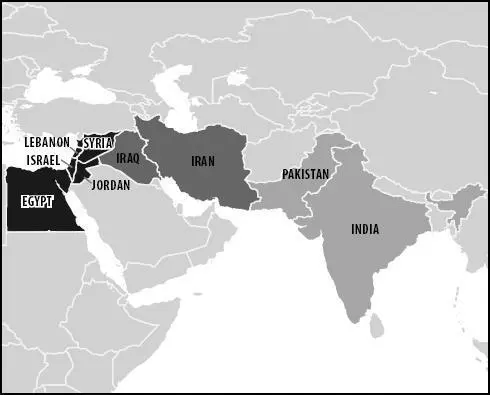
As we saw in the last chapter, the weakness of the Arab side has created a situation in which the Israelis no longer have to concern themselves with their opponents’ reactions. In the decades ahead, the Israelis will try to take advantage of this to create new realities on the ground, while the United States, in keeping with its search for strategic balance, will try to limit Israeli moves.
The Indo-Pakistani balance is being destabilized in Afghanistan, a complex war zone where American troops are pursuing two competing goals, at least as stated officially. The first is to prevent al Qaeda from using Afghanistan as a base of operations; the second is to create a stable democratic government. But denying terrorists a haven in Afghanistan achieves little, because groups following al Qaeda’s principles (al Qaeda prime, the group built around Osama bin Laden, is no longer fully functioning) can grow anywhere, from Yemen to Cleveland. This is an especially significant factor when the attempt to disrupt al Qaeda requires destabilizing the country, training the incipient Afghanistan army, managing the police force of Afghan recruits, and intruding into Afghan politics. There is no way to effectively stabilize a country in which you have to play such an intrusive role.
Unscrambling this complexity begins with recognizing that the United States has no vital interest in the kind of government Afghanistan develops, and that once again the president cannot allow counterterrorism to be a primary force in shaping national strategy.
But the more fundamental recognition necessary for ensuring balance over the next ten years is that Afghanistan and Pakistan are in fact one entity, both sharing various ethnic groups and tribes, with the political border between them meaning very little. The combined population of these two countries is over 200 million people, and the United States, with only about 100,000 troops in the region, is never going to be able to impose its will directly and establish order to its liking.
Moreover, the primary strategic issue is not actually Afghanistan but Pakistan, and the truly significant balance of power in the region is actually that between Pakistan and India. Ever since independence, these two countries partitioned from the same portion of the British Empire have maintained uneasy and sometimes violent relations. Both are nuclear powers, and they are obsessed with each other. While India is the stronger, Pakistan has the more defensible terrain, although its heartland is more exposed to India. Still, the two have been kept in static opposition—which is just where the United States wants them.
Obviously, the challenges inherent in maintaining this complex balance over the next ten years are enormous. To the extent that Pakistan disintegrates under U.S. pressure to help fight al Qaeda and to cooperate with U.S. forces in Afghanistan, the standoff with India will fail, leaving India the preeminent power in the region. The war in Afghanistan must inevitably spread to Pakistan, triggering internal struggles that can potentially weaken the Pakistani state. This is not certain, but it is too possible to dismiss. With no significant enemies other than the Chinese, who are sequestered on the other side of the Himalayas, India would be free to use its resources to try to dominate the Indian Ocean basin, and it would very likely increase its navy to do so. A triumphant India would obliterate the balance the United States so greatly desires, and thus the issue of India is actually far more salient than the issues of terrorism or nation-building in Afghanistan.
Читать дальшеИнтервал:
Закладка:
Похожие книги на «The Next Decade»
Представляем Вашему вниманию похожие книги на «The Next Decade» списком для выбора. Мы отобрали схожую по названию и смыслу литературу в надежде предоставить читателям больше вариантов отыскать новые, интересные, ещё непрочитанные произведения.












Обсуждение, отзывы о книге «The Next Decade» и просто собственные мнения читателей. Оставьте ваши комментарии, напишите, что Вы думаете о произведении, его смысле или главных героях. Укажите что конкретно понравилось, а что нет, и почему Вы так считаете.