Eduardo Galeano - Soccer in Sun and Shadow
Здесь есть возможность читать онлайн «Eduardo Galeano - Soccer in Sun and Shadow» весь текст электронной книги совершенно бесплатно (целиком полную версию без сокращений). В некоторых случаях можно слушать аудио, скачать через торрент в формате fb2 и присутствует краткое содержание. Год выпуска: 2013, ISBN: 2013, Издательство: Byliner Inc., Жанр: Публицистика, на английском языке. Описание произведения, (предисловие) а так же отзывы посетителей доступны на портале библиотеки ЛибКат.
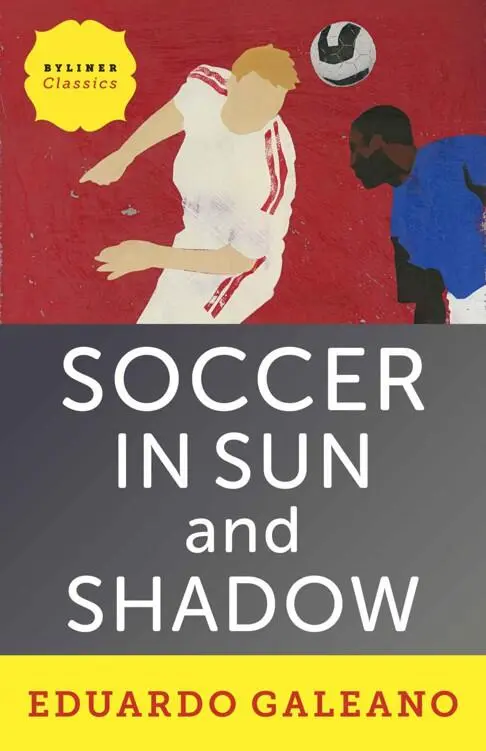
- Название:Soccer in Sun and Shadow
- Автор:
- Издательство:Byliner Inc.
- Жанр:
- Год:2013
- ISBN:9781614520771
- Рейтинг книги:4 / 5. Голосов: 1
-
Избранное:Добавить в избранное
- Отзывы:
-
Ваша оценка:
Soccer in Sun and Shadow: краткое содержание, описание и аннотация
Предлагаем к чтению аннотацию, описание, краткое содержание или предисловие (зависит от того, что написал сам автор книги «Soccer in Sun and Shadow»). Если вы не нашли необходимую информацию о книге — напишите в комментариях, мы постараемся отыскать её.
Soccer in Sun and Shadow — читать онлайн бесплатно полную книгу (весь текст) целиком
Ниже представлен текст книги, разбитый по страницам. Система сохранения места последней прочитанной страницы, позволяет с удобством читать онлайн бесплатно книгу «Soccer in Sun and Shadow», без необходимости каждый раз заново искать на чём Вы остановились. Поставьте закладку, и сможете в любой момент перейти на страницу, на которой закончили чтение.
Интервал:
Закладка:
The Irangate scandal was exploding, implicating President Reagan, the CIA, and Nicaraguan contras in gunrunning and drug trafficking, and exploding as well was the spaceship Challenger , on takeoff from Cape Canaveral with seven crew members on board. The U.S. Air Force was bombing Libya and killing a daughter of Colonel Gaddafi to punish him for an attack that years later was found to have been perpetrated by Iran.
In a Lima jail, four hundred prisoners were being shot. Well-informed sources in Miami were announcing the imminent fall of Fidel Castro, it was only a matter of hours. Many buildings without proper foundations but with lots of people inside had collapsed when an earthquake struck Mexico City a year before, and a good part of the city was still in ruins when the thirteenth World Cup got under way there.
Participating were fourteen European countries and six from the Americas, as well as Morocco, South Korea, Iraq, and Algeria. “The wave” was born in the stands at the Cup in Mexico, and ever since it has moved fans the world over to the rhythm of a rough sea. There were matches that made your hair stand on end, like France against Brazil where the infallible Platini, Zico, and Sócrates failed on penalty kicks. And there were two spectacular goalfests involving Denmark: they scored six on Uruguay and suffered five scored by Spain.
But this was Maradona’s World Cup. With two lefty goals against England, Maradona avenged the wound to his country’s pride inflicted in the Falklands War: the first he converted with his left hand, which he called “the hand of God,” and the other with his left foot, after having sent the English defenders to the ground.
Argentina faced Germany in the final. It was Maradona who made the decisive pass that left Burruchaga alone with the ball when the clock was running out, so that Argentina could win 3–2 and take the championship. But before that another memorable goal had occurred: Valdano set off with the ball from the Argentine goal and crossed the entire field. When Schumacher came out to meet him, he bounced the ball off the right post and into the net. Valdano talked to the ball as he came upfield, begging her: “Please, go in.”
France took third place, followed by Belgium. Lineker of England led the list of scorers with six. Maradona scored five goals, as did Careca of Brazil and Butragueño of Spain.

The Telecracy

Nowadays the stadium is a gigantic TV studio. The game is played for television, so you can watch it at home. And television rules.
At the ’86 World Cup, Valdano, Maradona, and other players protested because the important matches were played at noon under a sun that fried everything it touched. Noon in Mexico, nightfall in Europe, that was the best time for European television. The German goalkeeper, Harald Schumacher, told the story: “I sweat. My throat is dry. The grass is like dried shit: hard, strange, hostile. The sun shines straight down on the stadium and strikes us right on the head. We cast no shadows. They say this is good for television.”
Was the sale of the spectacle more important than the quality of play? The players are there to kick not to cry, and Havelange put an end to that maddening business: “They should play and shut their traps,” he decreed.
Who ran the 1986 World Cup? The Mexican Soccer Federation? No, please, no more intermediaries: it was run by Guillermo Cañedo, vice president of Televisa and president of the company’s international network. This World Cup belonged to Televisa, the private monopoly that owns the free time of all Mexicans and also owns Mexican soccer. And nothing could be more important than the money Televisa, along with FIFA, could earn from the European broadcast rights. When a Mexican journalist had the insolent audacity to ask about the costs and profits of the World Cup, Cañedo cut him off cold: “This is a private company and we don’t have to report to anybody.”
When the World Cup ended, Cañedo continued as a Havelange courtier occupying one of the vice presidencies of FIFA, another private company that does not have to report to anybody.
Televisa not only holds the reins on national and international broadcasts of Mexican soccer, it also owns three first-division clubs: América, the most powerful, Necaxa, and Atlante.
In 1990 Televisa demonstrated the ferocious power it holds over the Mexican game. That year, the president of the club Puebla, Emilio Maurer, had a deadly idea: Televisa could easily put out more money for the exclusive rights to broadcast the matches. Maurer’s initiative was well received by several leaders of the Mexican Soccer Federation. After all, the monopoly paid each club a little more than a thousand dollars, while amassing a fortune from selling advertising.
Televisa then showed them who was boss. Maurer was bombarded without mercy: overnight, creditors foreclosed on his companies and his home, he was threatened, assaulted, and declared a fugitive from justice, and a warrant was issued for his arrest. What’s more, one nasty morning his club’s stadium was closed without warning. But gangster tactics were not enough to make him climb down from his horse, so they had no choice but to put Maurer in jail and sweep him out of his rebel club and out of the Mexican Soccer Association, along with all of his allies.
Throughout the world, by direct and indirect means, television decides where, when, and how soccer will be played. The game has sold out to the small screen in body and soul and clothing too. Players are now TV stars. Who can compete with their shows? The program that had the largest audience in France and Italy in 1993 was the final of the European Cup Winners’ Cup between Olympique de Marseille and AC Milan. Milan, as we all know, belongs to Silvio Berlusconi, the czar of Italian television. Bernard Tapie was not the owner of French TV, but his club, Olympique, received from the small screen that year three hundred times more money than in 1980. He lacked no motive for affection.
Now millions of people can watch matches, not only the thousands who fit into the stadiums. The number of fans has multiplied, along with the number of potential consumers of as many things as the image manipulators wish to sell. But unlike baseball and basketball, soccer is a game of continuous play that offers few interruptions for showing ads. The one halftime is not enough. American television has proposed to correct this unpleasant defect by dividing the matches into four twenty-five-minute periods — and Havelange agrees.

Staid and Standardized

Don Howe, manager of the English team, said in 1987: “A player who feels satisfied after losing a match could never be any good at soccer.”
Professional soccer, ever more rapid, ever less beautiful, has tended to become a game of speed and strength, fueled by the fear of losing.
Players run a lot and risk little or nothing. Audacity is not profitable. Over forty years, between the ’54 and ’94 World Cups, the average number of goals fell by half, even though as of 1994 an extra point was awarded for each victory to try to discourage ties. The highly praised efficiency of mediocrity: in modern soccer, ever more teams are made up of functionaries who specialize in avoiding defeat, rather than players who run the risk of acting on inspiration and who allow their creative spirit to take charge.
Читать дальшеИнтервал:
Закладка:
Похожие книги на «Soccer in Sun and Shadow»
Представляем Вашему вниманию похожие книги на «Soccer in Sun and Shadow» списком для выбора. Мы отобрали схожую по названию и смыслу литературу в надежде предоставить читателям больше вариантов отыскать новые, интересные, ещё непрочитанные произведения.



Обсуждение, отзывы о книге «Soccer in Sun and Shadow» и просто собственные мнения читателей. Оставьте ваши комментарии, напишите, что Вы думаете о произведении, его смысле или главных героях. Укажите что конкретно понравилось, а что нет, и почему Вы так считаете.