Antony Beevor - Berlin - The Downfall 1945
Здесь есть возможность читать онлайн «Antony Beevor - Berlin - The Downfall 1945» весь текст электронной книги совершенно бесплатно (целиком полную версию без сокращений). В некоторых случаях можно слушать аудио, скачать через торрент в формате fb2 и присутствует краткое содержание. Город: New York, Год выпуска: 2007, ISBN: 2007, Издательство: Penguin Books, Жанр: nonf_military, История, на английском языке. Описание произведения, (предисловие) а так же отзывы посетителей доступны на портале библиотеки ЛибКат.
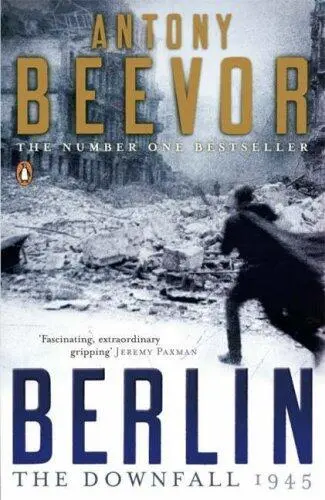
- Название:Berlin: The Downfall 1945
- Автор:
- Издательство:Penguin Books
- Жанр:
- Год:2007
- Город:New York
- ISBN:978-0-141-90302-6
- Рейтинг книги:3 / 5. Голосов: 1
-
Избранное:Добавить в избранное
- Отзывы:
-
Ваша оценка:
Berlin: The Downfall 1945: краткое содержание, описание и аннотация
Предлагаем к чтению аннотацию, описание, краткое содержание или предисловие (зависит от того, что написал сам автор книги «Berlin: The Downfall 1945»). Если вы не нашли необходимую информацию о книге — напишите в комментариях, мы постараемся отыскать её.
Antony Beevor reconstructs the experiences of those millions caught up in the nightmare of the Third Reich's final collapse, telling a terrible story of pride, stupidity, fanatacism, revenge and savagery, but also one of astonishing endurance, self-sacrifice and survival against all odds.
Berlin: The Downfall 1945 — читать онлайн бесплатно полную книгу (весь текст) целиком
Ниже представлен текст книги, разбитый по страницам. Система сохранения места последней прочитанной страницы, позволяет с удобством читать онлайн бесплатно книгу «Berlin: The Downfall 1945», без необходимости каждый раз заново искать на чём Вы остановились. Поставьте закладку, и сможете в любой момент перейти на страницу, на которой закончили чтение.
Интервал:
Закладка:
The married couple emerged into the anteroom corridor which served as the bunker conference room. Generals and secretaries congratulated them. They then retired to the little sitting room for a wedding breakfast with champagne for the new Frau Hitler, as she now insisted on being called by servants. She had finally been rewarded for her loyalty in a world of betrayal. They were later joined by Bormann, Goebbels and his wife, Magda, and the two remaining secretaries, Gerda Christian and Traudl Junge. Hitler took Traudl Junge away to another room, where he dictated his political and personal testaments. She sat there in nervous excitement, expecting to hear at last a profound explanation of the great sacrifice’s true purpose. But instead a stream of political clichés, delusions and recriminations poured forth. He had never wanted war. It had been forced on him by international Jewish interests. The war, ‘in spite of all setbacks,’ he claimed, ‘will one day go down in history as the most glorious and heroic manifestation of a people’s will to live’.
Grand Admiral Dönitz, the head of the Kriegsmarine, was appointed Reich President. The Army, the Luftwaffe and the SS had either failed or betrayed him. The loyal Dönitz — ‘Hitlerjunge Quex’ — had emerged in front of schemers. Yet Goebbels was appointed Reich Chancellor, while ‘my most faithful Party comrade, Martin Bormann’ became Party Chancellor as well as executor of his private will. Hitler clearly wanted to continue his policy of divide and rule from beyond the grave, even on the most spectral administration ever assembled. Perhaps the most bizarre appointment was for Gauleiter Karl Hanke to replace Himmler as Reichsführer SS. Hanke, a pre-war lover of Magda Goebbels, was still trapped in Breslau, directing his own provincial performance of enforced suicide on a city. Goebbels, meanwhile, wrote his own will. He believed it his duty — ‘in the delirium of treachery which surrounds the Führer in these most critical days of the war’ — to refuse Hitler’s order to leave Berlin and ‘stay with him unconditionally until death’. One of the copies of Hitler’s testament was sent by a trusted officer to Field Marshal Schörner, the new commander-in-chief of the army. The covering letter from General Burgdorf confirmed that ‘the shattering news of Himmler’s treachery’ was for Hitler the final blow.
The rather sedate wedding party deep in the bunker was overtaken by much wilder behaviour closer to the surface. When Traudl Junge was finally released from her typing at around 4 a.m. on Sunday 29 April, and the Führer and Frau Hitler retired, she went upstairs to find some food for the Goebbels children. The scenes which she encountered, not far from where the wounded lay in the Reich Chancellery’s underground field hospital, shocked her deeply. ‘An erotic fever seemed to have taken possession of everybody. Everywhere, even on the dentist’s chair, I saw bodies locked in lascivious embraces. The women had discarded all modesty and were freely exposing their private parts.’ SS officers who had been out searching cellars and streets for deserters to hang had also been tempting hungry and impressionable young women back to the Reich Chancellery with promises of parties and inexhaustible supplies of food and champagne. It was the apocalypse of totalitarian corruption, with the concrete submarine of the Reich Chancellery underworld providing an Existentialist theatre set for hell.
The reality for ordinary Berliners was becoming more terrible by the hour. On 28 April, Soviet troops reached the street of an anonymous woman diarist. ‘I had a queasy sensation in my stomach,’ she wrote. ‘It reminded me of the feeling I used to have as a schoolgirl before taking a maths exam — discomfort and restlessness, and the longing for everything to be over.’ From an upstairs window they watched a Soviet supply column of horse-drawn carts, with foals nuzzling up against their mothers. The street already smelled of horse dung. A field kitchen was set up in the garage opposite. There were no German civilians to be seen at all. ‘Ivans’ were learning to ride bicycles they had found. The sight reassured her. They seemed like big children.
When she ventured out, one of the first questions she faced was, ‘Do you have a husband?’ She spoke some Russian and was able to parry their ‘clumsy banter’. But then she noticed them exchanging looks and she began to feel afraid. One soldier, who smelled of alcohol, followed her when she retreated down into the cellar. There, the other women sat frozen as he walked along unsteadily, flashing his torch into their faces. He persisted in his unsubtle approach and the diarist, as if leading him on, managed to escape the cellar and fled up into the sunshine of the street. Other soldiers came and stripped the civilians in the cellar of their watches, but no violence was offered. In the evening, however, once the soldiers had eaten and drunk, they began their hunt. The diarist was ambushed in the dark by three of them, who began to rape her in turn. When the second one attacked her, he was interrupted by the arrival of three other soldiers, one of them a woman, but they all just laughed at the sight, including the woman.
Finally back in her own room, she piled all the furniture against the door and retired to bed. As was probably the case for all women in Berlin who were raped at this time, she found the lack of running water in which to wash herself afterwards made things far worse. She had hardly been in bed for long when her barricade was pushed aside. A group of soldiers came in and started eating and drinking in her kitchen. A giant named Petka picked her up when she tried to slip out of the apartment. She begged him not to allow the others to rape her as well and he agreed. Early the next morning, he woke up when the company rooster crowed down in the street. He announced that he must go back on duty, then nearly crushed her fingers in a goodbye handshake, assuring her that he would be back at 7 that evening.
Many other women also ‘conceded’ to one soldier in the hope of protecting themselves from gang rape. Magda Wieland, a twenty-four-year-old actress, found the arrival of Russian troops in Giesebrechtstrasse, just off the Kürfurstendamm, ‘the most frightening moment of the whole war’. She hid in a huge, ornately carved mahogany cupboard when they burst in. A very young soldier from Central Asia hauled her out. He was so excited at the prospect of a beautiful young blonde that he suffered from premature ejaculation. By sign language, she offered herself to him as a girlfriend if he would protect her from other Russian soldiers. He was clearly thrilled at the idea of having a blonde girlfriend, and went out to boast to his friends, but another soldier arrived and raped her brutally.
In the cellar, Ellen Goetz, a Jewish friend of Magda’s who had sought shelter there when she escaped from the Lehrterstrasse prison after a heavy bombardment, was also dragged out and raped. When other Germans tried to explain to the Russians that she was Jewish and had been persecuted, they received the terse retort, ‘Frau ist Frau.’ Russian officers arrived later. They themselves behaved very correctly, but they did nothing to control their men.
Giesebrechtstrasse housed a very mixed section of Berlin life. Hans Gensecke, a well-known journalist, who had been punished for hiding Jews by being made to remove corpses from bombed cellars, also lived at No. 10. So too, on the third floor of the same block, did Kaltenbrunner’s mistress, who entertained him in her apartment decorated with gilded doors and silk upholstered furniture and tapestries, no doubt looted from occupied areas of Europe. Next door, No. 11, had been infamous for the presence of ‘Salon Kitty’, the Nazi brothel for Prominenten. This establishment, with sixteen young prostitutes, had been taken over earlier in the war by Heydrich and Schellenberg. It was run by the intelligence department of the SS to spy on senior officials, Wehrmacht officers and foreign ambassadors and then blackmail them. All the rooms were bugged, and soon after the capture of Berlin, the NKVD apparently examined the technology used with great interest. Next door, on the far side, Colonel General Paul von Hase, the city commandant of Berlin, had lived until his arrest and execution following the July plot.
Читать дальшеИнтервал:
Закладка:
Похожие книги на «Berlin: The Downfall 1945»
Представляем Вашему вниманию похожие книги на «Berlin: The Downfall 1945» списком для выбора. Мы отобрали схожую по названию и смыслу литературу в надежде предоставить читателям больше вариантов отыскать новые, интересные, ещё непрочитанные произведения.









Обсуждение, отзывы о книге «Berlin: The Downfall 1945» и просто собственные мнения читателей. Оставьте ваши комментарии, напишите, что Вы думаете о произведении, его смысле или главных героях. Укажите что конкретно понравилось, а что нет, и почему Вы так считаете.