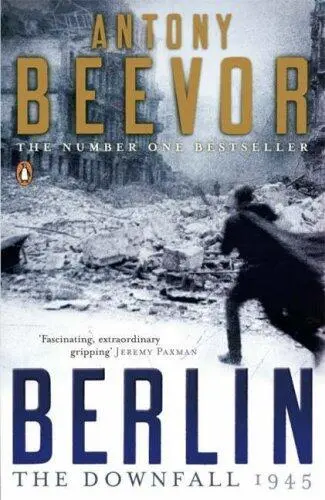
Antony Beevor - Berlin - The Downfall 1945
Здесь есть возможность читать онлайн «Antony Beevor - Berlin - The Downfall 1945» весь текст электронной книги совершенно бесплатно (целиком полную версию без сокращений). В некоторых случаях можно слушать аудио, скачать через торрент в формате fb2 и присутствует краткое содержание. Город: New York, Год выпуска: 2007, ISBN: 2007, Издательство: Penguin Books, Жанр: nonf_military, История, на английском языке. Описание произведения, (предисловие) а так же отзывы посетителей доступны на портале библиотеки ЛибКат.
- Название:Berlin: The Downfall 1945
- Автор:
- Издательство:Penguin Books
- Жанр:
- Год:2007
- Город:New York
- ISBN:978-0-141-90302-6
- Рейтинг книги:3 / 5. Голосов: 1
-
Избранное:Добавить в избранное
- Отзывы:
-
Ваша оценка:
Berlin: The Downfall 1945: краткое содержание, описание и аннотация
Предлагаем к чтению аннотацию, описание, краткое содержание или предисловие (зависит от того, что написал сам автор книги «Berlin: The Downfall 1945»). Если вы не нашли необходимую информацию о книге — напишите в комментариях, мы постараемся отыскать её.
Antony Beevor reconstructs the experiences of those millions caught up in the nightmare of the Third Reich's final collapse, telling a terrible story of pride, stupidity, fanatacism, revenge and savagery, but also one of astonishing endurance, self-sacrifice and survival against all odds.
Berlin: The Downfall 1945 — читать онлайн бесплатно полную книгу (весь текст) целиком
Ниже представлен текст книги, разбитый по страницам. Система сохранения места последней прочитанной страницы, позволяет с удобством читать онлайн бесплатно книгу «Berlin: The Downfall 1945», без необходимости каждый раз заново искать на чём Вы остановились. Поставьте закладку, и сможете в любой момент перейти на страницу, на которой закончили чтение.
Интервал:
Закладка:
On forest tracks and roads, vehicles burned and horses lay dead in their traces, while others still twitched and thrashed in pain. The ground was littered with abandoned weapons and helmets, prams, handcarts and suitcases. Halbe itself was described by eyewitnesses as a vision of hell through war. ‘Tanks rolled down the Lindenstrasse,’ the seventeen-year-old Erika Menze recorded. ‘They were covered with wounded soldiers. One of the wounded soldiers fell off the back of one. The following tank crushed him completely and the next tank after that drove over the large pool of blood. Of the soldier himself, there remained no trace.’ Outside the bakery, the pavement was literally covered with corpses. There was no space between them. ‘The heads were a yellowish grey, squashed flat, the hands a grey-black. Only wedding rings glimmered gold and silver.’
Fewer and fewer vehicles were left each day — several tanks, eight-wheeler armoured reconnaissance vehicles and some half-tracks. The vast majority of the soldiers were on their feet. On 29 April after dawn, the rain stopped and the sun came out a little. It was enough to get a rough idea of direction.
Survivors remember moments which seemed so unreal that they wondered afterwards if they had dreamed them in their exhaustion. Near Mückendorf, an officer cadet threw himself to the ground like the other soldiers with him when a hidden sub-machine gunner to their flank opened fire on them. They began firing back into the underbrush, unable to distinguish a target. Suddenly, two young SS women in black uniforms and armed with pistols appeared. ‘Get up!’ they screamed at them. ‘Attack, you cowards!’ At the end of what proved a very confused skirmish, there was absolutely no sign of the two ‘fanatics’.
The writer Konstantin Simonov happened to be on his way to Berlin in a jeep coming up the autobahn just after the main battle. On the stretch south of Teupitz, he saw a sight that he said he would never forget. ‘In that place, there was rather thick forest on both sides of the autobahn, half coniferous, half deciduous, already becoming green. A cross-cutting, not wide, led through the forest on both sides of the motorway, and one wasn’t able to see its ends… [it was] packed with something incredible: a terrible jam of cars, trucks, tanks, armoured cars, vehicles, ambulances, all of them not only pushed closely against one another, but literally jammed over one another, overturned, standing on end, upset, breaking the surrounding trees. In this mess of metal, wood and something unidentifiable was a dreadful mash of tortured human bodies. And all this went on along the cutting, into infinity. In the surrounding forest — corpses, corpses, corpses, mixed with, I suddenly noted, ones who were still alive. There were wounded people lying on greatcoats and blankets, sitting leaning against trees, some in bandages, others still without any. There were so many of them that apparently nobody had yet managed to do anything about them.’ Some even lay on the edge of the autobahn, which was half-blocked by debris and covered in oil, petrol and blood. One of the officers with him explained that this group had been ‘caught by the massed fire of several regiments of heavy artillery and katyushas’.
Soviet political departments were working hard all this time to persuade survivors to surrender. A quarter of a million leaflets were dropped over the forest. Loudspeakers boomed messages pre-recorded by ‘antifascist’ German prisoners. And Soviet soldiers shouted through the trees, ‘ Woina kaputt. Domoi. Woina kaputt! ’ — ‘The war’s over. Time to go home. The war’s over!’ Meanwhile, the political department of the 1st Ukrainian Front stiffened its men’s determination with the message, ‘The remains of the destroyed German hordes are wandering in the forests like wild beasts and will try to reach Berlin at any cost. But they won’t pass.’ Most of them did not. Close to 30,000 men lie buried in the cemetery at Halbe and every year scores more bodies are discovered out in the forest. In June 1999, the Ninth Army’s Enigma machine was also found in a shallow grave beside the autobahn. Nobody knows for sure how many refugees died with the soldiers, but it could have been as many as 10,000. At least 20,000 Red Army soldiers died too. Most are buried in a cemetery on the Baruth-Zossen road, but scores of their bodies too are still being found deep in the woods.
The most astonishing part of the story is not the numbers who died or were forced to surrender, but the 25,000 soldiers and several thousand civilians who succeeded in getting through three lines of Soviet troops to reach Wenck’s army round Beelitz. (Marshal Konev refused to accept that ‘more than 3,000–4,000’ eluded his forces.) There, between the forest and the Elbe, where safety lay with the Americans on the far bank, they were to face many more swings between hope and despair in the last days of the war.
At the time of the main battle round Halbe, Army Group Vistula headquarters decided that it must have lost all contact with General Busse. A Fieseler Storch light aircraft was sent with an officer to make contact, but this attempt failed utterly. The Ninth Army was on its own, thus confirming the collapse of Army Group Vistula as a coherent entity.
General Hasso von Manteuffel’s Third Panzer Army was already doomed once Rokossovsky’s 2nd Belorussian Front broke through across the lower Oder. General Heinrici gave Manteuffel permission to withdraw westwards into Mecklenburg, but deliberately avoided informing Field Marshal Keitel or General Krebs in the Führer bunker, because this was in direct defiance of Hitler’s order.
Rokossovsky’s advance westwards between Berlin and the Baltic forced Heinrici and his staff to abandon their headquarters at Hassleben, near Prenzlau. On their withdrawal, they passed close to Himmler’s retreat of Hohenlychen. There they saw a Hitler Youth battalion with an average age of fourteen. The boys, staggering under the weight of their weapons and packs, were trying to put a brave face on it. One staff officer spoke to their commander, saying it was a crime ‘to send these children against a battle-hardened enemy’, but this did no good. The Third Reich, in its death throes, revealed its frenzied rage against both common sense and common humanity.
Heinrici, having given Manteuffel permission to withdraw, knew that it would not be long before he heard from the two chief ‘gravediggers of the German army’. Field Marshal Keitel, on discovering what had happened, telephoned Heinrici on 29 April, accusing him of ‘disobedience and unsoldierly weakness’. He told him that he was relieved of his command forthwith. Keitel tried to appoint General von Manteuffel as Heinrici’s successor, but he refused. General Jodl rang not long afterwards. In his coldest manner, he also accused Heinrici of cowardice and weak, incompetent leadership. Heinrici was ordered to report to OKW’s new headquarters. His aides, fearing that he would be executed or forced to commit suicide like Rommel, begged him to spin out his journey. He followed their advice and the end of the war saved him.
23. The Betrayal of the Will
During the withdrawal into the centre of Berlin, the SS execution squads went about their hangman’s work with an increased urgency and cold fanaticism. Around the Kurfürstendamm, SS squads entered houses where white flags had appeared and shot down any men they found. Goebbels, terrified of the momentum of collapse, described these signs of surrender as a ‘plague bacillus’. Yet General Mummert, the commander of the Müncheberg Panzer Division, ordered the SS and Feldgendarmerie squads out of his sector round the Anhalter Bahnhof and Potsdamerplatz. He threatened to shoot executioners on the spot.
Читать дальшеИнтервал:
Закладка:
Похожие книги на «Berlin: The Downfall 1945»
Представляем Вашему вниманию похожие книги на «Berlin: The Downfall 1945» списком для выбора. Мы отобрали схожую по названию и смыслу литературу в надежде предоставить читателям больше вариантов отыскать новые, интересные, ещё непрочитанные произведения.







Обсуждение, отзывы о книге «Berlin: The Downfall 1945» и просто собственные мнения читателей. Оставьте ваши комментарии, напишите, что Вы думаете о произведении, его смысле или главных героях. Укажите что конкретно понравилось, а что нет, и почему Вы так считаете.