Antony Beevor - Berlin - The Downfall 1945
Здесь есть возможность читать онлайн «Antony Beevor - Berlin - The Downfall 1945» весь текст электронной книги совершенно бесплатно (целиком полную версию без сокращений). В некоторых случаях можно слушать аудио, скачать через торрент в формате fb2 и присутствует краткое содержание. Город: New York, Год выпуска: 2007, ISBN: 2007, Издательство: Penguin Books, Жанр: nonf_military, История, на английском языке. Описание произведения, (предисловие) а так же отзывы посетителей доступны на портале библиотеки ЛибКат.
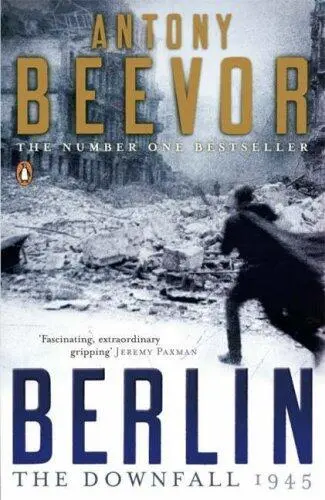
- Название:Berlin: The Downfall 1945
- Автор:
- Издательство:Penguin Books
- Жанр:
- Год:2007
- Город:New York
- ISBN:978-0-141-90302-6
- Рейтинг книги:3 / 5. Голосов: 1
-
Избранное:Добавить в избранное
- Отзывы:
-
Ваша оценка:
Berlin: The Downfall 1945: краткое содержание, описание и аннотация
Предлагаем к чтению аннотацию, описание, краткое содержание или предисловие (зависит от того, что написал сам автор книги «Berlin: The Downfall 1945»). Если вы не нашли необходимую информацию о книге — напишите в комментариях, мы постараемся отыскать её.
Antony Beevor reconstructs the experiences of those millions caught up in the nightmare of the Third Reich's final collapse, telling a terrible story of pride, stupidity, fanatacism, revenge and savagery, but also one of astonishing endurance, self-sacrifice and survival against all odds.
Berlin: The Downfall 1945 — читать онлайн бесплатно полную книгу (весь текст) целиком
Ниже представлен текст книги, разбитый по страницам. Система сохранения места последней прочитанной страницы, позволяет с удобством читать онлайн бесплатно книгу «Berlin: The Downfall 1945», без необходимости каждый раз заново искать на чём Вы остановились. Поставьте закладку, и сможете в любой момент перейти на страницу, на которой закончили чтение.
Интервал:
Закладка:
This is the tidy version of events — the staff officer’s summary, trying to produce order out of chaos. But within the forest, in and around Halbe especially, the reality of the battle was appalling, mainly due to Soviet artillery and air bombardment.
‘If the first attempts to break out through the encirclement succeeded, they were immediately destroyed by Russian aircraft and artillery,’ Major Diehl, the commander of the 90th Regiment in the 35th SS Police Grenadier Division, told his interrogators when captured. ‘The losses were huge. One literally could not raise one’s head and I was absolutely unable to conduct the battle. All I could do was lie under a tank with my adjutant and look at the map.’
Men with chest and stomach wounds lay bleeding to death. Most of the injuries came from wood splinters, as in an eighteenth-century battle at sea. The Soviet tank crews and artillery deliberately aimed to explode their shells high in the trees. For those below there was little protection. Digging trenches in the sandy soil filled with tree roots was an impossible task, even for those who still had spades. Some men in their desperation for shelter tried to dig frantically with their helmets or rifle butts, but they could achieve little more than a shallow shell-scrape, which was no protection from the splinters.
Air and artillery bombardments in such conditions produced a panic even among experienced soldiers. When Soviet reconnaissance or ground attack aircraft appeared overhead, those German soldiers riding on the vehicle began firing at them wildly with sub-machine guns and rifles. Any wounded or exhausted men on foot who collapsed in the path of armoured vehicles or trucks were simply run over by wheels or crushed by tank tracks.
As the battle continued in that last week of April, there were few front lines in the expanse of forest. Skirmishes were deadly, with a tank suddenly surprising an enemy in enfilade down a fire-break or ride. A Tiger and a Panther, followed by half-tracks, all covered with exhausted soldiers clinging on to the outside, were fired at by a Soviet tank. Everyone tried to fire back at once in the confusion. The infantrymen on the outsides of the tanks had to jump as the turret traversed. But the Soviet tank was faster. Its next shell hit one of the half-tracks, which happened to be loaded with cans of spare fuel. It exploded in a ball of flame, setting light to the forest around.
Constant smoke from burning pine trees drifted through the forest. Although Soviet commanders denied it, their artillery and aviation regiments certainly seemed to be using phosphorous or other incendiary projectiles. Horses towing supply carts or limbers and guns were terrified and bolted easily. The smoke also greatly reduced visibility in the already gloomy light amid the tall, straight trunks like cathedral columns. There was a constant noise of men calling to each other, hoping to make contact with their group. Despite all the attempts to issue orders to recognizable formations, the different army corps had mingled into an incoherent mass, with Wehrmacht and SS trudging uneasily alongside each other. Mutual suspicion had greatly increased. The SS claimed that army officers refused to pick up their wounded, but there was little sign of SS officers doing anything for Wehrmacht soldiers, except crush them under their tracks if they were in the way. The army’s resentment of the SS as an alien organization rose very close to the surface. There were apparently also SS women, armed and in black uniforms, riding on the Tiger tanks.
After the first breakout failed, groups tried to slip through in different directions. One detachment came across a Soviet artillery position which had been stormed by half-tracks the day before. They crossed the autobahn and found dead Soviet soldiers still in their foxholes. Like the other groups, they continued on through the forests towards the rendezvous round Kummersdorf, which the first breakthrough group had almost reached. After the autobahn, the most dangerous part was crossing the Baruth-Zossen road, defended by another line of Soviet rifle divisions and artillery.
On the night of 28 April, another determined attempt at a mass breakout from the Halbe area was made. In desperate fighting, the Germans managed to smash the line held by the 50th Guards Rifle Division. ‘For this they paid in heavy losses,’ wrote General Luchinsky. Konev, determined that the rest should be crushed, reinforced the flanks. Trees were felled across tracks leading westwards. Each rifle division set up lines of anti-tank guns hidden behind fire-breaks or tracks, as if they were engaged in a gigantic boar shoot. Rifle regiments, supported by small tank detachments, attacked into the forest east of the autobahn.
Busse’s men were spread over a wide area, with large groups around Halbe, and others stretching most of the way back to Storkow, where the rearguard still held out against Zhukov’s forces. The Soviet attacks were designed to break up Busse’s forces into different pockets. During almost all hours of daylight, Soviet U-2 biplanes flew low over the tree-tops, trying to spot fugitive groups for the artillery and aviation to attack. Altogether, the air divisions supporting the 1st Ukrainian Front flew ‘2,459 attack missions and 1,683 bombing sorties’.
For the Germans in the forest, without maps or compasses, it was almost impossible to find their way. The smoke and the trees made it hard even to see the sun to estimate where west might lie. Most of the exhausted soldiers simply trudged along the sandy paths, leaderless and lost. There was great resentment against the ‘gentlemen of the staff’ in their clean uniforms, driven in their Kübelwagen vehicles, and apparently not picking up any of the wounded or those who had collapsed. All around crossing points of roads there was ‘a patchwork quilt of corpses, grey-green corpses’. Six soldiers from the 36th SS Grenadier Division commanded by Major General Oskar Dirlewanger, infamous for his role in the suppression of both risings in Warsaw, surrendered despite the risk of execution. ‘It’s already been five days since we’ve seen an officer,’ one of them said. ‘We feel that the war will end very soon, and the stronger this feeling becomes, the more we don’t want to die.’ It was rare for the SS to surrender. As far as most of them were concerned, capture meant a ‘shot in the back of the neck’ or a Siberian camp.
A terrible, one-sided battle developed round the large village of Halbe during 28 and 29 April as Soviet forces attacked from the south with katyushas and artillery. Many of the young Wehrmacht soldiers were shaking with fear and ‘literally shitting themselves’, according to Hardi Buhl, a villager. The local inhabitants were sheltering in their cellars, and when these terrified boy soldiers sought safety there too, they gave them clothes. But SS soldiers, on realizing what was happening, tried to stop it with reprisals. Hardi Buhl was with his family in their cellar, which was packed with other families and soldiers — some forty people in all — when an SS man appeared with a panzerfaust, which he aimed at the cowering inmates. The explosion in such a confined space would have killed them all. But before he fired, a Wehrmacht soldier in the corner nearest the stairs, who had been hard to see in the gloom, shot him in the back of the neck. There were other reports of shooting between SS and Wehrmacht around Halbe, but they are hard to verify.
Another attempt to break out westwards was made from Halbe by the central group. Siegfried Jürgs, a young officer cadet with Fahnenjunker Regiment 1239, described in his diary what he saw from his position on the leading tank. Wounded, whom nobody helped, were left screaming by the side of the track. ‘I never suspected that three hours later, I would be one of them.’ As they attacked a Soviet blocking detachment, he had jumped down from the tank with the other infantry to take up position in the ditch. But then a mortar bomb exploded and he was pierced through the back by a large fragment of shrapnel. Another explosion left him with shrapnel in his shoulder, chest and again in his back. Jürgs was luckier than the wounded he had seen earlier. He was picked up by a truck a number of hours later, but these vehicles were overloaded with wounded and there were screams of pain from the back as they lurched and bumped in and out of potholes on the forest tracks. Those too badly wounded to be moved were left to suffer where they lay. Few had any strength left to bury the dead. At best bodies were rolled into a ditch or shell crater and some sandy soil thrown over them.
Читать дальшеИнтервал:
Закладка:
Похожие книги на «Berlin: The Downfall 1945»
Представляем Вашему вниманию похожие книги на «Berlin: The Downfall 1945» списком для выбора. Мы отобрали схожую по названию и смыслу литературу в надежде предоставить читателям больше вариантов отыскать новые, интересные, ещё непрочитанные произведения.








Обсуждение, отзывы о книге «Berlin: The Downfall 1945» и просто собственные мнения читателей. Оставьте ваши комментарии, напишите, что Вы думаете о произведении, его смысле или главных героях. Укажите что конкретно понравилось, а что нет, и почему Вы так считаете.