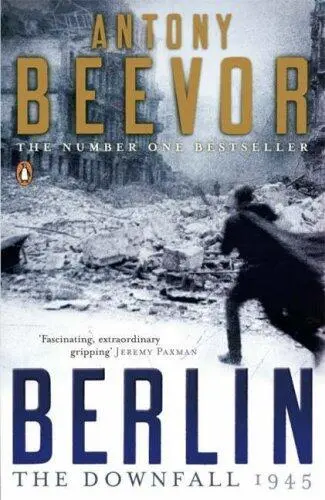
Antony Beevor - Berlin - The Downfall 1945
Здесь есть возможность читать онлайн «Antony Beevor - Berlin - The Downfall 1945» весь текст электронной книги совершенно бесплатно (целиком полную версию без сокращений). В некоторых случаях можно слушать аудио, скачать через торрент в формате fb2 и присутствует краткое содержание. Город: New York, Год выпуска: 2007, ISBN: 2007, Издательство: Penguin Books, Жанр: nonf_military, История, на английском языке. Описание произведения, (предисловие) а так же отзывы посетителей доступны на портале библиотеки ЛибКат.
- Название:Berlin: The Downfall 1945
- Автор:
- Издательство:Penguin Books
- Жанр:
- Год:2007
- Город:New York
- ISBN:978-0-141-90302-6
- Рейтинг книги:3 / 5. Голосов: 1
-
Избранное:Добавить в избранное
- Отзывы:
-
Ваша оценка:
Berlin: The Downfall 1945: краткое содержание, описание и аннотация
Предлагаем к чтению аннотацию, описание, краткое содержание или предисловие (зависит от того, что написал сам автор книги «Berlin: The Downfall 1945»). Если вы не нашли необходимую информацию о книге — напишите в комментариях, мы постараемся отыскать её.
Antony Beevor reconstructs the experiences of those millions caught up in the nightmare of the Third Reich's final collapse, telling a terrible story of pride, stupidity, fanatacism, revenge and savagery, but also one of astonishing endurance, self-sacrifice and survival against all odds.
Berlin: The Downfall 1945 — читать онлайн бесплатно полную книгу (весь текст) целиком
Ниже представлен текст книги, разбитый по страницам. Система сохранения места последней прочитанной страницы, позволяет с удобством читать онлайн бесплатно книгу «Berlin: The Downfall 1945», без необходимости каждый раз заново искать на чём Вы остановились. Поставьте закладку, и сможете в любой момент перейти на страницу, на которой закончили чтение.
Интервал:
Закладка:
The nurses and patients, who had been looted very thoroughly the day before by Soviet troops and liberated slave labourers, heard artillery. Nobody knew where this battle was coming from. A shell hit one of the blocks. The children were taken down into the cellars. The nurses asked each other whether this could be the Americans arriving. Later, they suddenly saw German troops arriving from the west in skirmishing formation, dashing forwards from tree to tree. Two of the nurses ran outside towards them, screaming, ‘Blast the Russians away!’ As the battle intensified, the director of the hospital, Dr Potschka, decided to make contact with the Americans on the Elbe. The Swiss clearly could not help them.
The battle for Beelitz continued for several days. In the course of the fighting and the earlier outrages, seventy-six civilians were killed, including fifteen children. ‘It was fought with great bitterness,’ the battalion commander of the Scharnhorst wrote, ‘and no prisoners were taken.’ He and his men were appalled when the Soviets captured a house in which all their wounded comrades were lying in the cellar. The young soldiers — some of them were so young that civilians in Beelitz referred to them as ‘ Kindersoldaten’ — suffered ‘tank fright’ on first encountering T-34 and Stalin tanks. But within a couple of days confidence returned when four Stalin tanks were knocked out with panzerfausts. Peter Rettich, the battalion commander, hailed his young soldiers’ ‘fantastic acts of bravery’ and their ‘dedication’ and then added that it was ‘a crying shame and a crime to throw such boys into this all-destructive hell’.
On 28 April, the 3,000 wounded and sick children were loaded by men of the Ulrich von Hutten Division on to a shuttle of goods trains which took them slowly off towards Barby. There the Kinderklinik was re-established and the Americans accepted the wounded as prisoners of war. Wenck, however, had set the Twelfth Army more important missions. One was the drive up towards Potsdam with the bulk of the Hutten Division to open up an escape corridor. The other was to help the Ninth Army save itself.
The German troops in the huge Spree forest south-east of Berlin represented an unwieldy mixture of mangled divisions and terrified civilians fleeing the Red Army. The 80,000 men had come together from different directions and different armies. The bulk were from General Busse’s Ninth Army — XI SS Panzer Corps on the Oderbruch and V SS Mountain Corps south of Frankfurt. The Frankfurt garrison, as Busse had been hoping, also managed to escape to join them. They were joined from the south by V Corps, which had formed the northern flank of the Fourth Panzer Army until cut off and forced back by Konev’s drive on Berlin. [4] Soviet sources claim that Busse’s force in the forest amounted to 200,000 men, with 300 tanks and 2,000 guns, a preposterous exaggeration for propaganda purposes. One detailed US Army report, however, puts the figures even lower, at around 40,000.
Busse, having consulted with General Wenck, was determined to break out due westwards through the tall pine forests south of Berlin. He would join up with the Twelfth Army, and both would withdraw to the Elbe. Busse’s main problem was that his rearguard was tied down in constant battles with Zhukov’s forces, and he warned Wenck that his army was ‘pushing to the west like a caterpillar’. Neither he nor Wenck intended to waste any more lives by following Hitler’s increasingly hysterical orders to attack up towards Berlin. Busse, shortly after midnight on 25 April, had been given authority ‘to decide for himself on the best direction of attack’. From then on, he adopted a Nelsonian tactic of refusing to acknowledge most signals, although in many cases radio communications genuinely broke down.
His men and the civilians who had sought refuge with them had virtually no food left. Vehicles were kept moving until they ran out of fuel or broke down and then they were destroyed or cannibalized for spare parts. He did, however, have thirty-one tanks left — half a dozen Panthers from the Kurmark, the remains of General Hans von Luck’s 21st Panzer Division, and around ten King Tigers from the 502nd SS Heavy Panzer Battalion. These he hoped to use as his spearhead to break through the rear of Konev’s armies attacking Berlin. Their fuel tanks were topped up by siphoning from trucks abandoned by the side of the road. His remaining artillery would fire an opening barrage with their last shells, then blow up their guns.
Busse’s men were encircled in the pattern of lakes and forest southwest of Fürstenwalde by troops from both the 1st Belorussian Front and Konev’s 1st Ukrainian Front. On the afternoon of 25 April, Zhukov sent his forces into the attack from the north and east. They included the 3rd Army, the 2nd Guards Cavalry Corps, which was well adapted to forest fighting, the 33rd Army and the 69th Army.
Konev had realized, after studying the map, that the Germans had little choice for their breakout. They would have to cross the Berlin-Dresden autobahn south of the series of lakes starting at Teupitz. Konev reacted rapidly, albeit rather late in the day. On 25 April, Gordov’s 3rd Guards Army was rushed into positions close to the Berlin-Dresden autobahn ‘to block all the forest roads leading from east to west’. They chopped down tall pine trees to form tank barriers. But Gordov did not manage to occupy the southern part of his sector. And although the 28th Army reinforced the area east of Baruth as ordered, a slight gap remained between the two armies.
On the morning of 26 April, Busse’s vanguard, advancing through Halbe, happened to find the weak point between the two armies. They crossed the autobahn and reached the Baruth-Zossen road, which was the supply line to Rybalko in Berlin. General Luchinsky, to avert the danger, even had to send the 50th and 96th Guards Rifle Divisions into a counter-attack ‘without information about the situation’. The fighting was chaotic, but heavy bombing and strafing from the 2nd Air Army and relentless counter-attacks on the ground forced many of the Germans back across the autobahn into the Halbe forest. The panzer crews had found that their tracks did not grip on the sandy soil of the pine forest and they were forced to avoid the forest roads because of the constant air attacks.
The group that managed to cross both the autobahn and the Baruth-Zossen road was spotted by a Luftwaffe aircraft. This was reported to Army Group Vistula and to General Jodl. Hitler was furious when he heard that they were heading westwards, but he still could not believe that Busse would dare to disobey him. A signal was sent that night via Jodl. ‘The Führer has ordered that concentric attacks of Ninth and Twelfth Armies must not only serve to save the Ninth Army but principally to save Berlin.’ Further signals were more explicit: ‘The Führer in Berlin expects that the armies will do their duty. History and the German people will despise every man who in these circumstances does not give his utmost to save the situation and the Führer.’ Hitler’s one-way concept of loyalty was perfectly revealed. The signal was repeated several times that night and the following day. There was no reply from the forest.
During that night and the next day, 27 April, the Germans renewed their attack along two axes: in the south from Halbe through towards Baruth, and in the north from Teupitz. In the north, several thousand Germans supported by tanks drove a wedge into the 54th Guards Rifle Division, captured Zesch am See and surrounded part of the 160th Rifle Regiment. In the south, the thrust towards Baruth encircled the 291st Guards Rifle Regiment under Lieutenant Colonel Andryushchenko in Radeland, where they seized attics and basements and fought until rescued by the 150th Guards Rifle Regiment from Baruth. Once again, the Germans ‘suffered very heavy losses’.
Читать дальшеИнтервал:
Закладка:
Похожие книги на «Berlin: The Downfall 1945»
Представляем Вашему вниманию похожие книги на «Berlin: The Downfall 1945» списком для выбора. Мы отобрали схожую по названию и смыслу литературу в надежде предоставить читателям больше вариантов отыскать новые, интересные, ещё непрочитанные произведения.








Обсуждение, отзывы о книге «Berlin: The Downfall 1945» и просто собственные мнения читателей. Оставьте ваши комментарии, напишите, что Вы думаете о произведении, его смысле или главных героях. Укажите что конкретно понравилось, а что нет, и почему Вы так считаете.