Antony Beevor - Berlin - The Downfall 1945
Здесь есть возможность читать онлайн «Antony Beevor - Berlin - The Downfall 1945» весь текст электронной книги совершенно бесплатно (целиком полную версию без сокращений). В некоторых случаях можно слушать аудио, скачать через торрент в формате fb2 и присутствует краткое содержание. Город: New York, Год выпуска: 2007, ISBN: 2007, Издательство: Penguin Books, Жанр: nonf_military, История, на английском языке. Описание произведения, (предисловие) а так же отзывы посетителей доступны на портале библиотеки ЛибКат.
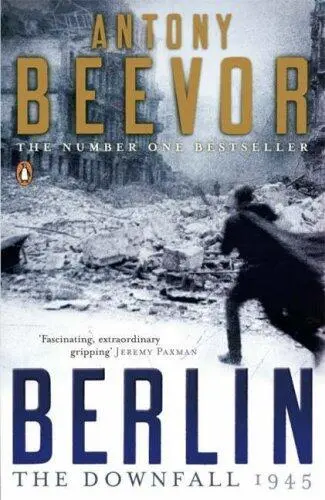
- Название:Berlin: The Downfall 1945
- Автор:
- Издательство:Penguin Books
- Жанр:
- Год:2007
- Город:New York
- ISBN:978-0-141-90302-6
- Рейтинг книги:3 / 5. Голосов: 1
-
Избранное:Добавить в избранное
- Отзывы:
-
Ваша оценка:
Berlin: The Downfall 1945: краткое содержание, описание и аннотация
Предлагаем к чтению аннотацию, описание, краткое содержание или предисловие (зависит от того, что написал сам автор книги «Berlin: The Downfall 1945»). Если вы не нашли необходимую информацию о книге — напишите в комментариях, мы постараемся отыскать её.
Antony Beevor reconstructs the experiences of those millions caught up in the nightmare of the Third Reich's final collapse, telling a terrible story of pride, stupidity, fanatacism, revenge and savagery, but also one of astonishing endurance, self-sacrifice and survival against all odds.
Berlin: The Downfall 1945 — читать онлайн бесплатно полную книгу (весь текст) целиком
Ниже представлен текст книги, разбитый по страницам. Система сохранения места последней прочитанной страницы, позволяет с удобством читать онлайн бесплатно книгу «Berlin: The Downfall 1945», без необходимости каждый раз заново искать на чём Вы остановились. Поставьте закладку, и сможете в любой момент перейти на страницу, на которой закончили чтение.
Интервал:
Закладка:
Since the one thing holding up Soviet attempts to replicate the Manhattan Project’s research was the shortage of uranium, the importance which Stalin and Beria attached to securing research laboratories and their supplies was considerable. They also wanted German scientists capable of processing uranium. Beria’s preparations for the Berlin operation had clearly been enormous. Colonel General Makhnev was in charge of the special commission. The large numbers of NKVD troops to secure the laboratories and uranium stores were directly supervised by no less a personage than General Khrulev, the chief of rear area operations for the whole of the Red Army. The chief NKVD metallurgist, General Avraami Zavenyagin, had set up a base on the edge of Berlin and scientists from the main team of researchers oversaw the movement of materials and the dismantling of laboratories.
The NKVD commission made its report. As well as all the equipment at the Kaiser Wilhelm Institute, they found ‘250kgs of metallic uranium; three tons of uranium oxide; twenty litres of heavy water’. The three tons of uranium oxide misdirected to Dahlem was a real windfall. There was a particular reason for speed, Beria and Malenkov reminded Stalin rather unnecessarily in a retrospective confirmation of action already carried out: the Kaiser Wilhelm Institute was ‘situated in the territory of the future Allied zone’. ‘Taking into account the extreme importance for the Soviet Union of all the above-mentioned equipment and materials,’ they wrote, ‘we request your decision on disassembling and evacuating equipment and other items from these enterprises and institutes back to the USSR.’
The State Committee for Defence accordingly authorized the ‘NKVD Commission headed by Comrade Makhnev’ to ‘evacuate to the Soviet Union to Laboratory No. 2 of the Academy of Sciences and Special Metal Department of the NKVD all the equipment and materials and archive of the Kaiser Wilhelm Institute in Berlin’.
Makhnev’s men also rounded up Professor Peter Thiessen and Dr Ludwig Bewilogua, who were flown to Moscow. But the major figures of the Kaiser Wilhelm Institute — Werner Heisenberg, Max von Laue, Carl Friedrich von Weizsäcker and Otto Hahn, who had won the Nobel Prize for chemistry only a few months before — were beyond their grasp. They were earmarked by the British and taken back to be lodged at Farm Hall, their debriefing centre for German scientists in East Anglia.
Other less important laboratories and institutes were also stripped out and many more scientists were arrested and sent to a special holding pen in the concentration camp of Sachsenhausen. Professor Baron von Ardenne volunteered. He was persuaded by General Zavenyagin to write ‘an application addressed to the Council of People’s Commissars of the USSR that he wished to work with Russian physicists and place the Institute and himself at the disposal of the Soviet government’.
Beria and Kurchatov’s scientists at last had some uranium to start work in earnest, and experts to process it, but the need for further supplies was desperate in their eyes. General Serov, the NKVD chief in Berlin, was ordered to concentrate on securing the uranium deposits in Czechoslovakia and, above all, in Saxony, south of Dresden. The presence of the uncompromising General George Patton’s Third Army in the region must have caused the Soviet authorities considerable concern. It may also explain why they were so nervous about whether US forces would withdraw to the previously agreed occupation zones.
In Dahlem, some of Rybalko’s officers visited Sister Kunigunde, the mother superior of Haus Dahlem, a maternity clinic and orphanage. She informed them that they had not hidden any German soldiers. The officers and their men behaved impeccably. In fact, the officers even warned Sister Kunigunde about the second-line troops following on behind. Their prediction proved entirely accurate, but there was no chance of escape. Nuns, young girls, old women, pregnant women and mothers who had just given birth were all raped without pity. One woman compared events in Dahlem to ‘the horrors of the Middle Ages’. Others thought of the Thirty Years War.
The pattern, with soldiers flashing torches in the faces of women huddled in the bunkers to select their victims, appears to have been common to all the Soviet armies involved in the Berlin operation. This process of selection, as opposed to the immediate violence shown in East Prussia, indicates a definite change. By this stage Soviet soldiers treated German women much more as sexual spoils of war than as substitutes for the Wehrmacht on which to vent their rage.
Rape has often been defined by writers on the subject as an act of violence which has little to do with sex. But that is a definition from the victim’s perspective. To understand the crime, however, one needs to see things from the perpetrator’s point of view, especially in this second stage when unaggravated rape had succeeded the extreme onslaught of January and February. The soldiers concerned appear to have felt that they were satisfying a sexual need after all their time at the front. In this most soldier rapists did not demonstrate gratuitous violence, provided the woman did not resist. A third stage in the process, and even a fourth, developed in the weeks to come, as will be seen. But the basic point is that, in war, undisciplined soldiers without fear of retribution can rapidly revert to a primitive male sexuality. The difference between the incoherent violence in East Prussia and the notion of carnal booty in Berlin underlines the fact that there can be no all-embracing definition of the crime. On the other hand, it tends to suggest that there is a dark area of male sexuality which can emerge all too easily, especially in war, when there are no social and disciplinary restraints. Much also depends on the military culture of a particular national army. As the Red Army example shows, the practice of collective rape can even become a form of bonding process.
Soviet political officers still talked of ‘violence under the pretext of revenge’. ‘When we broke into Berlin,’ the political department of the 1st Belorussian Front reported, ‘some of the troops indulged in looting and violence towards civilians. Political officers tried to control this. They organized meetings devoted to such topics as “the honour and dignity of the Red Army warrior”, “a looter is the worst enemy of the Red Army” and “how to understand correctly the problem of taking revenge”.’ But the idea of controlling their troops through political exhortation, particularly when the Party line had suddenly changed, was doomed to failure.
Germans were deeply shocked by the lack of discipline within the Red Army and the inability of officers to control their men, except in extreme cases by shooting them on the spot. All too often, women encountered total indifference or amusement that they should attempt to complain about rape. ‘That? Well, it certainly hasn’t done you any harm,’ said one district commandant in Berlin to a group of women who had come to request protection from repeated attacks. ‘Our men are all healthy.’ Unfortunately, many of them were not free from disease, as women soon found to their even greater cost.
22. Fighting in the Forest
‘Who would ever have thought,’ noted a battalion commander of the Scharnhorst Division as they advanced to Beelitz, ‘that it would be just a day’s march from the Western Front to the Eastern Front! It says everything about our situation.’
General Wenck’s XX Corps had started its attack eastwards on 24 April to break through to meet the Ninth Army encircled in the forests beyond Konev’s supply lines. That evening, the Theodor KörnerDivision of Reich Labour Service youths attacked General Yermakov’s 5th Guards Mechanized Corps near Treuenbrietzen. On the next day, the Scharnhorst Division approached Beelitz. They had no idea of what lay ahead as they moved through a mixture of thick young plantations and mature, well-spaced pine forest. The operation, observed the battalion commander, ‘had the character of an armed reconnaissance’. A few kilometres before Beelitz, they came upon the hospital complex at Heilstätten.
Читать дальшеИнтервал:
Закладка:
Похожие книги на «Berlin: The Downfall 1945»
Представляем Вашему вниманию похожие книги на «Berlin: The Downfall 1945» списком для выбора. Мы отобрали схожую по названию и смыслу литературу в надежде предоставить читателям больше вариантов отыскать новые, интересные, ещё непрочитанные произведения.








Обсуждение, отзывы о книге «Berlin: The Downfall 1945» и просто собственные мнения читателей. Оставьте ваши комментарии, напишите, что Вы думаете о произведении, его смысле или главных героях. Укажите что конкретно понравилось, а что нет, и почему Вы так считаете.