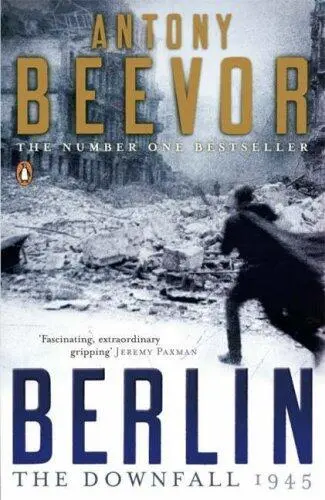
Antony Beevor - Berlin - The Downfall 1945
Здесь есть возможность читать онлайн «Antony Beevor - Berlin - The Downfall 1945» весь текст электронной книги совершенно бесплатно (целиком полную версию без сокращений). В некоторых случаях можно слушать аудио, скачать через торрент в формате fb2 и присутствует краткое содержание. Город: New York, Год выпуска: 2007, ISBN: 2007, Издательство: Penguin Books, Жанр: nonf_military, История, на английском языке. Описание произведения, (предисловие) а так же отзывы посетителей доступны на портале библиотеки ЛибКат.
- Название:Berlin: The Downfall 1945
- Автор:
- Издательство:Penguin Books
- Жанр:
- Год:2007
- Город:New York
- ISBN:978-0-141-90302-6
- Рейтинг книги:3 / 5. Голосов: 1
-
Избранное:Добавить в избранное
- Отзывы:
-
Ваша оценка:
Berlin: The Downfall 1945: краткое содержание, описание и аннотация
Предлагаем к чтению аннотацию, описание, краткое содержание или предисловие (зависит от того, что написал сам автор книги «Berlin: The Downfall 1945»). Если вы не нашли необходимую информацию о книге — напишите в комментариях, мы постараемся отыскать её.
Antony Beevor reconstructs the experiences of those millions caught up in the nightmare of the Third Reich's final collapse, telling a terrible story of pride, stupidity, fanatacism, revenge and savagery, but also one of astonishing endurance, self-sacrifice and survival against all odds.
Berlin: The Downfall 1945 — читать онлайн бесплатно полную книгу (весь текст) целиком
Ниже представлен текст книги, разбитый по страницам. Система сохранения места последней прочитанной страницы, позволяет с удобством читать онлайн бесплатно книгу «Berlin: The Downfall 1945», без необходимости каждый раз заново искать на чём Вы остановились. Поставьте закладку, и сможете в любой момент перейти на страницу, на которой закончили чтение.
Интервал:
Закладка:
As a very tall boy, Boeseler was hungry the whole time. He had no compunction about slicing up a horse killed by a shell to take the meat home for his mother to preserve in vinegar. Soviet soldiers were amazed and impressed by the speed with which city-bred Berliners, who were not ‘kulaks and landowners’, managed to strip a dead horse to the bone. Sensing the Russian fondness for children, Boeseler took his three-year-old sister to visit a bivouac of Soviet soldiers nearby. The soldiers gave them a loaf, then added a slab of butter. The next day, they were given soup. But then he heard of cases of gang rape in the neighbourhood, so Boeseler hid his mother and a neighbour in the coal cellar for three days.
German standards of cleanliness suffered badly. Their clothes and skin felt impregnated with the dust from plaster and pulverized masonry, and there was no water to waste on washing. In fact, prudent Berliners had been boiling water to put in preserving jars, knowing that reliable drinking water would be the greatest need in the days ahead.
The few unevacuated hospitals which had remained in Berlin were so inundated with casualties that most newcomers were turned away. The situation was made even worse by the fact that wards were limited to the cellars. In the days of bombing, staff had been able to get the patients downstairs when the sirens went, but with constant artillery fire, there was no warning. One woman who went to offer her services saw chaos and ‘wax-like faces wreathed in blood-stained bandages’. A French surgeon operating on fellow prisoners of war described how they had to work in a cellar on a wooden table, ‘almost without antiseptic and with the instruments scarcely boiled’. There was no water to wash their surgical clothes and lighting depended on two bicycles with dynamos.
Because of the virtual impossibility of obtaining official help, many wounded soldiers and civilians were tended in the cellars of houses by mothers and girls. This was dangerous, however, because the Russians reacted to the presence of any soldier in a cellar as if the whole place were a defensive position. To avoid this, the women usually stripped the wounded of their uniforms, which they burned, and gave them spare clothes from upstairs. Another danger arose when members of the Volkssturm, on deciding to slip away home just before the Russians arrived, left behind the vast majority of their weapons and ammunition. Women who found any guns wasted no time in disposing of them. Word had got round that the Red Army was liable to execute all the inhabitants in a building where weapons were found.
The parish pump was once again the main place for exchanging information. Official news was unreliable. The Panzerbär, a news-sheet called the ‘armoured bear’ after the symbol of Berlin, claimed that towns such as Oranienburg had been retaken. Goebbels’s propaganda ministry, or the ‘Promi’ as Berliners called it, was reduced to distributing handbills now that the radio transmitters were in enemy hands. ‘Berliner! Hold on. Wenck’s army is marching to our relief. Just a few more days and Berlin will be free again.’ With several Soviet armies approaching the centre of the city, fewer and fewer people were convinced by the notion of Berlin being freed by a single German army. Many, however, still clung to the idea of the Americans riding to their rescue, even though Stalin’s encirclement of the city had put paid to any hope of that.
Colonel Sebelev, an engineer attached to the 2nd Guards Tank Army in Siemensstadt, in the north-west of the city, took a moment to write to his family. ‘At the moment I am sitting with my officers on the fifth floor of a building, writing orders to units. Signallers and runners come and go constantly. We are moving towards the centre of Berlin. Gunfire, fires and smoke everywhere. Soldiers run from one building to another and creep through the courtyards carefully. Germans were shooting at our tanks from windows and doors, but General Bogdanov’s tankists adopted a clever tactic. They are moving not in the middle of the streets, but on the pavements, and some of them are shooting with cannons and machine guns at the right side of the street and others at the left side and Germans are running away from windows and doors. In the courtyards of the houses the soldiers from the support services are handing out food from vehicles to the city’s population, which is starving. The Germans have a starved and long-suffering look. Berlin is not a beautiful city, narrow streets, barricades everywhere, broken trams and vehicles. The houses are empty because everybody is in the basements. We all are happy here to know that you are already sowing grain. How happy I would be if I could sow potatoes, tomatoes, cucumbers, pumpkins and so forth. Goodbye, kisses and hugs. Your Pyotr.’
Sebelev did not mention that tactics had not been clever to begin with and losses were heavy. Zhukov’s desperation for speed, which prompted him to send the two tank armies straight into the city, led to tanks driving in a line straight up the middle of a street. Even Chuikov’s 8th Guards Army, proud of their street-fighting inheritance at Stalingrad, made many mistakes at first. The roles of course were completely reversed this time, with the Red Army as the attacker enjoying a huge superiority in armour and air power, and the Wehrmacht as the defender and ambusher.
The Waffen SS did not believe in standing behind the makeshift barricades erected close to street corners. They knew that these not very effective obstacles would be the first thing to be blasted by gunfire. It was all right to put riflemen at windows of the upper floors or on roofs, because tanks could not elevate their guns enough. But with the panzerfaust, they made their ambushes from basements and cellar windows. This was because the panzerfaust was very hard to fire accurately from above. The Hitler Youth copied the SS enthusiastically, and soon the Volkssturm — the ones who had seen service in the First World War and stayed at their posts — followed the same tactics. Red Army soldiers referred to the Hitler Youth and the Volkssturm as ‘totals’ because they were the product of ‘total mobilization’. Wehrmacht officers called them the ‘casserole’ because they were a mixture of old meat and green vegetables.
Tank losses, especially in the 1st Guards Tank Army, prompted a rapid rethink of tactics. The first ‘new tactic’ was to cover each tank with sub-machine gunners who sprayed every window and aperture ahead as the vehicles advanced. But there were so many soldiers clinging to the tank that it could hardly traverse its turret. Then they went in again for festooning their vehicles with bedsprings and other metal to make the panzerfausts explode prematurely. But more and more they relied on heavy guns, especially 152mm and 203mm howitzers, to blast barricades and buildings over open sights. The 3rd Shock Army also used its anti-aircraft guns constantly against rooftops.
Infantry tactics were based largely on Chuikov’s notes, evolved since Stalingrad and hurriedly updated after the storming of Poznan. He started from the precept that ‘Offensive operations carried out by major formations as if in normal battle conditions stand no chance of success.’ This was exactly how the two tank armies began. He rightly emphasized the need for careful reconnaissance, both the approach and the enemy’s likely escape routes. Smoke or darkness should be used to cover the approach of infantry until they were within thirty metres of their objective, otherwise losses would be prohibitively high.
The assault groups of six to eight men should be backed by reinforcement groups and then by reserve groups, ready to deal with a counterattack. The assault groups, as in Stalingrad days, were to be armed with ‘grenades, sub-machine guns, daggers, and sharpened spades to be used as axes in hand-to-hand fighting’. The reinforcement groups needed to be ‘heavily armed’, with machine guns and anti-tank weapons. They had to have sappers equipped with explosives and pick-axes ready to blast through walls from house to house. The danger was that as soon as they opened a hole in the wall, a German soldier the other side would throw a grenade through first. But most Red Army men soon found that the panzerfausts abandoned by the Volkssturm offered the best means of ‘flank progress’. The blast was enough to flatten anyone in the room beyond.
Читать дальшеИнтервал:
Закладка:
Похожие книги на «Berlin: The Downfall 1945»
Представляем Вашему вниманию похожие книги на «Berlin: The Downfall 1945» списком для выбора. Мы отобрали схожую по названию и смыслу литературу в надежде предоставить читателям больше вариантов отыскать новые, интересные, ещё непрочитанные произведения.







Обсуждение, отзывы о книге «Berlin: The Downfall 1945» и просто собственные мнения читателей. Оставьте ваши комментарии, напишите, что Вы думаете о произведении, его смысле или главных героях. Укажите что конкретно понравилось, а что нет, и почему Вы так считаете.