Antony Beevor - Berlin - The Downfall 1945
Здесь есть возможность читать онлайн «Antony Beevor - Berlin - The Downfall 1945» весь текст электронной книги совершенно бесплатно (целиком полную версию без сокращений). В некоторых случаях можно слушать аудио, скачать через торрент в формате fb2 и присутствует краткое содержание. Город: New York, Год выпуска: 2007, ISBN: 2007, Издательство: Penguin Books, Жанр: nonf_military, История, на английском языке. Описание произведения, (предисловие) а так же отзывы посетителей доступны на портале библиотеки ЛибКат.
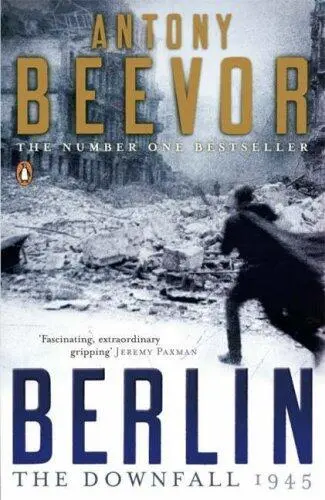
- Название:Berlin: The Downfall 1945
- Автор:
- Издательство:Penguin Books
- Жанр:
- Год:2007
- Город:New York
- ISBN:978-0-141-90302-6
- Рейтинг книги:3 / 5. Голосов: 1
-
Избранное:Добавить в избранное
- Отзывы:
-
Ваша оценка:
Berlin: The Downfall 1945: краткое содержание, описание и аннотация
Предлагаем к чтению аннотацию, описание, краткое содержание или предисловие (зависит от того, что написал сам автор книги «Berlin: The Downfall 1945»). Если вы не нашли необходимую информацию о книге — напишите в комментариях, мы постараемся отыскать её.
Antony Beevor reconstructs the experiences of those millions caught up in the nightmare of the Third Reich's final collapse, telling a terrible story of pride, stupidity, fanatacism, revenge and savagery, but also one of astonishing endurance, self-sacrifice and survival against all odds.
Berlin: The Downfall 1945 — читать онлайн бесплатно полную книгу (весь текст) целиком
Ниже представлен текст книги, разбитый по страницам. Система сохранения места последней прочитанной страницы, позволяет с удобством читать онлайн бесплатно книгу «Berlin: The Downfall 1945», без необходимости каждый раз заново искать на чём Вы остановились. Поставьте закладку, и сможете в любой момент перейти на страницу, на которой закончили чтение.
Интервал:
Закладка:
The failure of mains water meant more dangerous queues. Women waited in line with pails and enamel jugs at their nearest street pump, listening to the constant metallic squeaking from the rusty joint of its handle. They found that they had changed under fire. Swearwords and callous remarks which they would never have uttered before now slipped out quite naturally. ‘Over and over again during these days,’ the same diarist wrote, ‘I’ve been noticing that not only my feelings, but those of almost all women towards men have changed. We are sorry for them, they seem so pathetic and lacking in strength. The weakly sex. A kind of collective disappointment among women seems to be growing under the surface. The male-dominant Nazi world glorifying the strong man is tottering, and with it the myth “man”.’
The Nazi regime, which had never wanted women to be sullied by war, or indeed anything which interfered with child-rearing, now claimed in its desperation that young women were fighting alongside men. On one of the very few radio stations still on the air, there was an appeal to women and girls: ‘Take up the weapons of wounded and fallen soldiers and take part in the fight. Defend your freedom, your honour and your life!’ Germans who heard this appeal far from Berlin were shocked at this ‘most extreme consequence of total war’. Yet only a very few young women took up weapons. Most were auxiliaries attached to the SS. A handful, however, found themselves caught up in the fighting, through either extraordinary circumstances or an ill-judged rush of romanticism. In order to stay with her lover, Ewald von Demandowsky, the actress Hildegard Knef put on uniform and joined him at Schmargendorf, defending the freight yards with his scratch company.
In the cellars of apartment blocks, the different couples from upstairs ate their food avoiding each other’s eyes. It was rather like families in railway compartments on a long journey, consuming picnics in front of each other with a pretence of privacy. Yet when news came through that a barracks nearby had been abandoned, any semblance of civility disappeared. Law-abiding citizens became frenzied looters of the storerooms. It was every man, woman and child for themselves and anything they could grab. Once outside with their boxes, spontaneous bartering began as they eyed each other’s unlawful gains. There was no fixed black-market rate at that time. It depended on caprice or particular need — a loaf of bread for a bottle of schnapps, a torch battery for a block of cheese. Abandoned shops were also plundered. Folk and personal memories from Berlin in the winter of 1918 were strong. This was another generation of ‘hamsters’, storing food for an oncoming catastrophe.
Starvation, however, was not the main danger. Many were simply not prepared for the shock of Russian revenge, however much propaganda they had heard. ‘We had no idea what was going to happen,’ the Lufthansa secretary Gerda Petersohn remembered. Relatives serving as soldiers on the Eastern Front had never mentioned what had been done to the Soviet population. And even when relentless propaganda made Berlin women aware of the danger of rape, many reassured themselves that although it must be a risk out in the countryside, here in the city it could hardly happen on an extensive scale in front of everybody.
Gerda, the nineteen-year-old who had brought back the Luftwaffe malt tablets from the looted railway wagon in Neukölln, saw a certain amount of another girl of her age who lived in the same building. She was called Carmen and had been a member of the Bund deutscher Mädel, the female equivalent of the Hitler Youth. Carmen had pin-up posters of Luftwaffe fighter aces on her bedroom wall and had wept copiously when Molders, the most famous of them all, had been killed.
On the night of 25 April, as the Red Army advanced into Neukölln, it was unusually quiet. The inhabitants of the building were sheltering in the cellar. They then felt the vibration from a tank coming down their street. Soon afterwards, a draught of fresh air which made the candles flicker told them that the door had been opened. The first Russian word they heard was ‘ Stoi!’ A soldier from Central Asia armed with a sub-machine gun came in and took their rings, watches and jewellery. Gerda’s mother had hidden Gerda under a pile of laundry. Another young soldier came in later and indicated to Gerda’s sister that he wanted her to come with him, but she put her child on her lap and looked down. The soldier told a man in the cellar to tell her to do as she was told, but the man pretended not to understand. The soldier wanted to take her into a little room adjacent to the cellar. He kept pointing, but she kept the baby on her lap and did not move. The baffled young soldier lost his nerve and left abruptly.
When the morning of 26 April came, they emerged to find that they had got off very lightly. They heard terrible stories of what had happened during the night. A butcher’s daughter aged fourteen had been shot when she resisted. Gerda’s sister-in-law, who lived a short distance away, had been gang-raped by soldiers and the whole family had decided to hang themselves. The parents died, but Gerda’s sister-in-law was cut down by a neighbour and brought to the Petersohn apartment. They all saw the rope marks round her neck. The young woman was beside herself when she recognized her surroundings and realized that her parents had died and she had been saved.
The next night, the families in the house decided to avoid the cellar. They would all pack into one sitting room to find safety in numbers. Over twenty women and children assembled there. Frau Petersohn grabbed the chance to hide Gerda, her other daughter and her daughter-in-law under a table with a long cloth reaching almost to the floor. It was not long before Gerda heard Russian voices and then saw Red Army boots so close to the table that she could have reached out to touch them. The soldiers dragged three young women from the room. One of them was Carmen. Gerda heard her screams. She felt so strange because Carmen was screaming her name and she did not know why. The screams eventually dissolved into sobbing.
While the soldiers were still occupied with their victims, Frau Petersohn made up her mind. ‘They’ll be back,’ she murmured to the three of them under the table. She told them to follow her and led them rapidly upstairs to the bomb-damaged top floor, where an old woman still lived. Gerda spent the night huddled on the balcony, determined to jump to her death if the Russians came for them. But their immediate worry was how to keep her sister’s baby from crying. Gerda suddenly remembered the Luftwaffe malt tablets. Whenever the baby became restless, they slipped a malt tablet in her mouth. When dawn came, they saw that the baby’s face was smeared with brown, but the tactic had worked.
Mornings were safe, with Soviet soldiers either sleeping off their debauches or returned to the fighting, so they crept back down to their own apartment. There, in a grotesque version of Goldilocks, they found that their beds had been used by the soldiers for their activities. The sisters also discovered their brother’s Wehrmacht uniform laid out carefully on the floor and defecated upon.
Gerda sought out Carmen to try to offer some sort of sympathy, but also in the hope of discovering why she had screamed out her name again and again. The moment Carmen set eyes on her, Gerda saw a bitter hostility. Carmen’s attitude immediately became clear. ‘Why me and why not you?’ That was why she had yelled her name. The two never spoke to each other again.
Although there appears to have been a fairly general pattern, the course of events when Soviet troops arrived was never predictable. In another district, frightened civilians heard a bang on the door of their bunker after the sound of fighting died away. Then a Red Army soldier armed with a sub-machine gun entered. ‘ Tag, Russki!’ he greeted them cheerily, and went away without even taking their watches. Another lot of soldiers two hours later were more aggressive. They grabbed Klaus Boeseler, a fourteen-year-old boy who was just over six foot one and had blond hair. ‘ Du SS!’ one of them shouted. It was more of a statement than a question. They seemed so determined to execute him that he was terrified. But the others in the cellar eventually managed to persuade the soldiers by sign language that he was in fact a schoolboy.
Читать дальшеИнтервал:
Закладка:
Похожие книги на «Berlin: The Downfall 1945»
Представляем Вашему вниманию похожие книги на «Berlin: The Downfall 1945» списком для выбора. Мы отобрали схожую по названию и смыслу литературу в надежде предоставить читателям больше вариантов отыскать новые, интересные, ещё непрочитанные произведения.









Обсуждение, отзывы о книге «Berlin: The Downfall 1945» и просто собственные мнения читателей. Оставьте ваши комментарии, напишите, что Вы думаете о произведении, его смысле или главных героях. Укажите что конкретно понравилось, а что нет, и почему Вы так считаете.