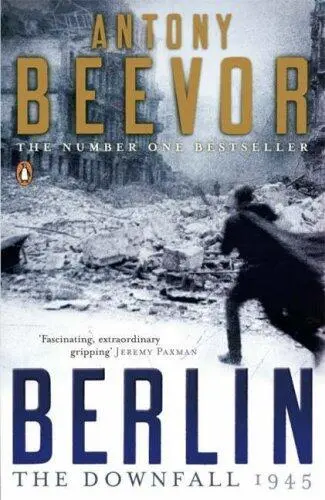
Antony Beevor - Berlin - The Downfall 1945
Здесь есть возможность читать онлайн «Antony Beevor - Berlin - The Downfall 1945» весь текст электронной книги совершенно бесплатно (целиком полную версию без сокращений). В некоторых случаях можно слушать аудио, скачать через торрент в формате fb2 и присутствует краткое содержание. Город: New York, Год выпуска: 2007, ISBN: 2007, Издательство: Penguin Books, Жанр: nonf_military, История, на английском языке. Описание произведения, (предисловие) а так же отзывы посетителей доступны на портале библиотеки ЛибКат.
- Название:Berlin: The Downfall 1945
- Автор:
- Издательство:Penguin Books
- Жанр:
- Год:2007
- Город:New York
- ISBN:978-0-141-90302-6
- Рейтинг книги:3 / 5. Голосов: 1
-
Избранное:Добавить в избранное
- Отзывы:
-
Ваша оценка:
Berlin: The Downfall 1945: краткое содержание, описание и аннотация
Предлагаем к чтению аннотацию, описание, краткое содержание или предисловие (зависит от того, что написал сам автор книги «Berlin: The Downfall 1945»). Если вы не нашли необходимую информацию о книге — напишите в комментариях, мы постараемся отыскать её.
Antony Beevor reconstructs the experiences of those millions caught up in the nightmare of the Third Reich's final collapse, telling a terrible story of pride, stupidity, fanatacism, revenge and savagery, but also one of astonishing endurance, self-sacrifice and survival against all odds.
Berlin: The Downfall 1945 — читать онлайн бесплатно полную книгу (весь текст) целиком
Ниже представлен текст книги, разбитый по страницам. Система сохранения места последней прочитанной страницы, позволяет с удобством читать онлайн бесплатно книгу «Berlin: The Downfall 1945», без необходимости каждый раз заново искать на чём Вы остановились. Поставьте закладку, и сможете в любой момент перейти на страницу, на которой закончили чтение.
Интервал:
Закладка:
The two journalists, exhilarated by their exploit, returned to Torgau the next day. Tully described it as ‘the craziest thing I have ever done’. Clearly, he had never imagined the wider consequences. The US military authorities were furious, but not as angry as the Soviet authorities. This was demonstrated by the signals which flashed between Rheims, Washington, DC, and Moscow. An exasperated Eisenhower decided that because they had entered Berlin illegally, their stories could not be published unless submitted to Moscow for censorship. When events were moving so fast, this, of course, meant that they would be well out of date by the time they could appear. Eisenhower was especially irritated because he believed that their jaunt to Berlin had wrecked the proposal to get other journalists there for the surrender. But the people who probably suffered the most were the trusting Russians who had helped and entertained Tully and Irwin. Apparently, even officers involved in the celebrations at Torgau became objects of suspicion to the NKVD in the post-war purges, because they had been in contact with capitalist foreigners.
Stalin wanted Berlin surrounded as rapidly as possible with a cordon sanitaire. This meant the urgent occupation of all the territory up to the Elbe which had been allocated as part of the future Soviet zone. Konev’s armies not involved in the attack on Berlin or the fight against the Ninth and Twelfth Armies were pushed westwards. The Elbe was reached during the course of 24 and 25 April at numerous points other than Torgau. Units of the 5th Guards Army, the 32nd Guards Rifle Corps commanded by General Rodimtsev of Stalingrad fame and the 4th Guards Tank Corps also reached the river. General Baranov’s Ist Guards Cavalry Corps went one further. At the special request of Stalin’s cavalry chum Marshal Semyon Budenny, Konev had given him a specific task. Soviet intelligence had heard that the stallions of the Soviet Union’s most important stud farm in the northern Caucasus, shipped back to Germany in 1942, were held west of the Elbe near Riesa. The guards cavalry crossed the river, located them and drove them back. It could have been a border raid across the Rio Grande.
To satisfy Stalin’s impatience for details on Berlin, General Serov, the NKVD representative with the 1st Belorussian Front, provided an immensely detailed report of conditions in the city. Beria had it on Stalin’s desk on 25 April. Serov observed that the destruction was far worse towards the centre of the city, where many buildings were still blazing from Soviet artillery fire. ‘On the walls of many buildings one frequently sees the word “Pst” [i.e. silence] written in big letters.’ Berliners apparently explained that it was an attempt by the Nazi government to suppress criticism of its military efforts at a time of crisis. Berliners were already asking questions about the new form of government to be established in the city. Yet ‘out of ten Germans asked if they could act as local bürgermeister, not a single one agreed, producing different insignificant excuses,’ he wrote. ‘They seem to be afraid of the consequences and fear to take on the job. It is therefore necessary to select bürgermeisters from among the prisoners of war who come from Berlin held in our camps.’ These, no doubt, were selected anti-fascists who had received the relevant political training.
‘Interrogation of captured Volkssturm members revealed an interesting fact. When they were asked why there are no regular soldiers and officers among them, they said that they were afraid of their responsibility for what they had done in Russia. They will therefore surrender to the Americans, while the Volkssturm can surrender to the Bolsheviks because they are guilty of nothing.’ Serov wasted no time putting in place cordons in and around Berlin, using the 105th, 157th and 333rd NKVD Frontier Guards Regiments.
Serov was perhaps most surprised by the state of Berlin’s defences. ‘No serious permanent defences have been found inside the ten- to fifteen-kilometre zone around Berlin. There are fire-trenches and gun-pits and the motorways are mined in certain sections. There are some trenches just as one comes to the city, but less in fact than any other city taken by the Red Army.’ Interrogations of Volkssturm men revealed how few regular troops there were in the city, how little ammunition there was and how reluctant the Volkssturm was to fight. Serov discovered also that German anti-aircraft defence had almost ceased to function, thus allowing Red Army aviation a clear sweep over the city. All of these observations were naturally kept secret. Soviet propaganda accounts had to emphasize what a formidable foe they faced in Berlin.
Serov indicated, while avoiding any politically controversial remarks, the reason for continued German resistance. ‘It became clear from interrogating prisoners and civilians that there is still a great fear of the Bolsheviks.’ Beria, with interesting logic, used the need to change ‘the attitude of Red Army troops towards German prisoners and the civilian population’ as the basis for an overhaul of the military administration of civilian affairs. He recommended that, ‘in order to create a normal atmosphere in the rear of the operational Red Army on German territory’, a new deputy Front commander should be appointed for civilian affairs. Needless to say, the deputy Front commander in each case was the resident NKVD chief — Serov for the 1st Belorussian Front, General Meshik for the Ist Ukrainian Front and Tsanava for the 2nd Belorussian Front. It should be a guiding principle ‘that the deputy Front commander is at the same time a representative of the NKVD of the USSR and is responsible to the NKVD of the USSR for the work on removing enemy elements’. He did not need to add the key point. They owed no responsibility to the military chain of command, at a time when both Stalin and Beria were afraid of triumphant generals.
The need for action was justified by the fact that the Americans were already prepared to administer their zone of occupation, while the Soviet Union had done nothing. For your information: on the territory of west Germany, the Allies have established the position of special deputy of commander of Allied troops in charge of civilian affairs. Major General Lucius Clay, who until appointed to this position, was deputy chief of the bureau of mobilizing military resources of the USA.’ Beria was evidently impressed to hear that he would have 3,000 specially trained officers serving under him, ‘with economic and administrative experience’. Their Soviet counterparts, with the emphasis on NKVD control, clearly were to have very different qualifications. The report ended in the usual style: ‘I request a decision. Beria.’
21. Fighting in the City
The civilians to be administered by Beria’s deputies had little idea of the realities of Soviet rule. They also had more urgent preoccupations as the battle was fought out on their streets, in their apartments and even through the cellars in which they sheltered. The only benefit in the early hours of Thursday 26 April was a thunderstorm, with such heavy rain that it put out some of the fires. Strangely enough, that seemed to increase the smell of burning, not diminish it.
Civilian casualties had been heavy already. Like Napoleonic infantry, the women standing in line for food simply closed ranks after a shellburst decimated a queue. Nobody dared lose their place. Some claimed that women just wiped the blood from their ration cards and stuck it out. ‘There they stand like walls,’ noted a woman diarist, ‘those who not so long ago dashed into bunkers the moment three fighter planes were announced over central Germany.’ Women queued for a handout of butter and dry sausage, while men emerged only to line up for an issue of schnapps. It seemed to be symbolic. Women were concerned with the immediacy of survival while men needed escape from the consequences of their war.
Читать дальшеИнтервал:
Закладка:
Похожие книги на «Berlin: The Downfall 1945»
Представляем Вашему вниманию похожие книги на «Berlin: The Downfall 1945» списком для выбора. Мы отобрали схожую по названию и смыслу литературу в надежде предоставить читателям больше вариантов отыскать новые, интересные, ещё непрочитанные произведения.








Обсуждение, отзывы о книге «Berlin: The Downfall 1945» и просто собственные мнения читателей. Оставьте ваши комментарии, напишите, что Вы думаете о произведении, его смысле или главных героях. Укажите что конкретно понравилось, а что нет, и почему Вы так считаете.