Antony Beevor - Berlin - The Downfall 1945
Здесь есть возможность читать онлайн «Antony Beevor - Berlin - The Downfall 1945» весь текст электронной книги совершенно бесплатно (целиком полную версию без сокращений). В некоторых случаях можно слушать аудио, скачать через торрент в формате fb2 и присутствует краткое содержание. Город: New York, Год выпуска: 2007, ISBN: 2007, Издательство: Penguin Books, Жанр: nonf_military, История, на английском языке. Описание произведения, (предисловие) а так же отзывы посетителей доступны на портале библиотеки ЛибКат.
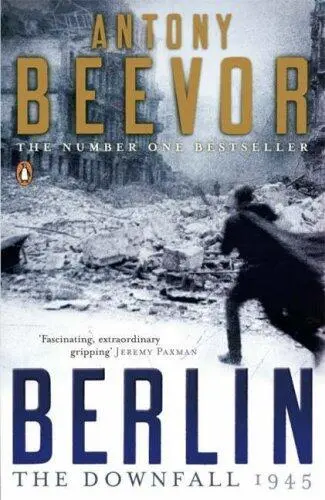
- Название:Berlin: The Downfall 1945
- Автор:
- Издательство:Penguin Books
- Жанр:
- Год:2007
- Город:New York
- ISBN:978-0-141-90302-6
- Рейтинг книги:3 / 5. Голосов: 1
-
Избранное:Добавить в избранное
- Отзывы:
-
Ваша оценка:
Berlin: The Downfall 1945: краткое содержание, описание и аннотация
Предлагаем к чтению аннотацию, описание, краткое содержание или предисловие (зависит от того, что написал сам автор книги «Berlin: The Downfall 1945»). Если вы не нашли необходимую информацию о книге — напишите в комментариях, мы постараемся отыскать её.
Antony Beevor reconstructs the experiences of those millions caught up in the nightmare of the Third Reich's final collapse, telling a terrible story of pride, stupidity, fanatacism, revenge and savagery, but also one of astonishing endurance, self-sacrifice and survival against all odds.
Berlin: The Downfall 1945 — читать онлайн бесплатно полную книгу (весь текст) целиком
Ниже представлен текст книги, разбитый по страницам. Система сохранения места последней прочитанной страницы, позволяет с удобством читать онлайн бесплатно книгу «Berlin: The Downfall 1945», без необходимости каждый раз заново искать на чём Вы остановились. Поставьте закладку, и сможете в любой момент перейти на страницу, на которой закончили чтение.
Интервал:
Закладка:
As they escaped north up the Hermannstrasse, they saw scrawled on a house wall ‘SS traitors extending the war!’ There was no doubt in their minds as to the culprits: ‘German Communists at work. Were we going to have to fight against the enemy within as well?’
Soon Soviet tanks were also attacking the remains of the Müncheberg Panzer Division on Tempelhof aerodrome amid the wrecked fuselages of Focke-Wulf fighters. The aircraft’s Red Army nickname of a ‘frame’ at last seemed entirely accurate. The boom and crack of artillery and tank fire, punctuated by screaming salvoes of katyushas, extended right up to the Nordland command post. Krukenberg was lightly wounded in the face by a shell splinter.
With Neukölln heavily penetrated by Soviet combat groups, Krukenberg prepared a fall-back position round the Hermannplatz. The twin towers of the Karstadt department store provided excellent observation posts for watching the advance of four Soviet armies — the 5th Shock Army from Treptow Park, the 8th Guards Army and the Ist Guards Tank Army from Neukölln and Konev’s 3rd Guards Tank Army from Mariendorf.
Krukenberg positioned half of the French under Fenet on the other side of the Hermannplatz with their panzerfausts to prepare for a Soviet tank attack. Fenet had over 100 Hitler Youth attached to his group. They were instructed to fire their panzerfausts only at close range and only at the turret. The Waffen SS believed that it was better to aim for the turret, as a direct hit there would disable the crew.
During that evening and night, the French under Fenet accounted for fourteen Soviet tanks. A determined show of resistance could take the Soviets by surprise and hold them back. By the Halensee bridge at the western end of the Kurfürstendamm, three young men from a Reich Labour Service battalion armed with a single machine gun managed to beat back all attacks for forty-eight hours.
The battle for Tempelhof aerodrome was to continue for another day, with Soviet artillery and katyusha rocket launchers blasting the administrative buildings. Inside, the corridors echoed with the screams of the wounded and were filled with smoke and the smell of burning chemicals. ‘The silence which followed the end of a bombardment was a prelude to the roar of engines and rattle of tracks which announced a new tank attack.’
As Weidling’s battered corps retreated towards the centre on that afternoon of 25 April, Hitler insisted to their commander, who had been summoned to the Führer bunker, that things would change for the better. ‘The situation must improve,’ he told Weidling. ‘From the south-west the Twelfth Army of General Wenck will come to Berlin and, together with the Ninth Army, will deliver a crushing blow to the enemy. The troops commanded by Schörner will come from the south. These blows should change the situation to our advantage.’ To underline the disaster along the whole Eastern Front, General von Manteuffel had just reported that Rokossovsky’s 2nd Belorussian Front had shattered his defence lines south of Stettin. Major General Dethleffsen of the OKW command staff also had to visit the Führer bunker that day and found ‘a self-deception bordering on hypnosis’.
That evening, Krukenberg was warned by General Krebs that the Nordland would be pulled back the next day to defence sector ‘Z’ (for Zentrum). This was directed from the air ministry on the Wilhelm-strasse, a block north of Gestapo headquarters. Krukenberg, when he went back to make contact, found the cellars full of unsupervised Luftwaffe personnel doing nothing. He went up to the state opera house on the Unter den Linden, a few hundred metres down from the abandoned Soviet embassy. It was where Dekanozov had returned just after dawn on 22 June 1941 after hearing from Ribbentrop of the Wehrmacht’s invasion of the Soviet Union. Now, the Unter den Linden was empty as far as the eye could see. Krukenberg set up his own headquarters in the cellars of the opera house. A huge, throne-like armchair from the former royal box provided him with the opportunity to snatch a couple of hours’ sleep in comfort. They were left in comparative peace by the enemy. No U-2 biplanes dropping small bombs appeared over their sector that night.
With the fall of Berlin imminent, SHAEF headquarters at Rheims forwarded a request to the Stavka in Moscow that day. ‘General Eisenhower desires to send a minimum of twenty-three Allied accredited war correspondents to Berlin following the capture of the city by the Red Army. He wishes to send more than that number if at all possible since, as he states, “the fall of Berlin will be one of the world’s greatest news events”.’ There was no reply from the Kremlin. Stalin clearly did not want any journalists in Berlin, particularly the uncontrollable western variety. He was, however, to be troubled by them from a totally unexpected direction.
During that day the main Nazi broadcasting station, Deutsch-landsender, fell silent, but the date of 25 April became known for an event which was soon flashed around the world. At Torgau on the Elbe, leading elements of Major General Vladimir Rusakov’s 58th Guards Rifle Division met up with US soldiers from the 69th Division. Nazi Germany was cut in half. Signals flashed up both chains of command — to Bradley, then Eisenhower at SHAEF, and to Konev, then General Antonov at the Stavka. Heads of state were immediately informed and then Stalin and Truman exchanged telegrams agreeing on the announcement of the event. Eisenhower’s first reaction was to send in the journalists, a decision he soon had cause to regret.
General Gleb Vladimirovich Baklanov, the commander of the 34th Corps, ordered the preparation of a typical Soviet banquet. The political department provided huge lengths of red material to decorate tables and podiums. Large portraits of Stalin were erected and rather smaller ones of Truman improvised, along with some interesting variations on the stars and stripes. Plenty of alcohol was laid on, and all the most attractive women soldiers in the 5th Guards Army were sent forward to Torgau in fresh uniforms.
General Baklanov was prepared for the usual round of Soviet toasts to victory, to peace and friendship between nations and the eternal destruction of the fascist beast. He was unprepared, however, for a group of boisterous American journalists keen to put a real swing into the celebrations. Red Army soldiers also obtained a good ration of vodka, so security was not quite as effective as usual.
Halfway through the proceedings, when Russian officers were dancing ‘with the pretty Russian women soldiers’, Andrew Tully of the Boston Traveller ‘remarked jokingly’ to Virginia Irwin of the St Louis Post Dispatch, ‘Let’s keep going to Berlin.’ ‘OK,’ she said. They slipped away from the party and drove their jeep to the Elbe, where they showed the Russian soldiers operating the ferry their SHAEF identification cards. They shouted ‘Jeep!’ and made swimming motions. Rather bewildered sentries, who had received no instructions on the subject, let them drive on to the ferry and sent it across the river.
The two journalists had a map which reached as far as Luckenwalde. Fearing that they might be ‘summarily treated as spies’ on such a fluid front, they stole one of the improvised American flags which the Russians had erected at Torgau and tied it to the side of the jeep. Whenever they were flagged down by a suspicious sentry or a traffic controller, they yelled ‘Amerikansky!’ with an amiable grin. ‘Keep smiling,’ Tully told Virginia Irwin.
They reached Berlin before nightfall and there they met Major Kovalesky, a young man with snow-white hair. They communicated through halting French. Kovalesky was at first suspicious, but was then convinced when they said, ‘ Nous sommes correspondents de guerre. Nous voulons aller [à] Berlin.’ The unfortunate Kovalesky, having no idea that their trip was unauthorized and that he might be held accountable later, took them to his command post in a half-ruined house. With typical Russian hospitality, he told his orderly, ‘a fierce Mongolian with a great scar on his left cheek’, to provide hot water for their guests. A quarter-full bottle of eau-de-Cologne, a cracked mirror and some face powder were also brought for Virginia Irwin. He then gave orders for a banquet. The table was lit by candles on upturned milk bottles, spring flowers were placed in a jar and the celebration began, with smoked salmon, black Russian bread, mutton cooked over charcoal, ‘huge masses of mashed potato with meat fat poured over them’, cheese and platterfuls of Russian pastries. ‘At each toast, the Russian officers stood up, clicked their heels, bowed deeply and drained tumblers of vodka. Besides vodka, there was cognac and a drink of dynamite strength the major described simply as “spirits”.’ After each course there were toasts ‘to the late and great President Roosevelt, to Stalin, to President Truman, to Churchill, to the Red Army and to the American jeep’.
Читать дальшеИнтервал:
Закладка:
Похожие книги на «Berlin: The Downfall 1945»
Представляем Вашему вниманию похожие книги на «Berlin: The Downfall 1945» списком для выбора. Мы отобрали схожую по названию и смыслу литературу в надежде предоставить читателям больше вариантов отыскать новые, интересные, ещё непрочитанные произведения.







Обсуждение, отзывы о книге «Berlin: The Downfall 1945» и просто собственные мнения читателей. Оставьте ваши комментарии, напишите, что Вы думаете о произведении, его смысле или главных героях. Укажите что конкретно понравилось, а что нет, и почему Вы так считаете.