Antony Beevor - Berlin - The Downfall 1945
Здесь есть возможность читать онлайн «Antony Beevor - Berlin - The Downfall 1945» весь текст электронной книги совершенно бесплатно (целиком полную версию без сокращений). В некоторых случаях можно слушать аудио, скачать через торрент в формате fb2 и присутствует краткое содержание. Город: New York, Год выпуска: 2007, ISBN: 2007, Издательство: Penguin Books, Жанр: nonf_military, История, на английском языке. Описание произведения, (предисловие) а так же отзывы посетителей доступны на портале библиотеки ЛибКат.
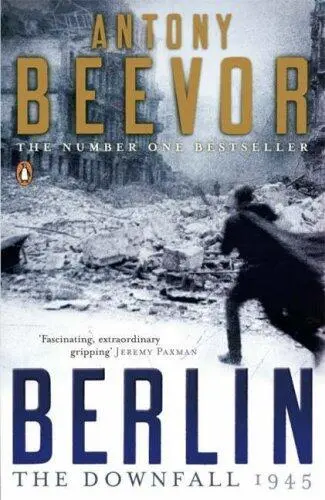
- Название:Berlin: The Downfall 1945
- Автор:
- Издательство:Penguin Books
- Жанр:
- Год:2007
- Город:New York
- ISBN:978-0-141-90302-6
- Рейтинг книги:3 / 5. Голосов: 1
-
Избранное:Добавить в избранное
- Отзывы:
-
Ваша оценка:
Berlin: The Downfall 1945: краткое содержание, описание и аннотация
Предлагаем к чтению аннотацию, описание, краткое содержание или предисловие (зависит от того, что написал сам автор книги «Berlin: The Downfall 1945»). Если вы не нашли необходимую информацию о книге — напишите в комментариях, мы постараемся отыскать её.
Antony Beevor reconstructs the experiences of those millions caught up in the nightmare of the Third Reich's final collapse, telling a terrible story of pride, stupidity, fanatacism, revenge and savagery, but also one of astonishing endurance, self-sacrifice and survival against all odds.
Berlin: The Downfall 1945 — читать онлайн бесплатно полную книгу (весь текст) целиком
Ниже представлен текст книги, разбитый по страницам. Система сохранения места последней прочитанной страницы, позволяет с удобством читать онлайн бесплатно книгу «Berlin: The Downfall 1945», без необходимости каждый раз заново искать на чём Вы остановились. Поставьте закладку, и сможете в любой момент перейти на страницу, на которой закончили чтение.
Интервал:
Закладка:
Most of the occupants of the bunker did not have anything to do. They sat around drinking and loitered in the corridors discussing whether suicide was better by gun or by cyanide. It seemed generally assumed that hardly anybody was going to leave the bunker alive. Although cool and damp, conditions in the bunker were still infinitely better than in any other cellar or air-raid shelter in Berlin. The occupants had water and electric light from generators, and there was no shortage of food and drink. The kitchens up in the Reich Chancellery were still serviceable and constant meals of stew were served.
Berliners now referred to their city as the ‘ Reichsscheiterhaufen’ — the ‘Reich’s funeral pyre’. Civilians were already suffering casualties in the street-fighting and house-clearing. Captain Ratenko, an officer from Tula in Bogdanov’s 2nd Guards Tank Army, knocked at a cellar door in Reinickendorf, a district in the north-west. Nobody opened it, so he kicked it in. There was a burst of sub-machine-gun fire and he was killed. The soldiers from the 2nd Guards Tank Army who were with him started firing through the door and the windows. They killed the gunman, apparently a young Wehrmacht officer in civilian clothes, but also a woman and a child. ‘The building was then surrounded by our men and burned down,’ the report stated.
SMERSH took an immediate interest in the question of concealed Wehrmacht officers. It set up a special hunting group, with a bloodhound who had been a Nazi Party member since 1927. He promised to find officers for them, no doubt in exchange for his own life. Altogether they took twenty, including a colonel. ‘Another officer killed his wife then committed suicide when SMERSH knocked at his door,’ the report stated.
Red Army soldiers decided to use the telephone network, but for amusement rather than information. While searching apartments, they would often stop to ring numbers in Berlin at random. Whenever a German voice answered, they would announce their presence in unmistakable Russian tones. This ‘surprised the Berliners immensely’, a political officer wrote. It was also not long before the political department of the 5th Shock Army began to report on ‘abnormal phenomena’, which covered everything from looting to injuries from drunken driving, and ‘immoral phenomena’.
Many of the true frontoviki behaved well. When a detachment of sappers from the 3rd Shock Army entered an apartment, a ‘small babushka’ told them that her daughter was ill in bed. She was almost certainly trying to protect her from rape, but the sappers did not seem to realize this. They just gave them some food and moved on. Other frontoviki, however, could be pitiless. This has been described as the effect of the ‘impersonal violence of war itself’ and a compulsion to treat women as ‘substitutes for the defeat of an enemy’. One historian noted that Soviet troops unleashed a wave of violence which then passed fairly rapidly, but the process often began again as soon as a new unit moved in.
On 24 April, the 3rd Shock Army used its 5th Artillery Breakthrough Division on one narrow sector where the Germans had resisted bitterly. The heavy guns destroyed seventeen houses, killing 120 defenders. The Soviet attackers claimed that in four of these houses, Germans had put out white flags of surrender and then fired again later. This became a frequent event in the fighting. Some soldiers, especially the Volkssturm, wanted to surrender and surreptitiously waved a white handkerchief, but more fanatical elements still fought on.
The Germans mounted a counter-attack with three assault guns, but this was apparently thwarted by the heroism of reconnaissance soldier Shulzhenok. Shulzhenok, having retrieved three panzerfausts, took up position in a ruined house. A German shell exploded close to him, deafening him and covering him with debris. This did not stop him from engaging the assault guns as they approached. He set the first one on fire and damaged the second. The third withdrew hurriedly. He was made a Hero of the Soviet Union for this action, but on the following day he ‘was killed by a terrorist in civilian clothes’. In the conditions of the time, this could mean an ill-equipped member of the Volkssturm, but the Soviet view of terrorists was little different from the Wehrmacht definition during Operation Barbarossa.
Not far behind these events, the writer Vasily Grossman stopped his jeep in the Weissensee district of north-east Berlin on the axis of the 3rd Shock Army. In a moment the jeep was surrounded by boys asking for sweets and staring curiously at the map open on his knees. Grossman was surprised by their daring. He really wanted to look around. ‘What contradicts our idea of Berlin as a military barracks are the masses of gardens and allotments in blossom,’ he noted. ‘A great thunder of artillery in the sky. In the moments of silence one can hear birds.’
The dawn of 25 April, as Krukenberg left the battered Reich Chancellery, was cold with a clear sky. West Berlin was still strangely quiet and empty. At Weidling’s headquarters on the Hohenzollerndamm, security was lax. Only pay-books were required as identity by the sentries. Weidling told him how his badly mauled panzer corps was split up to stiffen Hitler Youth detachments and badly armed Volkssturm units, none of which could be expected to fight fiercely. Krukenberg was to take over Defence Sector C in the south-east of Berlin, including the 11th SS Panzergrenadier Nordland Division. He received the impression that Ziegler, who was being relieved of command of the Nordland, was accused of not holding his men together.
Accounts of Ziegler’s dismissal vary considerably. Weidling’s chief of staff, Colonel Refior, believed that ‘Ziegler had secret orders from Himmler ordering him to pull back to Schleswig-Holstein’, and this was why he was arrested. Ziegler certainly seemed to be one of the few SS commanders who saw the pointlessness of fighting on. Shortly before his removal, Ziegler had given Hauptsturmführer Pehrsson leave to go to the Swedish Embassy to find out whether its officials would refuse to offer help to the remaining Swedes to return home.
One eyewitness claims that Ziegler was arrested late that morning at his headquarters on the Hasenheidestrasse just north of Tempelhof aerodrome by an unknown SS Brigadeführer. He was backed by an escort with machine pistols who sealed the approaches to divisional headquarters. Ziegler was escorted out to the vehicle. He saluted his astonished officers standing at the entrance and presented his compliments to them: ‘ Meine Herren, alies Gute!’ He was driven away under arrest to the Reich Chancellery. ‘What the hell’s going on?’ one of the officers, Sturmbannführer Vollmer, exclaimed. ‘Are we now without a commander?’ Krukenberg, in his account, depicts an entirely normal handover of command, with Ziegler driving off on his own to the Reich Chancellery.
In any case, the interregnum did not last long. Shortly after midday, Krukenberg arrived, followed a little later by Fenet’s men from the ‘Charlemagne’ battalion. Krukenberg was shaken to learn that the ‘Norge’ and ‘Danmark’ Panzergrenadier Regiments now amounted between them to little more than a battalion. The wounded, taken to the dressing station in a storage cellar on the Hermannplatz, were unlikely to feel in safe hands. They were ‘laid on a blood-smeared table as if it were a butcher’s block’.
The last remaining German bridgehead south of the Teltow Canal at Britz was being abandoned in a panic just as Krukenberg reached his new command. The remnants of his ‘Norge’ and ‘Danmark’ regiments were waiting impatiently by the canal for motor transport, which was having difficulty getting to them through the rubble-blocked streets. Just as the trucks finally arrived, a cry of alarm was heard: ‘ Panzer durchgebrochen!’ This cry prompted a surge of ‘tank fright’ even among hardened veterans and a chaotic rush for the vehicles, which presented an easy target for the two T-34S that had broken through. The trucks that got away even had men clinging on to the outsides.
Читать дальшеИнтервал:
Закладка:
Похожие книги на «Berlin: The Downfall 1945»
Представляем Вашему вниманию похожие книги на «Berlin: The Downfall 1945» списком для выбора. Мы отобрали схожую по названию и смыслу литературу в надежде предоставить читателям больше вариантов отыскать новые, интересные, ещё непрочитанные произведения.









Обсуждение, отзывы о книге «Berlin: The Downfall 1945» и просто собственные мнения читателей. Оставьте ваши комментарии, напишите, что Вы думаете о произведении, его смысле или главных героях. Укажите что конкретно понравилось, а что нет, и почему Вы так считаете.