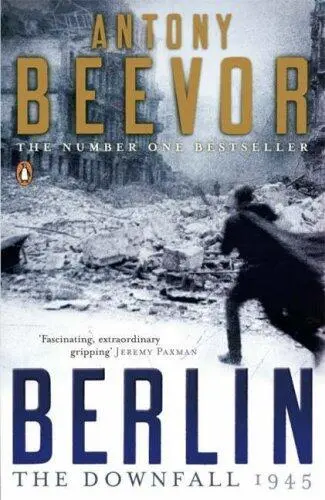
Antony Beevor - Berlin - The Downfall 1945
Здесь есть возможность читать онлайн «Antony Beevor - Berlin - The Downfall 1945» весь текст электронной книги совершенно бесплатно (целиком полную версию без сокращений). В некоторых случаях можно слушать аудио, скачать через торрент в формате fb2 и присутствует краткое содержание. Город: New York, Год выпуска: 2007, ISBN: 2007, Издательство: Penguin Books, Жанр: nonf_military, История, на английском языке. Описание произведения, (предисловие) а так же отзывы посетителей доступны на портале библиотеки ЛибКат.
- Название:Berlin: The Downfall 1945
- Автор:
- Издательство:Penguin Books
- Жанр:
- Год:2007
- Город:New York
- ISBN:978-0-141-90302-6
- Рейтинг книги:3 / 5. Голосов: 1
-
Избранное:Добавить в избранное
- Отзывы:
-
Ваша оценка:
Berlin: The Downfall 1945: краткое содержание, описание и аннотация
Предлагаем к чтению аннотацию, описание, краткое содержание или предисловие (зависит от того, что написал сам автор книги «Berlin: The Downfall 1945»). Если вы не нашли необходимую информацию о книге — напишите в комментариях, мы постараемся отыскать её.
Antony Beevor reconstructs the experiences of those millions caught up in the nightmare of the Third Reich's final collapse, telling a terrible story of pride, stupidity, fanatacism, revenge and savagery, but also one of astonishing endurance, self-sacrifice and survival against all odds.
Berlin: The Downfall 1945 — читать онлайн бесплатно полную книгу (весь текст) целиком
Ниже представлен текст книги, разбитый по страницам. Система сохранения места последней прочитанной страницы, позволяет с удобством читать онлайн бесплатно книгу «Berlin: The Downfall 1945», без необходимости каждый раз заново искать на чём Вы остановились. Поставьте закладку, и сможете в любой момент перейти на страницу, на которой закончили чтение.
Интервал:
Закладка:
The SS Sturmführer who had brought Hitler’s message that morning returned at 6 p.m. to General Weidling’s command post under the Bendlerblock. Weidling and his staff were finalizing their plans for the breakout that night which Hitler had authorized. The Sturmführer had brought a message ordering that all plans for a breakout were to be put aside. Weidling was to report at once to the Reich Chancellery.
When Weidling reached the Führer bunker, he was met by Goebbels, Bormann and Krebs. They took him to Hitler’s room, where the couple had committed suicide, and told him that their bodies had been burned and buried in a shell crater in the garden above. Weidling was forced to swear that he would not repeat this news to anybody. The only person in the outside world who was to be informed was Stalin. An attempt would be made that night to arrange an armistice, and General Krebs would inform the Soviet commander so that he could inform the Kremlin.
A rather dazed Weidling rang Colonel Refior in the Bendlerblock headquarters soon afterwards. He said that he could not tell him what had happened but he needed various members of his staff to join him immediately, including Colonel von Dufving, his chief of staff.
Heavy guns continued to thunder away at the Reichstag, less than a kilometre to the north of the Reich Chancellery. Captain Neustroev, the commander of one of the assault battalions, found himself being pestered by sergeants who wanted their platoons to have the honour of being the first into the objective. Each one dreamed of raising the 3rd Shock Army’s red banner over it. Everlasting Soviet glory would be attached to the deed. One banner party was formed entirely from Komsomol members. The banner party selected by the political department for Neustroev’s battalion included a Georgian, picked as ‘a special present to Stalin’. Certain nationalities — such as Chechens, Kalmyks and Crimean Tartars — were rigorously excluded, because it was forbidden to recommend for Hero of the Soviet Union any member of an ethnic group which had been condemned to exile.
Their divisional commander, General Shatilov, who in a moment of misplaced optimism had encouraged Front headquarters to think that the Reichstag had been taken already — the news had been flashed to Moscow — was now ordering his commanders to get a red banner on to the building at any cost. Darkness came early because of the thick smoke, and at around 6 p.m., the three rifle regiments of the 150th Rifle Division charged the building, closely supported by tanks.
The riflemen, finding that the windows and doors had been blocked or bricked up, needed the heavy guns to blast a way in for them. They eventually forced their way through to the main hall, only to discover German defenders firing down at them with panzerfausts or throwing grenades from the stone balconies above. One of the attackers, Senior Lieutenant Belyaev, vividly remembers the splattering of blood on the huge stone columns.
The casualties were terrible, but the Red Army soldiers, using the usual combination of grenade and sub-machine gun, began to fight their way up the broad staircases, firing from behind balustrades. Part of the German garrison — a mixture of sailors, SS and Hitler Youth — withdrew into the basement. The rest conducted a fighting retreat upwards and back along corridors. Fires, ignited by panzerfausts and hand grenades, started in many rooms and soon the great halls began to fill with smoke.
It was like a deadly rugby match. While the loose scrum fought in chaos, two men of the banner group tried to slip past to race for the roof with their red flag. They managed to reach the second floor before they were pinned down by machine-gun fire. The regiment claimed that a second attempt at 10.50 p.m. succeeded and the red flag flew from the cupola of the Reichstag. This version must be treated with extreme caution, since Soviet propaganda was fixated with the idea of the Reichstag being captured by 1 May.
Whatever the exact time, the ‘hoisting of the Red Flag of Victory’ was a superficial gesture at that stage, since even the official accounts acknowledge the ferocity of the fighting, which continued all night. As the Soviet troops fought their way upstairs, the Germans from the cellars attacked them from behind. At one point Lieutenant Klochkov saw a group of his soldiers crouched in a circle as if examining something on the floor. They all suddenly leaped back together and he saw that it was a hole. The group had just dropped grenades in unison on to the heads of unsuspecting Germans on the floor below.
In the centre of Berlin that night the flames in bombarded buildings cast strange shadows and a red glow on the otherwise dark streets. The soot and dust in the air made it almost unbreathable. From time to time there was the thunder of masonry collapsing. And to add to the terrifying effect, searchlight beams moved around above, searching a night sky in which the Luftwaffe had ceased to exist.
An exhausted group of foreign Waffen SS soldiers sought shelter in the cellars of the Hotel Continental. The place was already full of women and children who eyed the battle-worn soldiers uneasily. The manager approached them and asked if they would go instead to the air-raid shelter in the Jakobstrasse. The SS volunteers felt a bitter resentment that they who had been sacrificing their lives were now cold-shouldered. They turned and left. Fighting soldiers found themselves treated as pariahs. They were no longer brave defenders, but a danger. In hospitals, including one of the military Lazarette, nurses immediately confiscated weapons so that when the Russians arrived, they had no excuse to shoot the wounded.
The former commander of the Nordland, Brigadeführer Ziegler, who had been with Mohnke in the Reich Chancellery, suddenly turned up in the Air Ministry on the Wilhelmstrasse. He did not need to be told how desperate the situation was. But then, to everyone’s astonishment, a platoon of just over twenty Waffen SS commanded by a Belgian arrived. They were laughing, wrote another soldier present, ‘as if we had just won the war’. This group had come from a tank-hunting sortie round the Anhalter Bahnhof and claimed that it had now become ‘a tank graveyard’. An extraordinary comradeship of the damned had grown up among the foreign volunteers defending the last bastion of German nationalism. A Nordland section in the Air Ministry contained not just Scandinavians, but also three Latvians and ‘Our two Ivans’, who were no doubt Hiwis absorbed into the fighting ranks.
Colonel Refior in the Bendlerblock received a call from the Reich Chancellery. He was to start sending messages to the Red Army command in Berlin informing them that General Krebs wanted to arrange a time and place for negotiations.
The whole process of arranging a cease-fire on the 8th Guards Army’s sector took from 10 p.m. until the early hours of the next morning, which was already 1 May. General Chuikov gave orders for Krebs’s safe conduct to his headquarters, a semi-suburban house at Schulenburgring, on the west side of Tempelhof aerodrome. Chuikov had been celebrating with the writer Vsevolod Vishnevsky, the poet Dolmatovsky and the composer Blanter, who had been sent to Berlin to compose a victory hymn.
General Krebs, accompanied by Colonel von Dufving and Ober-sturmführer Neilandis, a Latvian acting as Dufving’s interpreter, went to the front line at around 10 p.m. Krebs himself, while remaining an apostle of total resistance, had been brushing up his Russian each day in the privacy of his shaving mirror.
The German plenipotentiaries were brought into Chuikov’s headquarters just before 4 a.m. Blanter, the only member of the merrymakers not in uniform, was pushed into a cupboard. Vishnevsky and Dolmatovsky, who were in uniform as war correspondents, pretended to be staff officers.
Читать дальшеИнтервал:
Закладка:
Похожие книги на «Berlin: The Downfall 1945»
Представляем Вашему вниманию похожие книги на «Berlin: The Downfall 1945» списком для выбора. Мы отобрали схожую по названию и смыслу литературу в надежде предоставить читателям больше вариантов отыскать новые, интересные, ещё непрочитанные произведения.








Обсуждение, отзывы о книге «Berlin: The Downfall 1945» и просто собственные мнения читателей. Оставьте ваши комментарии, напишите, что Вы думаете о произведении, его смысле или главных героях. Укажите что конкретно понравилось, а что нет, и почему Вы так считаете.