Antony Beevor - Berlin - The Downfall 1945
Здесь есть возможность читать онлайн «Antony Beevor - Berlin - The Downfall 1945» весь текст электронной книги совершенно бесплатно (целиком полную версию без сокращений). В некоторых случаях можно слушать аудио, скачать через торрент в формате fb2 и присутствует краткое содержание. Город: New York, Год выпуска: 2007, ISBN: 2007, Издательство: Penguin Books, Жанр: nonf_military, История, на английском языке. Описание произведения, (предисловие) а так же отзывы посетителей доступны на портале библиотеки ЛибКат.
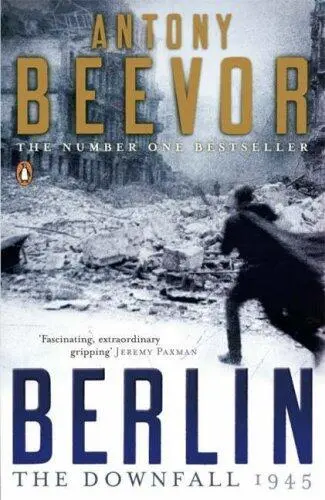
- Название:Berlin: The Downfall 1945
- Автор:
- Издательство:Penguin Books
- Жанр:
- Год:2007
- Город:New York
- ISBN:978-0-141-90302-6
- Рейтинг книги:3 / 5. Голосов: 1
-
Избранное:Добавить в избранное
- Отзывы:
-
Ваша оценка:
Berlin: The Downfall 1945: краткое содержание, описание и аннотация
Предлагаем к чтению аннотацию, описание, краткое содержание или предисловие (зависит от того, что написал сам автор книги «Berlin: The Downfall 1945»). Если вы не нашли необходимую информацию о книге — напишите в комментариях, мы постараемся отыскать её.
Antony Beevor reconstructs the experiences of those millions caught up in the nightmare of the Third Reich's final collapse, telling a terrible story of pride, stupidity, fanatacism, revenge and savagery, but also one of astonishing endurance, self-sacrifice and survival against all odds.
Berlin: The Downfall 1945 — читать онлайн бесплатно полную книгу (весь текст) целиком
Ниже представлен текст книги, разбитый по страницам. Система сохранения места последней прочитанной страницы, позволяет с удобством читать онлайн бесплатно книгу «Berlin: The Downfall 1945», без необходимости каждый раз заново искать на чём Вы остановились. Поставьте закладку, и сможете в любой момент перейти на страницу, на которой закончили чтение.
Интервал:
Закладка:
Apart from Himmler’s betrayal, Hitler’s other great preoccupation remained his fear of being taken alive by the Russians. News had come through of Mussolini’s execution by partisans and how the bodies of the Duce and his mistress, Clara Petacci, had been hoisted upside down in Milan. A transcript of the radio report had been prepared in the special outsize ‘Führer typeface’ which saved Hitler from wearing spectacles. It was presumably Hitler who underlined in pencil the words ‘hanged upside down’. Hitler was in any case determined that his own body should be burned to prevent its exhibition in Moscow. But the historical record also concerned him deeply. His bride was a willing companion in suicide, but if she had not been, he clearly would not have wanted her left alive for interrogation by his enemies. Death had been an inescapable clause in the contract.
During the night, confirmation had been received from Field Marshal Keitel that no relief could be expected. And that morning Brigadeführer Mohnke, following the intense artillery bombardment of the government quarter, warned that they had two days or less. General Weidling, who had arrived in the latter part of the morning, estimated that resistance would collapse that night due to lack of ammunition. He again asked for permission to break out of Berlin. Hitler would not give an immediate answer.
At about the time Weidling was with Hitler, Eva Hitler took Traudl Junge to her room. She presented her with the silver fox fur cape which she would clearly never wear again. Traudl Junge wondered what Hitler and his wife talked about when they were alone. They lacked the subjects of conversation of most newly married couples. She also wondered how she was to escape from the centre of Berlin in a silver fox fur cape. (Hitler’s presents to Eva had certainly improved in recent years. In 1937, his Christmas present to her had been ‘a book on Egyptian tombs’.)
General Weidling, meanwhile, returned to the Bendlerblock. These journeys through the shelling, dashing bent double from ruin to ruin, were exhausting for a man in his fifties. At 1 p.m., no more than an hour after his return, an SS Sturmführer, escorted by a small detachment, arrived from the Reich Chancellery. He handed over a letter. The large envelope had the eagle and swastika and ‘Der Führer’ embossed in gold capitals. Hitler informed Weidling that there was to be absolutely no question of capitulation. A breakout was permitted only if it were to join other combat formations. ‘If they cannot be found, then the fight is to be continued in small groups in the forests’ — the very forests which the Führer had refused to ‘wander about in’. Weidling was elated. One of the Nordland reconnaissance vehicles was sent round from position to position to warn commanders to prepare. They were going to break out westwards via Charlottenburg at 10 that night.
Before lunch, Hitler summoned his personal adjutant, Sturmbannführer Otto Günsche, and gave him careful instructions on the disposal of his corpse and that of his wife. (The very detailed investigation by SMERSH during the first few days of May concluded that Hitler’s chauffeur, Erich Kempka, had received orders on 29 April, the previous day, to send over jerry cans of petrol from the Reich Chancellery garage.) Hitler then had lunch with his dietician, Constanze Manzialy, and his two secretaries, Traudl Junge and Gerda Christian. Eva Hitler, who had presumably lost her appetite, did not join them. Although Hitler appeared quite calm, little conversation was attempted.
After lunch he joined his wife in her bedroom. A little later, they both appeared in the anteroom corridor, where Günsche had assembled the inner circle. Goebbels, Bormann, General Krebs, General Burgdorf and the two secretaries made their final farewells. Magda Goebbels, evidently in a disturbed state, remained in the bunker room, which she had taken over from Dr Morell. Hitler wore his usual attire of ‘black trousers and a grey-green military jacket’, with a white shirt and tie, which distinguished him from other Nazi Party leaders. Eva Hitler wore a dark dress with ‘pink flowers on the front’. Hitler shook hands with his closest associates in a distant manner, then left them.
The lower bunker was then cleared, but instead of sepulchral silence, a loud noise of partying came from upstairs in the Reich Chancellery canteen. Rochus Misch, the SS telephonist, was ordered to ring to stop this levity, but nobody answered. Another guard was sent up to stop the festivities. Günsche and two other SS officers stood in the corridor with instructions to preserve the Führer’s final privacy, but again it was broken, this time by Madga Goebbels begging to see him. She pushed past Günsche as the door was opened, but Hitler sent her away. She returned to her room sobbing.
Nobody seems to have heard the shot that Hitler fired into his own head. Not long after 3.15 p.m., his valet, Heinz Linge, followed by Günsche, Goebbels, Bormann and the recently arrived Axmann, entered Hitler’s sitting room. Others peered over their shoulders before the door was shut in their faces. Günsche and Linge carried Hitler’s corpse, wrapped in a Wehrmacht blanket, out into the corridor and then up the stairs to the Reich Chancellery garden. At some point, Linge managed to take his master’s watch, although it did him little good because he had to get rid of it before Soviet troops took him prisoner. Eva Hitler’s body — her lips were apparently puckered from the poison — was then carried up and laid next to Hitler’s, not far from the bunker exit. The two corpses were then drenched in petrol from the jerry cans. Goebbels, Bormann, Krebs and Burgdorf followed to pay their last respects. They raised their arms in the Hitler salute as a burning torch of paper or rag was dropped on to the two corpses. One of the SS guards, who had been drinking with the party in the canteen, watched from a side door. He hurried down the steps to the bunker. ‘The chief’s on fire,’ he called to Rochus Misch. ‘Do you want to come and have a look?’
The 3rd Shock Army’s SMERSH detachment had received instructions the day before to start making its way towards the government district. They soon discovered that their eventual destination was Hitler’s Reich Chancellery. ‘The information which the intelligence people had was scarce and self-contradictory and unreliable,’ wrote Yelena Rzhevskaya, the SMERSH group interpreter. A reconnaissance company had been allotted the task of taking Hitler alive, but they still did not know for certain whether he was in Berlin. The SMERSH group interrogated a ‘tongue’, but he was just a fifteen-year-old Hitler Youth ‘with bloodshot eyes and cracked lips’. He had been shooting at them, noted Rzhevskaya, ‘now he is sitting here looking around but not understanding anything. Just a boy.’ They had more luck on that evening of 29 April. A nurse was caught trying to get through the lines to her mother. She had pulled off her uniform cap. The day before she had been with the wounded in the Reich Chancellery bunker. She had heard there that Hitler was ‘in the basement’.
Rzhevskaya describes how their American jeep took them through barricades, which had been blasted open, and over tank ditches, partly filled with rubble and empty fuel barrels dropped by advancing tanks. ‘The air thickened as we approached the centre. Anyone who was in Berlin in those days will remember that acrid, fume-laden air, dark with smoke and brick dust, and the constant feeling of grittiness on one’s teeth.’
They soon had to abandon their vehicle because of the shelling and the streets blocked with rubble. Their map of the city proved of little help. Street signs had been destroyed in the shelling, so they had to ask Germans the way. Along their route they encountered signallers crawling through holes in walls, unrolling land-line cables, a hay cart bringing up forage and wounded soldiers being taken to the rear. Above them, sheets and pillowcases hung from windows in a sign of surrender. During heavy shelling, they made their way underground from cellar to cellar. ‘When will this nightmare end?’ German women asked her. In the street, she came across ‘an elderly woman, hatless and with a prominent white armband, taking a little boy and girl across the road. Both of them, their hair neatly combed, were also wearing white armbands. As she passed us, the woman cried out regardless of whether or not she was understood, “They are orphans. Our house has been bombed. I am taking them somewhere else. They are orphans.” ’
Читать дальшеИнтервал:
Закладка:
Похожие книги на «Berlin: The Downfall 1945»
Представляем Вашему вниманию похожие книги на «Berlin: The Downfall 1945» списком для выбора. Мы отобрали схожую по названию и смыслу литературу в надежде предоставить читателям больше вариантов отыскать новые, интересные, ещё непрочитанные произведения.









Обсуждение, отзывы о книге «Berlin: The Downfall 1945» и просто собственные мнения читателей. Оставьте ваши комментарии, напишите, что Вы думаете о произведении, его смысле или главных героях. Укажите что конкретно понравилось, а что нет, и почему Вы так считаете.