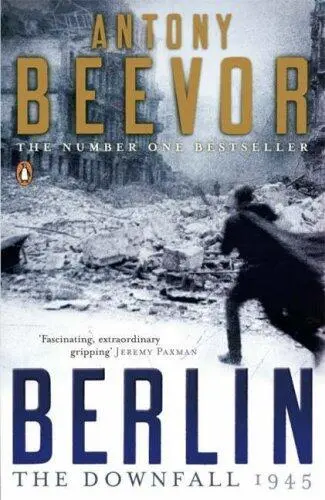
Antony Beevor - Berlin - The Downfall 1945
Здесь есть возможность читать онлайн «Antony Beevor - Berlin - The Downfall 1945» весь текст электронной книги совершенно бесплатно (целиком полную версию без сокращений). В некоторых случаях можно слушать аудио, скачать через торрент в формате fb2 и присутствует краткое содержание. Город: New York, Год выпуска: 2007, ISBN: 2007, Издательство: Penguin Books, Жанр: nonf_military, История, на английском языке. Описание произведения, (предисловие) а так же отзывы посетителей доступны на портале библиотеки ЛибКат.
- Название:Berlin: The Downfall 1945
- Автор:
- Издательство:Penguin Books
- Жанр:
- Год:2007
- Город:New York
- ISBN:978-0-141-90302-6
- Рейтинг книги:3 / 5. Голосов: 1
-
Избранное:Добавить в избранное
- Отзывы:
-
Ваша оценка:
Berlin: The Downfall 1945: краткое содержание, описание и аннотация
Предлагаем к чтению аннотацию, описание, краткое содержание или предисловие (зависит от того, что написал сам автор книги «Berlin: The Downfall 1945»). Если вы не нашли необходимую информацию о книге — напишите в комментариях, мы постараемся отыскать её.
Antony Beevor reconstructs the experiences of those millions caught up in the nightmare of the Third Reich's final collapse, telling a terrible story of pride, stupidity, fanatacism, revenge and savagery, but also one of astonishing endurance, self-sacrifice and survival against all odds.
Berlin: The Downfall 1945 — читать онлайн бесплатно полную книгу (весь текст) целиком
Ниже представлен текст книги, разбитый по страницам. Система сохранения места последней прочитанной страницы, позволяет с удобством читать онлайн бесплатно книгу «Berlin: The Downfall 1945», без необходимости каждый раз заново искать на чём Вы остановились. Поставьте закладку, и сможете в любой момент перейти на страницу, на которой закончили чтение.
Интервал:
Закладка:
‘Sunday 29 April,’ wrote Martin Bormann in his diary. ‘The second day which has started with a hurricane of fire. During the night of 28–29 April, the foreign press wrote about Himmler’s offer of capitulation. The wedding of Hitler and Eva Braun. Führer dictates his political and private wills. Traitors Jodl, Himmler and the generals abandon us to the Bolsheviks. Hurricane fire again. According to the information of the enemy, the Americans have broken into Munich.’
Hitler, even though his optimism and pessimism had been surging back and forth, finally realized that all was lost. His secure radiotelephone communications had collapsed, literally, when the last balloon raising the aerial above the Führer bunker was shot down. As a result Red Army listening stations intercepted its ordinary signals traffic that day. Bormann and Krebs jointly signed a message to all commanders: ‘Führer expects an unshakeable loyalty from Schörner, Wenck and others. He also expects Schörner and Wenck to save him and Berlin.’ Field Marshal Schörner replied that ‘the rear areas are completely disorganized. The civilian population makes it difficult to operate.’ Finally, Wenck made it clear that no miracles should be expected from the Twelfth Army: ‘The troops of the Army suffered great losses and there is a severe shortage of weapons.’
Those in the Führer bunker, even the loyalists, finally saw that the longer Hitler delayed his suicide the greater the number of people who would die. After the Himmler and Göring débâcles, nobody could consider a cease-fire until the Führer had killed himself. The problem was that if he waited until the Russians were at the Reich Chancellery door, then none of them would get out alive.
Freytag von Loringhoven did not want to die in such surroundings, or in such company. After the three messengers left, bearing copies of Hitler’s last testament, the idea occurred to him that, with communications down, he and Boldt could ask for permission to join up with troops outside the city. ‘Herr General,’ he said to General Krebs. ‘I do not want to die like a rat here, I would like to return to the fighting troops.’ Krebs was at first reluctant. Then he spoke to General Burgdorf. Burgdorf said that any of the remaining military aides should be allowed to leave. His assistant, Lieutenant Colonel Weiss, should go with Freytag von Loringhoven and Captain Boldt.
Hitler was approached for his approval after the midday situation conference. ‘How are you going to get out of Berlin?’ he asked. Freytag von Loringhoven explained their route, out of the Reich Chancellery cellars and across Berlin to the Havel, where they would find a boat. Hitler became enthused. ‘You must get an electric motor boat, because that doesn’t make any noise and you can get through the Russian lines.’ Freytag von Loringhoven, fearing his obsession with this one detail, agreed that it was the best method but said that, if necessary, they might have to use another craft. Hitler, suddenly exhausted, shook hands limply with each one and dismissed them.
The Russians, as the Nordland Division knew only too well, were already very close to the Reich Chancellery. Three T-34s had charged up the Wilhelmstrasse the day before, as far as the U-Bahn station, where they were ambushed by French SS panzerfausters.
Colonel Antonov’s 301st Rifle Division began its assault in earnest at dawn on 29 April, not long after the newly married couple in the Führer bunker had retired. Two of his rifle regiments attacked Gestapo headquarters on the Prinz-Albrechtstrasse, a building which had been heavily damaged in the 3 February air raid. In the now standard tactic, 203mm heavy howitzers were brought forward to blast open a breach at close range. Two battalions stormed in and hoisted a red banner, but the Soviet accounts fail to reveal the fact that after fierce fighting and heavy casualties they were forced to withdraw that evening by a ferocious Waffen SS counter-attack. The Russians had no idea whether any prisoners of the Gestapo remained alive inside. In fact, there were seven left who had been specially spared from the horrendous massacre which had taken place on the night of 23 April.
The Nordland, now under Mohnke’s command from the Reich Chancellery, was ‘fed from above’ with further encouraging messages about the progress of Wenck’s army and negotiations with the Allies. The only reinforcements Krukenberg had received were 100 elderly police officials. His men were too exhausted to care about messages from the Reich Chancellery. They were too tired even to speak. Their faces were empty. No man would wake up unless shaken vigorously. Tank hunting, one of them wrote later, had become a ‘descent into hell’.
The French ‘tank destroyer squads’ had played a particularly effective role in the defence. They accounted for about half of the 108 tanks knocked out on the whole sector. Henri Fenet, their battalion commander, described a seventeen-year-old from Saint Nazaire, called Roger, who fought alone with his panzerfausts ‘like a single soldier with a rifle’. Unterscharfführer Eugène Vanlot, a twenty-year-old plumber nicknamed ‘Gégène’, was the highest scorer, with eight tanks. He had knocked out two T-34S in Neukölln and then destroyed another six in less than twenty-four hours. On the afternoon of 29 April, Krukenberg summoned him to the subway car in the wrecked U-Bahn station, and there, ‘by the light of spluttering candle stubs’, he decorated him with one of the two last Knight’s Crosses to be awarded. The other recipient was Major Herzig, the commander of the 503rd SS Heavy Panzer Battalion. Mohnke presented him with his at about the same time. Fenet himself and Officer Cadet Apollot also received awards for destroying five tanks each. A Scandinavian Obersturmführer from the Nordland brought three bottles of looted French wine to toast the heroes.
Fenet, who had been wounded in the foot, explained that they fought on because they had only one idea in their heads: ‘The Communists must be stopped.’ There was no time ‘for philosophizing’. Protopopov, a White Guard officer who had fought in the Russian civil war and accompanied his French comrades to Berlin, also believed that the gesture was more important than the fact. Later, the few foreign SS volunteers who survived tried to rationalize their doomed battle as the need to provide an anti-Bolshevik example for the future. Even the sacrifice of boys was justified in those circumstances.
Just to the west of the battle around the Wilhelmstrasse, Chuikov’s 8th Guards Army attacked northwards across the Landwehr Canal into the Tiergarten. Some troops swam the canal, others used improvised craft under the cover of an artillery barrage and smoke screens. One group used sewer entrances to get behind the defenders.
At the Potsdamer bridge a clever ruse was adopted. Oil-soaked rags and smoke canisters were attached to the outside of a T-34 tank. As the tank approached the bridge, these were ignited. The anti-tank guns and a dug-in Tiger tank ceased fire, because their crews thought they had scored a direct hit. But by the time they had realized what was happening, the tank was across, firing at close range. Other T-34S raced across in its wake.
Another trick was used in the early afternoon. Three German civilians emerged with a white flag from a complex of tunnels and an underground air-raid bunker on three levels. They asked if civilians would be allowed out. A political officer, Guards Major Kukharev, accompanied by a soldier interpreter and ten sub-machine gunners, went forward to negotiate with them. The three civilians led Major Kukharev to the tunnel entrance. Three German officers appeared. They offered him a blindfold and said that they should discuss things inside, but Kukharev insisted on negotiating outside. It was eventually agreed that the 1,500 civilians sheltering inside would be allowed out. After they had left, the German captain announced that the remaining members of the Wehrmacht must now fulfil the Führer’s order to resist to the end. They turned to go back into the tunnel. ‘But Comrade Kukharev was not so simple,’ the report continued. ‘This enterprising political officer took out a small pistol which he had hidden in his sleeve and killed the captain and the other two officers.’ The sub-machine gunners from the 170th Guards Rifle Regiment then charged down into the bunker, and the Germans inside raised their hands in surrender. Many of them were young cadets.
Читать дальшеИнтервал:
Закладка:
Похожие книги на «Berlin: The Downfall 1945»
Представляем Вашему вниманию похожие книги на «Berlin: The Downfall 1945» списком для выбора. Мы отобрали схожую по названию и смыслу литературу в надежде предоставить читателям больше вариантов отыскать новые, интересные, ещё непрочитанные произведения.








Обсуждение, отзывы о книге «Berlin: The Downfall 1945» и просто собственные мнения читателей. Оставьте ваши комментарии, напишите, что Вы думаете о произведении, его смысле или главных героях. Укажите что конкретно понравилось, а что нет, и почему Вы так считаете.