Hugh McManners - Falklands Commando
Здесь есть возможность читать онлайн «Hugh McManners - Falklands Commando» весь текст электронной книги совершенно бесплатно (целиком полную версию без сокращений). В некоторых случаях можно слушать аудио, скачать через торрент в формате fb2 и присутствует краткое содержание. Город: London, Год выпуска: 2014, ISBN: 2014, Издательство: Nightstrike Publishing, Жанр: nonf_military, Биографии и Мемуары, на английском языке. Описание произведения, (предисловие) а так же отзывы посетителей доступны на портале библиотеки ЛибКат.
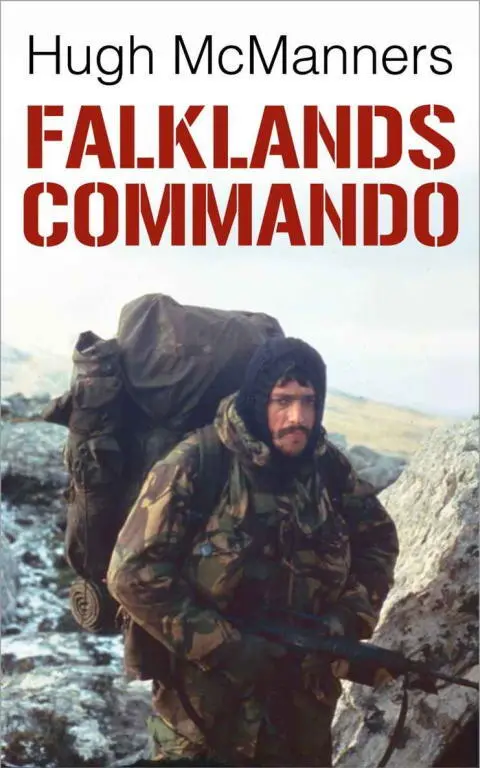
- Название:Falklands Commando
- Автор:
- Издательство:Nightstrike Publishing
- Жанр:
- Год:2014
- Город:London
- ISBN:978-0-992-81540-0
- Рейтинг книги:4 / 5. Голосов: 1
-
Избранное:Добавить в избранное
- Отзывы:
-
Ваша оценка:
Falklands Commando: краткое содержание, описание и аннотация
Предлагаем к чтению аннотацию, описание, краткое содержание или предисловие (зависит от того, что написал сам автор книги «Falklands Commando»). Если вы не нашли необходимую информацию о книге — напишите в комментариях, мы постараемся отыскать её.
Falklands Commando — читать онлайн бесплатно полную книгу (весь текст) целиком
Ниже представлен текст книги, разбитый по страницам. Система сохранения места последней прочитанной страницы, позволяет с удобством читать онлайн бесплатно книгу «Falklands Commando», без необходимости каждый раз заново искать на чём Вы остановились. Поставьте закладку, и сможете в любой момент перейти на страницу, на которой закончили чтение.
Интервал:
Закладка:
They were taken away later this afternoon, probably dead. They were both very young blokes.
I reckon that Paras will be undergoing a radical reassessment of the situation. Their future ops will be fairly ruthlessly prosecuted.
That sad and reflective diary entry was very soon overtaken by events. The two head-injury cases were flown ashore. The surgeons operated all night, saving them both. One woke from the anaesthetic and quoted his identity number when asked.
The ambush itself turned out not to have been Argentine, but a ‘Blue on Blue’ accident, own troops firing on each other. A 3 Para patrol had returned to their battalion lines from an unexpected direction, and amid confusion had been fired on by other companies in the same battalion, in an intense fire fight that lasted some time. Thankfully, because the ranges were around a thousand metres, the outer limits at which 7.62mm rounds are effective, the impact of the bullets was much less, allowing the casualties to recover from wounds that at lesser ranges would have been fatal.
Much later on, I was told that a lot of bodies had been discovered in the area north of Fanning Head, mostly killed by shell splinters. I felt regret that I had killed them, but also relief from my nagging worry about effect of our ‘humanitarian conduct’ of the operation. It seemed that after all, I’d not left a group of survivors who’d gone on to kill our friends.
Once back aboard Intrepid I wrote a letter home.
After I’d posted it into the Wardroom collection box, I began thinking about what I’d written, and asked the post orderly if I could retrieve it. This must have been a common situation, as he didn’t look at all surprised.
It was a dreadful letter, full of matter-of-fact statements that were fine for me, but would make my parents blood run cold back in sleepy Oxford. So I decided to write completely innocuous letters, one of which I reproduce here:
Well here we are, actually in the Falklands, which are not unlike NW Scotland, except that it is sunny at present, although when the wind blows it is very cold. The air is very clear and you can see for miles.
The ships are pretty well battened down all the time and we spend a good deal of it under the wardroom tables wearing our white hoods and gloves, telling jokes. We eat ‘action snacks,’ have ‘action cups of coffee’ and ‘action soup’, etc. etc. All this action stuff couldn’t feed a rabbit so is a bit of a contradiction! We get a big stew in the evenings when the action bit is relaxed, so we all top up.
I’m sharing a cabin with Chris Brown and we have managed to prevent anyone else from encroaching. This is just as well as we have a mountain of kit between us. I have acquired, of all things, a fighter pilot’s helmet. The others who arrived here more recently are crammed four to a cabin, so we are sitting pretty.
There are many animals, birds and fish here in startling profusion to contrast the rather sparse scenery and barrenness. The heather is in fact like out-of-control lettuce and very hard to walk through. The tussock grass is very much higher than its Brit counterpart and is reputed to contain fierce penguins that attack you as soon as look at you, which live in holes! There are seals, dolphins and even monster walruses that attack Land Rovers without hesitation. What sort of an Easter holiday did this turn out to be?
Despite the Navy’s attempts at normalising things wherever possible, life on board the ships was becoming very strange. All operational planning took place using Zulu time, i.e. UK time, ensuring there could be no confusion over signals sent from the UK, and the coordination of operations across three different time zones – emanating from UK or Ascension – like for example air supply drops.
All we had to do was get used to sunrise being around 11am and sunset at 10:30pm. The ships watches all got up at their normal time of 7am local, 10am Zulu, ate breakfast then went to action stations ready for the first air raids. These generally arrived fairly soon after that, and didn’t stop until 10 or 11 Zulu at night. ‘Action snacks’ – hot dogs, soup, sandwiches, and ‘nutty’ (chocolate and other sweetie bars) carried in respirator bags, kept hunger at bay until a cooked supper at midnight.
On Intrepid, the PWO took to using very old, traditional Royal Navy pipes – one presumes from the Napoleonic wars, to announce air raids, which I found strangely comforting. Sadly I can only remember the one:
“Air Raid Warning. Don anti-flash. Knock out pipes.”
“Air Raid Warning Yellow. Relax anti-flash. One, all round.”
This always made me think of our predecessors on the gun decks of tiny wooden warships. Having fired their guns broadside into the enemy ships, then with the helm turned away from the enemy and having taken the wounded below and reloaded, they were allowed to relax, smoking their clay pipes until the ship came downwind once more, again bringing their guns to bear on the enemy.
On several occasions when our ships were attacked, the Argentine’s thousand-pound iron bombs failed to explode, passing through the superstructure and out the other side, or lodging harmlessly to be dealt with by bomb-disposal. It seemed that the armourers loading the jets back at the Argentine bases were incorrectly setting the bombs’ safety fuses. These fuses consist of a small wind-vane device which rotates in the air to measure the distance the bomb has travelled, arming it only after a predetermined interval, to prevent the blast occurring close enough to the fragile aircraft to damage it.
When our bomb clearance guys examined unexploded bombs, the fuses were correctly set according to the manufacturers’ specifications, but were intact with time still to run. This was probably because the bombing approaches were being made at much lower heights than usual, to avoid our flak and missiles. But because these bombs had never been used in a real war against hostile ships, nobody had realised just how desperately low the pilots would fly.
We were ordered not to make any mention of this in our letters home, as it would be simple for enemy armourers to set the bombs to explode earlier. There was no censorship of our letters as it was felt we all understood the problem and could be trusted to be sensible. This specific point was emphasised to everyone several times.
But the night after the commander of Intrepid had again reminded us not to mention the fuses in our letters home, the World Service of the BBC announced it for us. The freedom to print the truth is obviously a cornerstone of democracy, but it would seem that editorial common sense practiced by media professionals is concerned with selling copy rather than with any other implications a story might have.
Much later I learned more about this from General Sir David Ramsbotham, who worked in the MoD throughout the Falklands War as the Director Public Relations Army. He told me that two days after HMS Glasgow was hit, it was MoD officials in London who revealed the bomb fusing story to journalists – which these journalists published. And then, two days later, MoD officials gave the same briefing to some American journalists, with additional speculation about faulty fusing mechanisms, elderly equipment, and the aircraft flying too low for the usual fuse timings to work.
Despite the obvious benefit to the Argentine Air Force of these very serious breaches of security by MoD officials, it took three complete days – until 23 May for the Chiefs of Staff to effect a complete ban on Government officials telling journalists about the unexploded bombs… [8]By which time it was too late.
Chapter 8. The Fox Bay Raid
A couple of days after the war ended, I visited Fox Bay settlement, at the south of the large island of West Falkland.
Читать дальшеИнтервал:
Закладка:
Похожие книги на «Falklands Commando»
Представляем Вашему вниманию похожие книги на «Falklands Commando» списком для выбора. Мы отобрали схожую по названию и смыслу литературу в надежде предоставить читателям больше вариантов отыскать новые, интересные, ещё непрочитанные произведения.






Обсуждение, отзывы о книге «Falklands Commando» и просто собственные мнения читателей. Оставьте ваши комментарии, напишите, что Вы думаете о произведении, его смысле или главных героях. Укажите что конкретно понравилось, а что нет, и почему Вы так считаете.