Geoff Dyer - Zona - A Book About a Film about a Journey to a Room
Здесь есть возможность читать онлайн «Geoff Dyer - Zona - A Book About a Film about a Journey to a Room» весь текст электронной книги совершенно бесплатно (целиком полную версию без сокращений). В некоторых случаях можно слушать аудио, скачать через торрент в формате fb2 и присутствует краткое содержание. Год выпуска: 2012, Издательство: Text Publishing, Жанр: Критика, Публицистика, на английском языке. Описание произведения, (предисловие) а так же отзывы посетителей доступны на портале библиотеки ЛибКат.
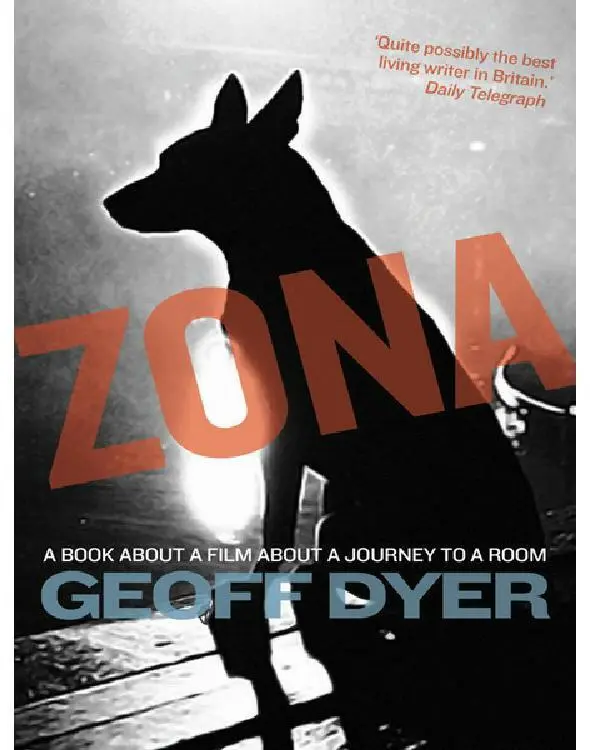
- Название:Zona: A Book About a Film about a Journey to a Room
- Автор:
- Издательство:Text Publishing
- Жанр:
- Год:2012
- ISBN:нет данных
- Рейтинг книги:4 / 5. Голосов: 1
-
Избранное:Добавить в избранное
- Отзывы:
-
Ваша оценка:
Zona: A Book About a Film about a Journey to a Room: краткое содержание, описание и аннотация
Предлагаем к чтению аннотацию, описание, краткое содержание или предисловие (зависит от того, что написал сам автор книги «Zona: A Book About a Film about a Journey to a Room»). Если вы не нашли необходимую информацию о книге — напишите в комментариях, мы постараемся отыскать её.
as 'possibly the best living writer in Britain', takes on his biggest challenge yet: unlocking the film that has obsessed him all his adult life. Magnificently unpredictable and hilarious (and surely one of the most unusual books ever written about cinema),
takes the reader on an enthralling, thought-provoking journey.
The ostensible subject of
is the film
, by the great Russian director Andrei Tarkovsky. As Dyer immerses us in the movie, it becomes apparent that
is only the point of departure for a wonderfully digressive exploration of cinema, of how we understand our obsessions and of how we try to realise — and, discover — our deepest wishes.
'An impassioned, yet acerbic and witty appraisal of a screen classic is a work of art in its own rights.'
Zona: A Book About a Film about a Journey to a Room — читать онлайн бесплатно полную книгу (весь текст) целиком
Ниже представлен текст книги, разбитый по страницам. Система сохранения места последней прочитанной страницы, позволяет с удобством читать онлайн бесплатно книгу «Zona: A Book About a Film about a Journey to a Room», без необходимости каждый раз заново искать на чём Вы остановились. Поставьте закладку, и сможете в любой момент перейти на страницу, на которой закончили чтение.
Интервал:
Закладка:
A HAND POURS white milk, the sweet milk of interspecies concord, from a triangular carton (a precursor of the Tetra Pak) into a wooden bowl, careless about the spillage but conscious, surely, that something has spilled over from a similar sequence in Mirror. The dog laps it up like a cat. It’s one of the best bits of lapping up in the history of cinema. No one has ever lapped up milk like this before or since — another excellent bit of lap-acting on the part of the dog who was unaware he was acting or, by the standard of the Method, had achieved a state of such complete immersion in his character that he was acting out of — in the sense of in —his skin. Stalker lies down by the bowl while the dog continues lapping up the milk like there’s no tomorrow. Stalker is back home and, once again, we’re back where we started. You can’t imagine how tired I am, Stalker tells his wife, stretched out horizontally on the floor of a room crammed with books. He’s got more books than an Oxford don. This is something we weren’t aware of before. Stalker is not just some Zone fundamentalist — he’s a big reader. I bet there are copies of Tragic Sense of Life, Wisdom and Insecurity, The Prelude and everything else mentioned in the course of this summary. Who knows, maybe he even has some of Writer’s books. 47Stalker is in an exhausted rage about the lack of belief of Writer and Professor, not only these two but everyone like them. He thumps the hard floor and his wife, kindly now, tells him not to get overexcited, to go to bed. It’s damp here, she says. If she only knew! Compared with where he’s been this is as warm as toast! But yes, he sure looks tired. By anyone’s standards it’s been a long and damp day or lifetime — whichever is the longer or damper. A cuckoo clock chirrups the hour — as though Stalker had brought back a souvenir from one of his previous trips to the Zone; or perhaps it was a gift from a satisfied client. 48She helps him into bed, taking off his trousers and shoes. As before, he keeps his sweater on— his sweater, which is dirty, soaking and stinky-looking, ripe for the starring role in an advertisement for the latest breakthrough in biological detergents. She tucks him in, sits on the side of the bed like she is looking after a patient, giving him a tablet and water. Some blossom or fluff is floating through the air, the same fluff or blossom that was seen floating through the Zone, in the moments after the land rippled like an acid trip so that the home is suffused with magic. Stalker looked a bit Nosferatulike before, back in the Zone; now, in bed, he looks like Nosferatu as the sun is about to come up. He’s in that exhausted, almost hysterical state that causes you to get more and more worked up over things you can do noth-ing about. All they can think about, he says, is not selling themselves cheap, how to get paid for every breath they take. No one believes. Not only those two — Writer and Professor, he means — no one. Who am I going to take there? He’s on the brink — or in the grips — of a total emotional and nervous breakdown, tormented by what seems now not so much as a lack in others as his own excess of belief. The worst thing is, not only do they not believe in the Zone, no one even needs it. A devastating possibility: the most wonderful place, the most wonderful thing in the world, and no one even needs it. Effectively people have no need of what they most want, have learned to do without. We see his face and her hand, mopping him, consoling him even though he is inconsolable.
When Coetzee found himself ‘sobbing uncontrollably’ on reading The Brothers Karamazov he asked himself why he found himself ‘more and more vulnerable’ to those pages. It had nothing to do with ethics or politics and everything to do with ‘the accents of anguish, the personal anguish of a soul unable to bear the horrors of this world.’
Back in the Zone Stalker said he might move there with his wife and child; now he tells his wife he won’t even go there again. Talk about cutting off your nose to spite your face. Or maybe the unbearable horrors of this world have proved more bearable than the promise and refuge of the Zone. She says she’ll go there with him. 49After all, she reminds him, there are plenty of things she could wish for. Such as? That her husband wasn’t a Stalker for one. That he wasn’t so obsessed by this wretched Zone, that he would stop sleeping in his dirty sweater…you name it. There’s also the possibility that she has realized that the one thing worse than his sneaking off to the Zone every chance he gets is having him here, getting under her feet, moping around at home the whole time. But no, she can’t go there. Because she’s a woman? No. Because what if she went and it didn’t work for her either? A last straw, too terrible even to contemplate clutching. He turns his head to sleep.
THE TRAIN WHISTLES are blowing. Stalker’s wife walks towards the wall and then sits down, turns to the camera and takes a cigarette from her packet. A dreadful moment, this, for me. By lighting and smoking a cigarette she turns herself, instantly, into something hideous. That sheepskin coat, we realize now, must stink of cigarettes— and her hair. And it’s not just that: I hate all gestures associated with finding, lighting and smoking a cigarette.
Her family were against their marrying, she says. Everyone in the neighbourhood laughed at him. She has lit her cigarette and shakes the match to extinguish it. I hate that smell, the smell of an extinguished match, as much as I hate the smell of cigarette smoke and I also hate the sight — by the side of cookers without a self-ignition facility — of curled and blackened matches. Lots of creaking and groaning of timbers, and the usual drop and drip of a tap or a leak, all imparting a touch of the nautical to this homely scene. He was a Stalker, an eternal prisoner. She knew this about him, and about the kind of children Stalkers have. But still, when he said come with me she went, like an apostle, and she’s never regretted it, not even with the pain and shame and sorrow.
Tarkovsky thought the wife’s expression of love and devotion was the ‘final miracle’, the heart of the film, its ultimate lesson: ‘namely that human love alone is— miraculously — proof against the blunt assertion that there is no hope for the world. This is our common, and incontrovertibly positive possession.’ Well, as Philip Larkin said on discovering that he was ‘too selfish, withdrawn and easily bored to love’: ‘useful to get that learned.’ As a lesson this — like so much in Sculpting in Time —fails to do justice to the revealed complexity of what takes place onscreen, but it does correspond with Olga Surkova’s assessment of Tarkovsky’s second wife, Larissa, as ‘a Russian angel standing guard over the persecuted Russian artist.’ 50At least that’s how things started out. Then Larissa came to believe she was ‘the fountain from which he drank’.
But of course in the film the wife is not married to a world-famous director, one of the most revered filmmakers ever to have shouted ‘Action’, she’s married to a Stalker whose pyjamas are his sweater.
Even with all the pain she has no regrets about the choice she made. In fact, it wouldn’t have been any better without the pain because then there would not have been any happiness. Without the pain there wouldn’t have been any hope. Hmm. Except happiness trumps hope, at least in the short term. It’s not just that if you’re happy you have no need of hope. When you’re happy, hope, like all the other big questions — as Solonitsyn’s character, Sartorius, says in Solaris —becomes meaningless. It is possible, in parts of California particularly, to live a life devoid of hope (in what’s to come) and brim full of happiness (for what is here now). Elsewhere, hope has persistence and endurance on its side, is happy to stand around and wait — for things to get bad again, for happiness to pass. In terms of the Zone, Stalker may have been right about his wife; maybe it wouldn’t have worked for her there. She clings to hope and the Zone, he suspects, lets through those who’ve lost all hope. Life is shit. You put up with it. You hope even though you don’t believe in hope. People who’ve got over terrible things say they never gave up hope, never stopped hoping. But hope is a source of torment as well as an inspiration. Didn’t the Buddha counsel against hope? Wasn’t hope one of the torments of Samsara from which we had to free ourselves? Besides, the Zone — on the evidence of this excursion at least — is not a place of hope so much as a place where hope turns in on itself, resigns itself to the way things are. To that extent she is there already, in the Zone.
Читать дальшеИнтервал:
Закладка:
Похожие книги на «Zona: A Book About a Film about a Journey to a Room»
Представляем Вашему вниманию похожие книги на «Zona: A Book About a Film about a Journey to a Room» списком для выбора. Мы отобрали схожую по названию и смыслу литературу в надежде предоставить читателям больше вариантов отыскать новые, интересные, ещё непрочитанные произведения.







Обсуждение, отзывы о книге «Zona: A Book About a Film about a Journey to a Room» и просто собственные мнения читателей. Оставьте ваши комментарии, напишите, что Вы думаете о произведении, его смысле или главных героях. Укажите что конкретно понравилось, а что нет, и почему Вы так считаете.