Elisabeth Kostova - The Historian
Здесь есть возможность читать онлайн «Elisabeth Kostova - The Historian» весь текст электронной книги совершенно бесплатно (целиком полную версию без сокращений). В некоторых случаях можно слушать аудио, скачать через торрент в формате fb2 и присутствует краткое содержание. Жанр: Триллер, на английском языке. Описание произведения, (предисловие) а так же отзывы посетителей доступны на портале библиотеки ЛибКат.
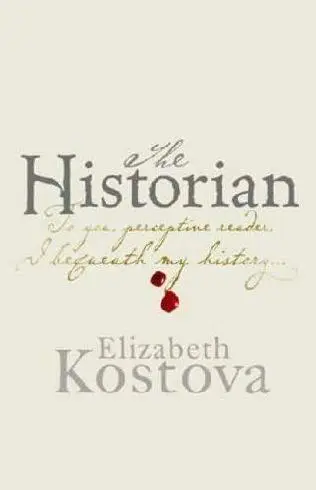
- Название:The Historian
- Автор:
- Жанр:
- Год:неизвестен
- ISBN:нет данных
- Рейтинг книги:5 / 5. Голосов: 1
-
Избранное:Добавить в избранное
- Отзывы:
-
Ваша оценка:
The Historian: краткое содержание, описание и аннотация
Предлагаем к чтению аннотацию, описание, краткое содержание или предисловие (зависит от того, что написал сам автор книги «The Historian»). Если вы не нашли необходимую информацию о книге — напишите в комментариях, мы постараемся отыскать её.
Late one night, exploring her father's library, a young woman finds an ancient book and a cache of yellowing letters. The letters are all addressed to "My dear and unfortunate successor," and they plunge her into a world she never dreamed of-a labyrinth where the secrets of her father's past and her mother's mysterious fate connect to an inconceivable evil hidden in the depths of history.
The letters provide links to one of the darkest powers that humanity has ever known-and to a centuries-long quest to find the source of that darkness and wipe it out. It is a quest for the truth about Vlad the Impaler, the medieval ruler whose barbarous reign formed the basis of the legend of Dracula. Generations of historians have risked their reputations, their sanity, and even their lives to learn the truth about Vlad the Impaler and Dracula. Now one young woman must decide whether to take up this quest herself-to follow her father in a hunt that nearly brought him to ruin years ago, when he was a vibrant young scholar and her mother was still alive.
What does the legend of Vlad the Impaler have to do with the modern world? Is it possible that the Dracula of myth truly existed-and that he has lived on, century after century, pursuing his own unknowable ends? The answers to these questions cross time and borders, as first the father and then the daughter search for clues, from dusty Ivy League libraries to Istanbul, Budapest, and the depths of Eastern Europe. In city after city, in monasteries and archives, in letters and in secret conversations, the horrible truth emerges about Vlad the Impaler's dark reign-and about a time-defying pact that may have kept his awful work alive down through the ages.
Parsing obscure signs and hidden texts, reading codes worked into the fabric of medieval monastic traditions-and evading the unknown adversaries who will go to any lengths to conceal and protect Vlad's ancient powers-one woman comes ever closer to the secret of her own past and a confrontation with the very definition of evil. Elizabeth Kostova's debut novel is an adventure of monumental proportions, a relentless tale that blends fact and fantasy, history and the present, with an assurance that is almost unbearably suspenseful-and utterly unforgettable.
Amazon.com Review
If your pulse flutters at the thought of castle ruins and descents into crypts by moonlight, you will savor every creepy page of Elizabeth Kostova's long but beautifully structured thriller The Historian. The story opens in Amsterdam in 1972, when a teenage girl discovers a medieval book and a cache of yellowed letters in her diplomat father's library. The pages of the book are empty except for a woodcut of a dragon. The letters are addressed to: "My dear and unfortunate successor." When the girl confronts her father, he reluctantly confesses an unsettling story: his involvement, twenty years earlier, in a search for his graduate school mentor, who disappeared from his office only moments after confiding to Paul his certainty that Dracula-Vlad the Impaler, an inventively cruel ruler of Wallachia in the mid-15th century-was still alive. The story turns out to concern our narrator directly because Paul's collaborator in the search was a fellow student named Helen Rossi (the unacknowledged daughter of his mentor) and our narrator's long-dead mother, about whom she knows almost nothing. And then her father, leaving just a note, disappears also.
As well as numerous settings, both in and out of the East Bloc, Kostova has three basic story lines to keep straight-one from 1930, when Professor Bartolomew Rossi begins his dangerous research into Dracula, one from 1950, when Professor Rossi's student Paul takes up the scent, and the main narrative from 1972. The criss-crossing story lines mirror the political advances, retreats, triumphs, and losses that shaped Dracula's beleaguered homeland-sometimes with the Byzantines on top, sometimes the Ottomans, sometimes the rag-tag local tribes, or the Orthodox church, and sometimes a fresh conqueror like the Soviet Union.
Although the book is appropriately suspenseful and a delight to read-even the minor characters are distinctive and vividly seen-its most powerful moments are those that describe real horrors. Our narrator recalls that after reading descriptions of Vlad burning young boys or impaling "a large family," she tried to forget the words: "For all his attention to my historical education, my father had neglected to tell me this: history's terrible moments were real. I understand now, decades later, that he could never have told me. Only history itself can convince you of such a truth." The reader, although given a satisfying ending, gets a strong enough dose of European history to temper the usual comforts of the closing words.
From Publishers Weekly
Starred Review. Considering the recent rush of door-stopping historical novels, first-timer Kostova is getting a big launch-fortunately, a lot here lives up to the hype. In 1972, a 16-year-old American living in Amsterdam finds a mysterious book in her diplomat father's library. The book is ancient, blank except for a sinister woodcut of a dragon and the word "Drakulya," but it's the letters tucked inside, dated 1930 and addressed to "My dear and unfortunate successor," that really pique her curiosity. Her widowed father, Paul, reluctantly provides pieces of a chilling story; it seems this ominous little book has a way of forcing itself on its owners, with terrifying results. Paul's former adviser at Oxford, Professor Rossi, became obsessed with researching Dracula and was convinced that he remained alive. When Rossi disappeared, Paul continued his quest with the help of another scholar, Helen, who had her own reasons for seeking the truth. As Paul relates these stories to his daughter, she secretly begins her own research. Kostova builds suspense by revealing the threads of her story as the narrator discovers them: what she's told, what she reads in old letters and, of course, what she discovers directly when the legendary threat of Dracula looms. Along with all the fascinating historical information, there's also a mounting casualty count, and the big showdown amps up the drama by pulling at the heartstrings at the same time it revels in the gruesome. Exotic locales, tantalizing history, a family legacy and a love of the bloodthirsty: it's hard to imagine that readers won't be bitten, too.
The Historian — читать онлайн бесплатно полную книгу (весь текст) целиком
Ниже представлен текст книги, разбитый по страницам. Система сохранения места последней прочитанной страницы, позволяет с удобством читать онлайн бесплатно книгу «The Historian», без необходимости каждый раз заново искать на чём Вы остановились. Поставьте закладку, и сможете в любой момент перейти на страницу, на которой закончили чтение.
Интервал:
Закладка:
“‘That means it dates at least from the first half of the fifteenth century,’ I breathed. ‘Before the conquest.’
“‘Oh, I think it is much older than that,’ Helen whispered, gently touching the seal. ‘My father-my father said it was very old. And you see the insignia here indicates Constantine Porphyrogenitus. He reigned in’-she searched an inner file-‘the first half of the tenth century. He was in power beforeBachkovski manastir was founded. The eagle must have been added later.’
“I scarcely breathed the words. ‘You mean that this is more than a thousand years old?’ Holding the book carefully in both hands, I sat down on the edge of the bed next to Helen. Neither of us made a sound; we were speaking more or less with our eyes. ‘It’s in nearly perfect condition. And you intend to smuggle such a treasure out of Bulgaria? Helen,’ I told her with a glance, ‘you are out of your mind. And what about the fact that it belongs to the Bulgarian people?’
“She kissed me, took the book out of my hands, and opened it to the front. ‘It was a gift from my father,’ she whispered. The inside front cover had a deep flap of leather over it, and she reached carefully inside this. ‘I have waited to look at this until we could open it together.’ She drew out a packet of thin paper covered with dense typing. Then we read together, in silence, Rossi’s agonized journal. When we were done, neither of us spoke, although we were both weeping. At last Helen wrapped the book in the handkerchief again and put it carefully back in its hiding place against her skin.
“Turgut smiled as I finished a diluted version of this story. ‘But there is more I have to tell you, and it is very important,’ I said. I described Rossi’s terrible imprisonment in the library. They listened with still, grave faces, and when I came to the fact that Dracula knew of the continued existence of a guard formed by the sultan to pursue him, Turgut drew a sharp breath. ‘I am sorry,’ I said.
“He translated quickly for Selim, who bowed his head and then said something in a soft voice. Turgut nodded. ‘He says the thing I most feel. This terrible news only means we must be the more diligent in pursuing the Impaler, and in keeping his influence from our city. His Gloriousness the Refuge of the World would command us in just this way, if he were alive. This is true. And what will you do with this book when you go home?’
“‘I know someone who has a connection with an auction house,’ I said. ‘We will be very careful, of course, and we’ll wait a while before we do anything. I expect some museum will get it, sooner or later.’
“‘And the money?’ Turgut shook his head. ‘What will you do with so much?’
“‘We’re thinking it over,’ I said. ‘Something in the service of good. We don’t yet know what.’
“Our plane to New York left at five, and Turgut began looking at his watch as soon as we’d finished our last enormous lunch on the divans. He had an evening class to teach, alas, alack, but Mr. Aksoy would ride with us to the airport in a taxicab. When we stood to go, Mrs. Bora brought out a scarf of the finest cream-colored silk, embroidered with silver, and put it around Helen’s neck. It hid the shabbiness of her black jacket and soiled collar and we all gasped-at least I did, and I can’t have been alone. Her face above the scarf was the countenance of an empress. ‘For your marriage day,’ Mrs. Bora said, standing on tiptoe to kiss her.
“Turgut kissed Helen’s hand. ‘It belonged to my mother,’ he said simply, and Helen could not speak. I spoke for both of us, shaking their hands. We would write, we would think of them. Life being long, we would see one another again.”
Chapter 76
“The last part of my story is perhaps the hardest for me to tell, since it begins with so much happiness, in spite of everything. We returned quietly to the university and took up our work again. I was questioned by the police once more, but they seemed satisfied that my trip abroad had been connected with research, and not with Rossi’s vanishing. The newspapers had seized upon his disappearance by then and made a local mystery of it, which the university did its best to ignore. My chairman questioned me, too, of course, and of course I told him nothing, except to say that I grieved as much as anyone for Rossi. Helen and I were married in my parents’ church in Boston that autumn-even in the midst of the ceremony I couldn’t help noticing how bare and plain it was, how devoid of incense.
“My parents were a little stunned by all this, of course, but they could not help liking Helen, ultimately. None of her native harshness showed around them, and when we visited them in Boston I often found Helen laughing in the kitchen with my mother, teaching her to cook Hungarian specialties, or discussing anthropology with my father in his cramped study. For myself, although I felt the pain of Rossi’s death and the frequent melancholy it seemed to cause in Helen, I found that first year full of a brimming joy. I finished my dissertation under a second adviser, whose face remained a blur to me throughout the process. It was not that I cared about Dutch merchants anymore; I only wanted to complete my education so that I could settle us comfortably somewhere. Helen published a long article on Wallachian village superstitions, which was well-received, and began a dissertation on the remnants of Transylvanian customs in Hungary.
“We wrote something else, too, as soon as we returned to the States: a note to Helen’s mother, care of Aunt Éva. Helen didn’t dare to put much information into it, but she told her mother in a few brief lines that Rossi had died remembering and loving her. Helen sealed the letter with a look of despair on her face. ‘I will tell her everything someday,’ she said, ‘when I can whisper it into her ear.’ We never knew for certain whether this letter reached its destination because neither Aunt Éva nor Helen’s mother wrote back, and within a year Soviet troops had invaded Hungary.
“I fully intended to live happily ever after, and I mentioned to Helen soon after we married that I hoped we would have children. At first she shook her head, touching the scar on her neck with gentle fingers. I knew what she meant. But her exposure had been minimal, I pointed out; she was well and strong and healthy. As time went by she seemed lulled by her own complete recovery, and I saw her looking with wistful eyes into the baby carriages we passed on the street.
“Helen received her doctorate in anthropology the spring after we were married. The speed with which she wrote her dissertation shamed me; I would often wake during that year to find that it was five in the morning and she had already left our bed for her desk. She looked pale and tired, and the day after she defended her dissertation I woke to blood on the sheets, and Helen lying next to me faint and wracked with pain: a miscarriage. She had been waiting to surprise me with good news. She was ill for several weeks afterward, and very quiet. Her dissertation received the highest honors, but she never spoke of that.
“When I got my first teaching job, in New York City, she urged me to take it, and we moved. We settled in Brooklyn Heights, in a pleasantly run-down brownstone. We took walks along the promenade to watch the tugboats navigating the port and the great passenger liners-the last of their race-pulling out for Europe. Helen taught at a university as good as mine and her students adored her; there was a magnificent balance to our lives, and we were making a living doing what we liked best.
“Now and then we took out theLife of Saint George and looked slowly through it, and the day came when we went to a discreet auction house with it, and the Englishman who opened it nearly fainted. It was sold privately, and eventually made its way to the Cloisters, in upper Manhattan, and a great deal of money made its way into a bank account we had set up for the purpose. Helen disliked elaborate living as much as I did, and apart from the attempt to send small amounts to her relatives in Hungary, we left the money alone, for the time being.
Читать дальшеИнтервал:
Закладка:
Похожие книги на «The Historian»
Представляем Вашему вниманию похожие книги на «The Historian» списком для выбора. Мы отобрали схожую по названию и смыслу литературу в надежде предоставить читателям больше вариантов отыскать новые, интересные, ещё непрочитанные произведения.




Обсуждение, отзывы о книге «The Historian» и просто собственные мнения читателей. Оставьте ваши комментарии, напишите, что Вы думаете о произведении, его смысле или главных героях. Укажите что конкретно понравилось, а что нет, и почему Вы так считаете.