Jason Elliot - The Network
Здесь есть возможность читать онлайн «Jason Elliot - The Network» весь текст электронной книги совершенно бесплатно (целиком полную версию без сокращений). В некоторых случаях можно слушать аудио, скачать через торрент в формате fb2 и присутствует краткое содержание. Жанр: Триллер, на английском языке. Описание произведения, (предисловие) а так же отзывы посетителей доступны на портале библиотеки ЛибКат.
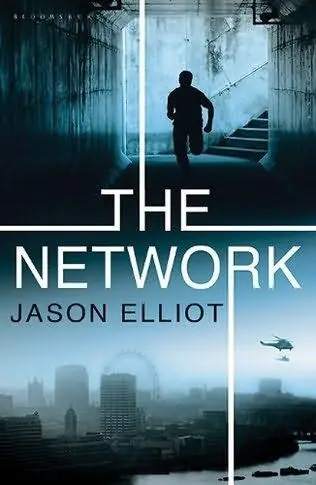
- Название:The Network
- Автор:
- Жанр:
- Год:неизвестен
- ISBN:нет данных
- Рейтинг книги:4 / 5. Голосов: 1
-
Избранное:Добавить в избранное
- Отзывы:
-
Ваша оценка:
The Network: краткое содержание, описание и аннотация
Предлагаем к чтению аннотацию, описание, краткое содержание или предисловие (зависит от того, что написал сам автор книги «The Network»). Если вы не нашли необходимую информацию о книге — напишите в комментариях, мы постараемся отыскать её.
The Network — читать онлайн бесплатно полную книгу (весь текст) целиком
Ниже представлен текст книги, разбитый по страницам. Система сохранения места последней прочитанной страницы, позволяет с удобством читать онлайн бесплатно книгу «The Network», без необходимости каждый раз заново искать на чём Вы остановились. Поставьте закладку, и сможете в любой момент перейти на страницу, на которой закончили чтение.
Интервал:
Закладка:
‘Goddamn it, Tony, you sound like you’re at the bottom of a creek. You on a satphone?’
‘I need to find a good travel agent,’ I tell her. ‘Someone to get me home quickly without showing up on anybody’s grid.’
‘Hell,’ she says, ‘so long as it’s illegal, I’ll help any way I can.’
This distant promise of help fills me with the strange urge to cry. I tell her where I am, that I need a new passport, ticket and some supporting identity. She doesn’t waste time on trying to find out how I came to be on the run from the Sudanese secret service. She just wants to know my exact location, preferred time frame and route for the exfil, whether the immigration system at the airport is computerised, and whether local law enforcement has a photograph of me. She asks what languages I speak. I tell her I’ll buy her dinner at Nora’s in DC when this is all over.
I feel burningly hot and then cold. I can’t sleep. My mind’s a whirlpool of black thoughts and things I don’t understand and my feelings are too strong for me to think properly. I feel brutalised by the thought that Jameela was expecting my arrival in Khartoum and played along with every part of it. I wonder, since everyone else I’ve trusted seems to be lying to me, whether Grace will betray me too.
Halfway through the night, sleep closes in on me.
So it’s with nothing short of a feeling of the miraculous that I open the package that arrives at dawn the next day. The old man delivers it when he comes to wake me, saying that a child came to the shrine and asked that it be given to the foreign guest. There’s a printed reservation number for my ticket, a Canadian passport in the name of Cousteau and a worn leather wallet complete with credit cards. There are even some Canadian dollars in it. I see from the passport that I entered Sudan three weeks earlier. I was told the CIA station in Khartoum had been shut down but they’ve obviously kept some talented employees on the payroll, and I’ve never been quite so grateful for the no-nonsense American attitude towards getting things done.
The rest is a gamble. If the police are stopping cars on the way to the airport I’ll call it off and try my chances to the south. But if they’re only checking passports, I have a good chance of slipping through. They won’t have my photograph, and only the two Mokhabarat officials can personally identify me.
I take a taxi to the airport and sit in the car with the driver until I see a party of foreigners disembarking from a hotel minibus. I pay the driver extra and ask him to wait, though I’m not planning to come back, and amble to the group of tourists, who are gathering up their bags. Scanning the building for signs of extra security, I break away from the tourists, head for the airline counter, and give the reservation reference to an attractive Sudanese girl wearing a purple veil. She thanks me and hands me a ticket in my new name. She bears a cruel resemblance to Jameela, whose face haunts me now. Then I head for the immigration desk, where the group I joined earlier are fussing over their departure forms, and fill out my own, remembering only at the last minute to check my signature against the one in my passport, which I copy as well as I can.
I will myself to be invisible, merging into the flow of the others in the hope that I’ll look like a member of the group. We go through security and form a line ahead of the final passport check. I’m nearly there. I shuffle forward, looking at the ground, not daring to look up and draw attention to my face. But I can’t resist a glance around to see what’s happening, and it’s at this precise moment, as if the very atoms in my surroundings have conspired to make it happen, that the uniformed immigration officer looks straight at me.
I turn my eyes away, but he calls out to me, and suddenly the world begins to slow down as if I’m in a dream, and I feel my heartbeat pushing up into my throat as he calls out again, tapping his pen on the kiosk to get my attention.
I pretend not to notice and turn towards the doors, wondering if there are any police between me and the exit, and whether I can make it to the taxi before things turn noisy. But the woman ahead of me in the queue, an earnest American in a safari hat, is tapping on my shoulder to get me to turn around, and now it seems the whole line is staring at me.
I’m trying hard to disguise my own dread. I wonder if I can manage the sprint to the doors, but my leg won’t take it. I force a bewildered smile to my face. The official is waving me impatiently towards him. I feel as if I’m standing above an open trapdoor and about to be forced to take a step forward. I walk to the booth, where he’s pointing his finger energetically at me. It’s only then I realise dimly that I’ve seen him before, and that it’s the same officer who stamped my passport when I first entered the country.
He takes my passport, opens it at a random page without even looking for my entry visa, and brings down the exit stamp with a thump. He doesn’t notice that I have a different name and nationality now. He points to himself and then to me, and with the same gleaming smile that flashed at me on the day of my arrival, says, ‘My friend.’
Then he returns my passport to me, and the pen I have earlier lent him, and waves me on.
12
The Firm likes its staff to live nearby. It makes them less dependent on public transport in case of ‘incidents’ that mean they have to get to work in a hurry. North or south of the river doesn’t make much difference these days, and the stigma attached to living near the Firm’s former headquarters at Century House in dreary north Lambeth has been thoroughly exorcised. So Kennington is fine; anywhere near the Oval but south of the gasworks is desirable; Fentiman Road is very nice if you can get it; and the quiet streets off St George’s Drive in Pimlico are rather perfect.
Seethrough, I now discover, lives a little further away, but at under three miles it’s not so far as to refute his claim that he sometimes jogs to work. According to the BT engineer I rely on for the occasional discreet enquiry, he lives a stone’s throw from St Luke’s Church in Chelsea, and it’s here that I wait for him in Gerhardt with some food and a Thermos and enough paracetamol to keep the pain in my leg under control.
His house doesn’t have a garage so he has to walk from his car to the front door, and it’s 9 p.m. when I finally catch sight of him. He’s moving at a pace that makes it painful for me to catch up, and his hand is just moving to the keys in his pocket when he senses the presence of someone behind him. As I reach him, he turns his head slightly but not enough to see my face.
‘Keep your hands by your sides,’ I tell him, ‘and keep walking.’ I’m pointing the antenna of the mobile at him through the pocket of my jacket.
‘Alright,’ he says quietly and very slowly, in the manner of a surgeon on the point of extracting a bullet. Then he realises that it’s me.
‘Oh, for fuck’s sake. You’re supposed to be in Khartoum.’
‘Keep walking, please.’
‘Fuck is going on, Ant?’
‘Did you hear what I said?’
‘Just don’t do anything bloody stupid.’ After a few yards he regains his habitual composure. ‘You’ve got a bit of a suntan, Ant. And you’re limping. Are you sure you’re alright?’
I know he’ll try to work the conversation around so that he’s in charge of it. I’m almost curious to see how he does it. He’s throwing out lines now, to see which one I’ll bite at. We turn into Sydney Street and move south.
‘Who helped you out, Ant? Cheltenham says you made a call to an unlisted number in America.’
‘You were running Hibiscus without telling me,’ I say.
Читать дальшеИнтервал:
Закладка:
Похожие книги на «The Network»
Представляем Вашему вниманию похожие книги на «The Network» списком для выбора. Мы отобрали схожую по названию и смыслу литературу в надежде предоставить читателям больше вариантов отыскать новые, интересные, ещё непрочитанные произведения.







Обсуждение, отзывы о книге «The Network» и просто собственные мнения читателей. Оставьте ваши комментарии, напишите, что Вы думаете о произведении, его смысле или главных героях. Укажите что конкретно понравилось, а что нет, и почему Вы так считаете.