J. JANCE - Hour of the Hunter
Здесь есть возможность читать онлайн «J. JANCE - Hour of the Hunter» весь текст электронной книги совершенно бесплатно (целиком полную версию без сокращений). В некоторых случаях можно слушать аудио, скачать через торрент в формате fb2 и присутствует краткое содержание. Жанр: Триллер, на английском языке. Описание произведения, (предисловие) а так же отзывы посетителей доступны на портале библиотеки ЛибКат.
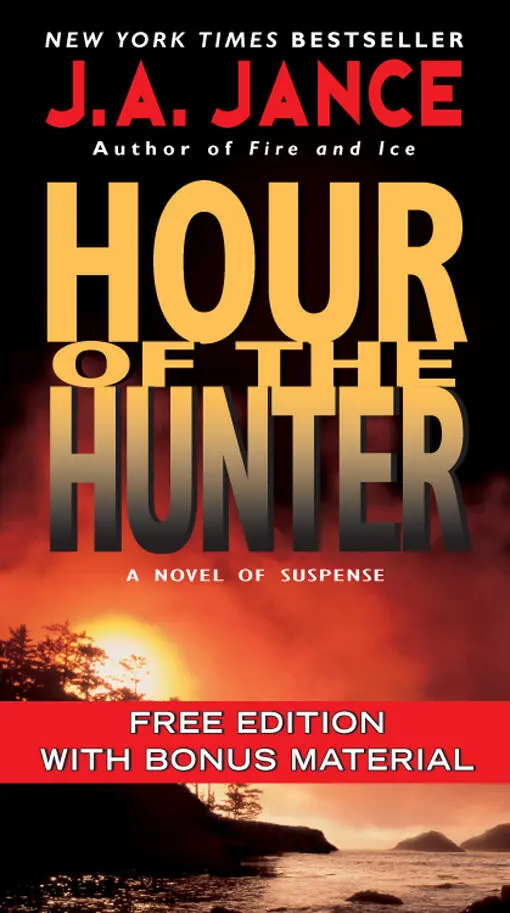
- Название:Hour of the Hunter
- Автор:
- Жанр:
- Год:неизвестен
- ISBN:нет данных
- Рейтинг книги:5 / 5. Голосов: 1
-
Избранное:Добавить в избранное
- Отзывы:
-
Ваша оценка:
Hour of the Hunter: краткое содержание, описание и аннотация
Предлагаем к чтению аннотацию, описание, краткое содержание или предисловие (зависит от того, что написал сам автор книги «Hour of the Hunter»). Если вы не нашли необходимую информацию о книге — напишите в комментариях, мы постараемся отыскать её.
Hour of the Hunter — читать онлайн бесплатно полную книгу (весь текст) целиком
Ниже представлен текст книги, разбитый по страницам. Система сохранения места последней прочитанной страницы, позволяет с удобством читать онлайн бесплатно книгу «Hour of the Hunter», без необходимости каждый раз заново искать на чём Вы остановились. Поставьте закладку, и сможете в любой момент перейти на страницу, на которой закончили чтение.
Интервал:
Закладка:
“Know anything about takin’ care of horses?” George Deeson asked.
“Not very much. I’ve never owned one before. Some of my friends have horses, but I don’t get to ride very often.”
“Reckon I’ll be over of a Saturday mornin’ to give you a lesson or two as long as your mama throws in some of her coffee and homemade biscuits.”
“How come, Mr. Deeson? I don’t understand.”
“How come? Why, girl, hasn’t your mama told you yet? Me and her’s gonna turn you into a rodeo queen.”
“Me?” Diana asked in stunned disbelief.
“Yup, you. You’re how old now? Thirteen?”
Diana nodded.
“It’ll take around four years, I reckon, give or take.” He leaned over and studied Diana’s face.
“Yup,” he said, “this girl’s got good bones. She’ll do just fine, but take it from me, missus, them braids gotta go. Braids don’t win no prizes these days, although they used to. They sure enough did, and not so very far back, neither.”
That evening, after supper, Iona cut off Diana’s braid. The following day, when school got out, Iona drove Diana to the drugstore in La Grande and bought her rollers, hair spray, combs and brushes, and makeup. When Diana came downstairs the next morning wearing her first tentative attempt at makeup, she waited for her father to say something, but he was strangely silent on the subject, almost as though he didn’t notice.
The next Saturday morning and for almost every Saturday morning that followed during the next four years, George Deeson appeared at the Coopers’ house bright and early to spend hours working with Diana and Waldo. When it was too cold to be outside, they worked in the barn. He taught her saddling and bridling and grooming. Together, Waldo and George Deeson taught Diana barrel racing. George taught her how to sit astride the horse so girl and horse were a single, symbiotic unit. He taught her how to read Waldo’s moods, how to calm him down during rumbling thunderstorms and barrages of exploding firecrackers, how to coax him in and out of unfamiliar horse trailers.
George Deeson taught Diana self-reliance, encouraged her to take Waldo off on long, solitary trail rides to one of the fifty-two alpine lakes in the Willowa Mountains surrounding Joseph, Oregon. There, with only her horse and her books, alone sometimes for days at a time, Diana could read and fish and care for her horse far away from Iona and Max Cooper’s day-to-day conflicts. And those trips weren’t good only for Diana, either. Starved for human companionship by his previous owner, Waldo thrived on the generous doses of attention Diana lavished on him.
But more than all that, George Deeson educated Diana Lee Cooper in something she never could have learned from her own mother. George Deeson taught Diana presence, schooled her in how to carry herself. He tutored her in the art of smiling and helped her master the rodeo-queen wave. Most of all, he infected her with his unshakable belief that one day she really would be queen of the Chief Joseph Days Rodeo.
George Deeson taught Diana all that and more. It didn’t dawn on her until years later that he never told her why.
And she didn’t ask.
Chapter 9
Looks at nothing rode in the truck without saying a word, offering no explanation and asking for none. Fat Crack did the same.
Halfway back to Sells, a call came in from Law and Order on the truck’s two-way radio. The tribal-police dispatcher told Fat Crack that he was needed near the Quijotoa Trading Post, where an Anglo lady’s Winnebago had broken down on her way to Rocky Point. She wanted a tow back home to Casa Grande.
Fat Crack was disappointed. He had wanted to go along to the hospital and watch the old medicine man strut his stuff. Now, that would be impossible.
In the early afternoon, Fat Crack came through the low pass outside Wedged Turtle Village, which Anglos call Sells. As the truck slowed for the cattle guard marking the village boundary, Looks At Nothing held out his hand. “Stop here,” he said.
“My aunt is in the hospital,” Fat Crack objected. “Let me take you there.”
“No,” Looks At Nothing responded. “I will go to her later. Not now. Let me out.”
Fat Crack stopped, and Looks At Nothing climbed down.
“But there’s nothing here,” Fat Crack said through the open window. “At least let me take you to the trading post.”
Looks At Nothing shook his head. “I have what I need,” he said. “I will wait under a tree until it is time.”
As Fat Crack drove away, he glanced back in the rearview mirror. Looks At Nothing, shimmering like a ghost in the rising midday heat, poked around with his cane in the nearby dirt and loose gravel. Then, after locating the soft shoulder of the road, the old man carefully made his sightless way down the steep embankment, heading unerringly toward the shade of a small grove of trees.
Fat Crack shook his head. Some things defied explanation. This was certainly one of them.
Long ago, a medicine man raised his daughter alone. She was good and beautiful and hardworking. The wise man taught his daughter that she must not laugh at silly things, or men would think she was too easy.
When the girl grew up and was ready to marry, her father said she would marry whoever could make her laugh. First Coyote tried, and then Whippoorwill, and even Horned Toad, but none of them could make her laugh.
One day Coyote was sitting on a hill when he saw the girl he still wanted to marry. She was walking around gathering wood, and her burden basket was walking behind her. Burden baskets never walk on their own sticks, but, as I told you, the girl’s father was a very powerful medicine man.
Coyote kept watching. The girl gathered a large stack of wood and loaded it into the basket, and still the burden basket followed her. As she started back to the village, Coyote came down to where she and her basket were walking.
“So,” Coyote said. “Your basket walks around.”
As soon as he said that, the basket stopped walking and turned into a mountain-Giwho Tho’ag or Quijotoa, as the whites call it.
And that, nawoj, is the story of Burden Basket Mountain.
Early afternoon passed with no word from Fat Crack and Looks At Nothing. Worrying that perhaps the medicine man would not come, Rita closed her eyes once more.
By age sixteen, most Papago girls were married. With the outing matron’s help, educated girls could now find domestic jobs in Tucson, Phoenix, and even California. Girls like that were especially prized wife material on the cash-poor reservation, but Dancing Quail was no prize. No one wanted to marry her.
Earnings from domestic service were far more than Dancing Quail made selling baskets and ollas. Not only that, anyone marrying Hejel Wi’ikam, as people now called her, would assume the added burden of her ready-made family-a blind, useless old grandmother and an arrogant younger sister named Juanita.
Once more the determined Franciscan sister saw a chance to redeem Alice Antone’s elder daughter. Once more they sent Father John to carry their message.
“Come to Topawa and work in the mission,” he said. “The sisters will teach you how to clean houses so that one day you, too, will be able to work in Phoenix or Tucson.”
For the first time, even Dancing Quail saw her lack of education as a liability. “But what of my grandmother?” she asked. “I can’t leave her here alone in Ban Thak.”
For this, Father John had a prerehearsed answer. “Bring her along. There’s a little house near the mission where you can both live. She won’t be far away. You’ll be able to care for her and still work and earn money.”
Читать дальшеИнтервал:
Закладка:
Похожие книги на «Hour of the Hunter»
Представляем Вашему вниманию похожие книги на «Hour of the Hunter» списком для выбора. Мы отобрали схожую по названию и смыслу литературу в надежде предоставить читателям больше вариантов отыскать новые, интересные, ещё непрочитанные произведения.





Обсуждение, отзывы о книге «Hour of the Hunter» и просто собственные мнения читателей. Оставьте ваши комментарии, напишите, что Вы думаете о произведении, его смысле или главных героях. Укажите что конкретно понравилось, а что нет, и почему Вы так считаете.