Nicola Griffith - Always
Здесь есть возможность читать онлайн «Nicola Griffith - Always» весь текст электронной книги совершенно бесплатно (целиком полную версию без сокращений). В некоторых случаях можно слушать аудио, скачать через торрент в формате fb2 и присутствует краткое содержание. Город: New York, Год выпуска: 2007, ISBN: 2007, Издательство: Riverhead Books, Жанр: Триллер, на английском языке. Описание произведения, (предисловие) а так же отзывы посетителей доступны на портале библиотеки ЛибКат.
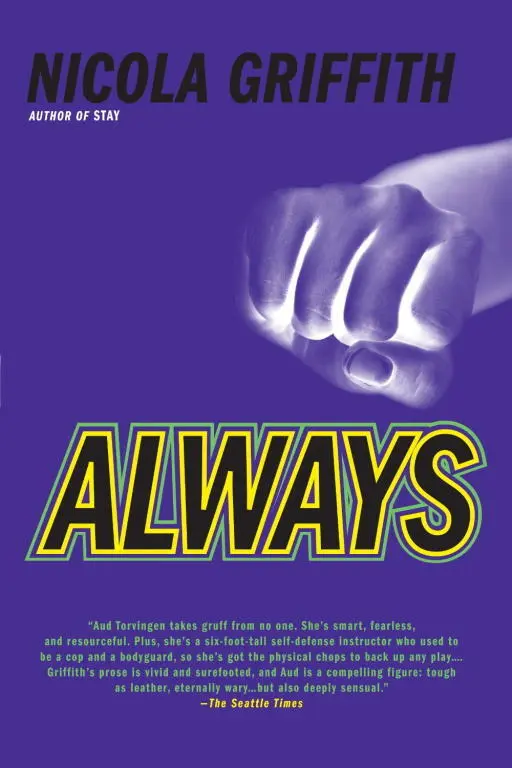
- Название:Always
- Автор:
- Издательство:Riverhead Books
- Жанр:
- Год:2007
- Город:New York
- ISBN:9781594482946
- Рейтинг книги:3 / 5. Голосов: 1
-
Избранное:Добавить в избранное
- Отзывы:
-
Ваша оценка:
Always: краткое содержание, описание и аннотация
Предлагаем к чтению аннотацию, описание, краткое содержание или предисловие (зависит от того, что написал сам автор книги «Always»). Если вы не нашли необходимую информацию о книге — напишите в комментариях, мы постараемся отыскать её.
) returns in an exhilarating new thriller. It doesn’t matter how well trained you are, how big, how fast, how strong; there will always be someone out there bigger or faster or stronger. Always. That’s what Aud Torvingen teaches the students in her self-defense class. But the question is whether Aud really believes this lesson herself-and if not, what it will take for her to learn it.
Aud has trained herself to achieve a fierce, machine-like precision, in hand-to-hand combat as well as life. But in Always she is abruptly confronted with the limits of her own power. Her self-defense classes spin violently out of her grasp and, still reeling from the consequences, she embarks on a seemingly simple investigation of Seattle real estate fraud that pulls her into something far more complicated and dangerous than she had imagined.
Always — читать онлайн бесплатно полную книгу (весь текст) целиком
Ниже представлен текст книги, разбитый по страницам. Система сохранения места последней прочитанной страницы, позволяет с удобством читать онлайн бесплатно книгу «Always», без необходимости каждый раз заново искать на чём Вы остановились. Поставьте закладку, и сможете в любой момент перейти на страницу, на которой закончили чтение.
Интервал:
Закладка:
I put my box on the counter. Everything tilted sideways and people began flying about, like the snowflakes in a shaken snow globe. Well, I thought, I hope the bowl is well packed. Somewhere in the distance, a roar grew. Herds of bison? A train? And then I got it.
“Earthquake!” I bellowed. “Everyone out on the street.” I grabbed the man behind the counter under his tailored armpits and lifted him bodily over the counter and away from the glass.
And then everything was silent and still, and a woman in a green jacket was standing too close, and there was no glass on the floor, no crack in the column.
I turned and surveyed the store. Everyone was staring at me. In the shoe department a man with one shoe on and one shoe off had grabbed his toddler and pushed her behind him protectively.
“Ma’am,” the green-jacketed woman said.
My boxed bowl stood exactly where I’d put it. The jewelry clerk was white-faced and swallowing over and over. His tie was askew.
“Ma’am,” Green Jacket said again. “Are you ill?”
“I’m not sure,” I said. It was quiet enough to hear the teenagers in the lingerie department giggle. They were giggling at me.
“Perhaps you would like to come with me, someplace quiet, and sit for a moment.”
She put her hand on my arm. I considered it. The skin between her wrist and knuckles crinkled, just beginning to get crepey. Late forties, then. Not old enough for there to be much danger of her bones being brittle from osteoporosis. A swift wrist lock wouldn’t hurt her. There again, she was only doing her job. I remembered the sound of breaking bone just three weeks ago, and I hesitated. “A glass of water would be nice,” I said.
“Very good. I’ll have someone bring your purchase.”
After two or three steps, she let go of my arm, but she kept very close. In the elevator, we stared at each other in the reflective chrome.
The office was quiet. Some people spoke. I spoke back. Everyone was very calm. “Medication,” I said. “A momentary confusion.” Which, in its way, was true. I apologized for any distress I might have caused. Someone brought me a paper cup of icy water. They assured me they were only concerned for my well-being. I thanked them. They insisted on calling me a taxi and then escorting me to it. The car would be perfectly safe in the parking garage, they said.
I got into the taxi, gave the driver directions. Outside the Fairmont I found I didn’t want to be inside, several stories up. It might not have been a real earthquake but I still felt safer closer to the ground. I told him to wait, took the box to Bernard and asked him to send it up to my room.
I got back in the cab.
“Take me to a park.”
“Looks like it might rain.”
“I don’t care.”
“You’re the boss.” He pulled into traffic. “Volunteer Park. That’s the place. There’s a conservatory, too, in case of that rain. And there’s a museum. Asian Art Museum.”
“Fine,” I said, wondering why that sounded so familiar.
I leaned back, took out my phone. Dialed.
Eric answered on the first ring. “Are hallucinogenic flashbacks to be expected? ” I asked him.
“They are certainly within the realm of possibility.”
“How can I avoid them?”
“Flashbacks are often triggered by stress. Physiological or emotional: extreme temperature, for example, or worry. Even low blood sugar. Lack of sleep, or grief. Excessive stimulus. Extraordinary physical effort. Take your pick, really. Have you had an episode?”
I ignored that. “So I could have one of these anytime?”
“No. We don’t really understand how it works, but they’re rare. My guess is that you’re unlikely to have another. Of course, I would have said it was unlikely you’d have one in the first place.” Pause. “I don’t feel as though I’m being very reassuring.”
“No. Is there any treatment?”
"Lead a perfectly regulated, boring existence.” Silence. “Aud, what happened? ”
“I thought there was an earthquake. In Nordstrom.”
“Ah.” Silence. “I’m sorry. Is there anything you need?”
“Thank you, no.”
Another silence. Then, “You understand that, although I don’t have a license to practice, I still regard our discussion as carrying the weight of doctor-patient privilege.”
“Thank you. But I don’t mind if you tell my mother. Unless you think she’d worry.”
“She’s your mother.”
OUTSIDE THEmuseum a banner announced the new exhibit of Chinese furniture. Petra and Mike, I remembered. I wondered if they’d gone.
WE LOOKEDat the Ming high-yoke-back chair and the docent shook his head again. “The owner paid almost a quarter million dollars for that one chair alone, and that was eighteen years ago. Rare as all get-out. I don’t know of any others in this neck of the woods. Not of huanghuali. Elm, or some other soft wood, maybe.”
But no softwood could ever look like this, even one lavished with care and the patina of fifteen generations of reverent handling. Its dense golden wood was simple but sensuous, with an S-shaped splat and indented yoke-back, and delicate curved arms that flowed like wooden streams. Simple, organic, precise. The joinery was seamless, yet the mortise-and-tenon construction meant it could be dismantled and reassembled without using pins or glue. It was solid and stable and undeniably real. It had the visual balance and functional elegance of a Japanese sword. I wanted it.
“It looks strong.”
“Yes,” he said. “As sound today as when it was made.”
I nodded, and squatted, and wanted to run my fingertips along the yoke-back. It would be silky, and cool to the touch. I imagined stroking the inside curve of the left arm. Not an ounce of wood wasted. The rear legs were longer and thinner than Kick’s spine, and arched as gracefully as she did when I touched her.
It had been made before Shakespeare wrote Hamlet, before Newton watched apples thump to the ground outside his childhood home. Its crafters had not had the benefits of modern steel blades or precision measuring tools, yet I would pick this chair above a warehouse full of Wiram furniture without thinking. This chair wasn’t about thinking. It wasn’t even about doing. It was about being, absolutely itself.
The bowl and the chair were simple and beautiful, form and function wholly aligned. They could be nothing other than themselves. Who was I? What was my function? Who was I if I couldn’t trust my own senses? The body knows, I’d told my self-defense class. But sometimes the body was wrong. I began to understand the awful, confused world my students must live in.
I walked through the park for an hour. There were very few people about; the wind was gusting, and every now and again rain rattled the foliage overhead. I felt some of that almost-ecstatic delight in the ordinary that the drugged coffee had induced: rain sparkled on the bole of an apple tree and I paused to look, and noted the screw-type distribution of leaves around its stem, which ensured each leaf got as much sunlight as possible. I picked a rain-flecked daisy. It had thirteen petals. She loves me. I picked another: thirty-four. She loves me not. Another. Twenty-one. She loves me. All numbers in the Fibonacci series. Nature didn’t need to measure. Even its improvisations were orderly and graceful.
I was wet. It was a little after three o’clock. I called another cab and headed back to the Nordstrom parking lot.
KICK’S VANwasn’t in the lot, but the big rolling doors were open, and I saw Dornan just inside the entrance, wearing a bright yellow construction hat, handing up a pipe to a rigger on the growing scaffold.
I was surprised by how glad I was to see him.
Читать дальшеИнтервал:
Закладка:
Похожие книги на «Always»
Представляем Вашему вниманию похожие книги на «Always» списком для выбора. Мы отобрали схожую по названию и смыслу литературу в надежде предоставить читателям больше вариантов отыскать новые, интересные, ещё непрочитанные произведения.






Обсуждение, отзывы о книге «Always» и просто собственные мнения читателей. Оставьте ваши комментарии, напишите, что Вы думаете о произведении, его смысле или главных героях. Укажите что конкретно понравилось, а что нет, и почему Вы так считаете.