The Medieval Murderers - The Tainted Relic
Здесь есть возможность читать онлайн «The Medieval Murderers - The Tainted Relic» весь текст электронной книги совершенно бесплатно (целиком полную версию без сокращений). В некоторых случаях можно слушать аудио, скачать через торрент в формате fb2 и присутствует краткое содержание. Жанр: Исторический детектив, на английском языке. Описание произведения, (предисловие) а так же отзывы посетителей доступны на портале библиотеки ЛибКат.
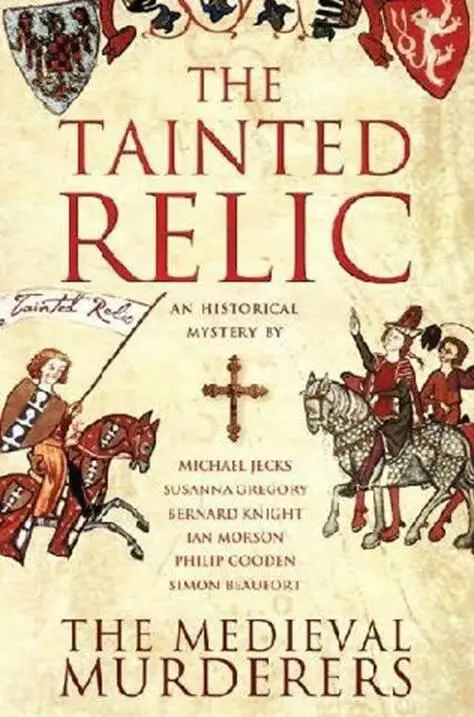
- Название:The Tainted Relic
- Автор:
- Жанр:
- Год:неизвестен
- ISBN:нет данных
- Рейтинг книги:4 / 5. Голосов: 1
-
Избранное:Добавить в избранное
- Отзывы:
-
Ваша оценка:
The Tainted Relic: краткое содержание, описание и аннотация
Предлагаем к чтению аннотацию, описание, краткое содержание или предисловие (зависит от того, что написал сам автор книги «The Tainted Relic»). Если вы не нашли необходимую информацию о книге — напишите в комментариях, мы постараемся отыскать её.
The Tainted Relic — читать онлайн бесплатно полную книгу (весь текст) целиком
Ниже представлен текст книги, разбитый по страницам. Система сохранения места последней прочитанной страницы, позволяет с удобством читать онлайн бесплатно книгу «The Tainted Relic», без необходимости каждый раз заново искать на чём Вы остановились. Поставьте закладку, и сможете в любой момент перейти на страницу, на которой закончили чтение.
Интервал:
Закладка:
Andrew rested his wrinkled hand on the younger man’s shoulder, partly for support and partly as a gesture of affection. ‘I know. I have every faith in you. Hold out your hand.’
Urban shuddered as Andrew moved the stained wood towards him.
Cambridge, a few days later
Brother Michael was blissfully unaware that his fine Benedictine habit would never be the same again. He held forth knowledgeably on all manner of subjects as he shared the Dominicans’ excellent dinner, and did not notice that his audience was looking not at him, but at his right shoulder. His colleague, Matthew Bartholomew, had tried several times to draw his attention to the problem, but had been silenced by a dismissive wave of the monk’s fat white hand. Michael did not like to be interrupted when he was of a mind to be erudite.
‘So, to conclude my thesis,’ he said pompously, revelling in the fact that no one had challenged his arguments for almost an hour, ‘I concur with the great theologian Francis de Meyronnes. During the three days between our Lord’s death and His resurrection, some of His blood became separated from His body and remained on Earth. Ergo, no relic containing Holy Blood is united to His divinity, just as it was not united to His divinity during the three days in the tomb. The blood of the mass, which is fully joined to His divinity, is thus far more worthy of veneration. However, this is not to say that Holy Blood relics are to be shunned-on the contrary, they are sacred and vital reminders of Christ’s resurrection and man’s subsequent redemption.’
He sat back, pleased with the elegance of his reasoning and certain that the Cambridge Dominicans would be unable to refute what he had said. He reached out with his knife and speared a roasted chicken, dragging it towards him and clearly intent on devouring the whole thing, despite the fact that the friars had already laid down their spoons and were waiting for the final grace. Michael was a large man, who used his position as the university’s senior proctor to inveigle invitations to some of the finest meals in Cambridge. It had been several days since his last grand repast, however, and so he was enjoying himself more than usual.
He had been summoned to the Dominican priory that day because one of its student novices had been involved in a fight-as Senior Proctor, Michael was obliged to investigate all incidents of violence among the university’s scholars. He had taken Bartholomew with him, anticipating that his friend’s skills as Master of Medicine might be required. The novice’s injuries were not serious, but Prior Morden was grateful for the physician’s services nonetheless, and had invited them to dine before they returned to their own college of Michaelhouse. Bartholomew, who had other patients to tend, started to decline, but Michael knew that the Dominicans ate well, and had accepted the offer before he could speak; the monk was acutely aware that the Black Friars’ supper would be far superior to anything on offer at Michaelhouse.
Prior Morden cleared his throat uncomfortably, and glanced at his assembled friars. He was a tiny man, so small he needed cushions on his chair to allow him to reach the table, and he had an odd habit of swinging his legs back and forth while he ate. It was fortunate they were short limbs, or his colleagues would have suffered cruelly from his vigorous kicks.
‘Well,’ he said eventually, his eyes straying from the monk’s flushed, greasy face to the vicinity of his right shoulder. ‘I see.’
Bartholomew could have told Michael he was wasting his time expounding to the Dominicans, who were known to be the least academically minded of the many religious orders that had gathered around the university in Cambridge. Morden had rashly mentioned an old chronicle in his library, however, which described an event in 1247: the third King Henry had presented Westminster Abbey with a phial containing blood from Christ’s passion. A violent debate was currently raging between Dominicans and Franciscans about the nature of Holy Blood, and whether it should or should not be venerated, and Michael had come down firmly on the side of the Franciscans. Bartholomew did not find the subject an especially engaging one, so kept what few thoughts he had on the issue to himself-there were far more fascinating topics to debate, and he felt it a waste to expend energy on a matter about which he was indifferent.
None of the Dominicans had spoken for some time, and the physician suspected they had understood very little of Michael’s complex analysis. Technically, Prior Morden and his friars should have been hammering on the tables with their pewter goblets, shrieking that the monk had spoken heresy within their halls. It would be what their order expected of them. But most had been more interested in their food than the monk’s erudite postulations, and Bartholomew sensed that they were bored by the monologue and wished their guest would talk about the murders he had solved or the disgraceful price of grain. Only one Black Friar looked as though he had followed what the monk had said, but he sat at that part of the table reserved for visitors, and was too polite to speak when he had not been invited to do so by his hosts.
Michael’s eyes narrowed, and he paused with a chicken leg halfway to his mouth. ‘Is that all you have to say? I think my assessment of the nature of Holy Blood warrants a more in-depth response than “I see”. Do you not agree, Matt?’
‘That theologian you kept citing,’ said Morden, before Bartholomew could formulate a suitably non-committal answer. ‘Meyronnes. I may be wrong, but I thought he was a Franciscan.’
Michael gazed at him, barely crediting that he should make such an observation when the name Meyronnes was on the lips of every scholar even remotely familiar with contemporary scholastic debate. Even Bartholomew, who was not at all interested in the controversy, knew its leading protagonists and the stances they had outlined. ‘Yes,’ he said warily. ‘What of it?’
‘Franciscans know nothing of theology,’ said Morden matter-of-factly, sounding relieved that he had got something right. ‘So, your thesis will be fatally flawed if you use him to prove your points.’
Michael sighed. Rivalry between the Orders was intense, particularly between Franciscans and Dominicans, and it was not unknown for scholars to dismiss entire schools of thought merely on the basis of who had proposed them. He saw, somewhat belatedly, that he would have to simplify his ideas if he wanted a sensible response from Morden and his slow-minded minions.
‘The blood relics polemic challenges some of the most basic tenets of our faith,’ he said, trying not to sound testy-he did not want to jeopardize future dining opportunities by revealing his disdain. ‘It concerns whether samples of Holy Blood-the most famous of which can be found at Hailes and Ashridge-should be venerated. The Franciscans say they should, your Order claims they should not.’
‘Well,’ said Morden again, still looking puzzled. His eyes dipped to Michael’s shoulder, and he rubbed a hand across his mouth. ‘We would of course say no, if the Franciscans say yes: it is only natural we should disagree. Christ’s blood is not holy, then-none of it, not a drop.’
‘But think, man!’ said Michael, becoming exasperated, despite his best intentions. ‘If you claim Holy Blood should not be venerated, then what does that say about the mass? You venerate the blood of Christ every day, so some of it must be sacred.’
‘Oh,’ said Morden, perplexed. ‘Well, if you put it like that, then I suppose it must be all right to revere these blood relics. However, as you have just pointed out, there are very few of them in existence. Most cannot be authenticated, and only Hailes and Ashridge have real ones.’
Читать дальшеИнтервал:
Закладка:
Похожие книги на «The Tainted Relic»
Представляем Вашему вниманию похожие книги на «The Tainted Relic» списком для выбора. Мы отобрали схожую по названию и смыслу литературу в надежде предоставить читателям больше вариантов отыскать новые, интересные, ещё непрочитанные произведения.





Обсуждение, отзывы о книге «The Tainted Relic» и просто собственные мнения читателей. Оставьте ваши комментарии, напишите, что Вы думаете о произведении, его смысле или главных героях. Укажите что конкретно понравилось, а что нет, и почему Вы так считаете.