Matthew Pearl - The Poe Shadow
Здесь есть возможность читать онлайн «Matthew Pearl - The Poe Shadow» весь текст электронной книги совершенно бесплатно (целиком полную версию без сокращений). В некоторых случаях можно слушать аудио, скачать через торрент в формате fb2 и присутствует краткое содержание. Жанр: Исторический детектив, на английском языке. Описание произведения, (предисловие) а так же отзывы посетителей доступны на портале библиотеки ЛибКат.
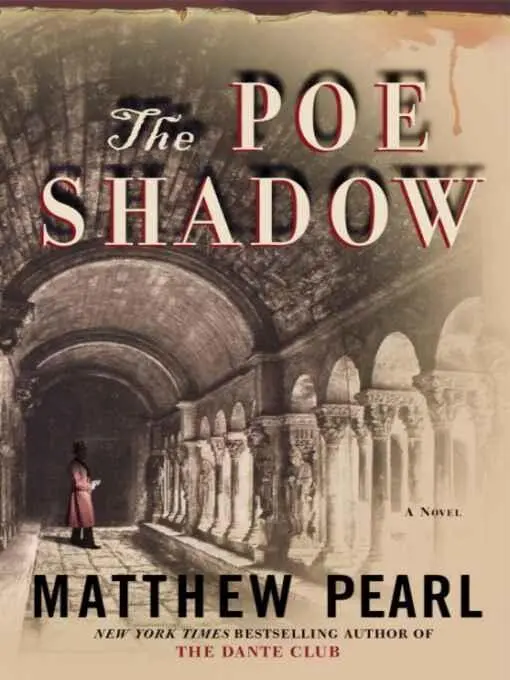
- Название:The Poe Shadow
- Автор:
- Жанр:
- Год:неизвестен
- ISBN:нет данных
- Рейтинг книги:5 / 5. Голосов: 1
-
Избранное:Добавить в избранное
- Отзывы:
-
Ваша оценка:
The Poe Shadow: краткое содержание, описание и аннотация
Предлагаем к чтению аннотацию, описание, краткое содержание или предисловие (зависит от того, что написал сам автор книги «The Poe Shadow»). Если вы не нашли необходимую информацию о книге — напишите в комментариях, мы постараемся отыскать её.
Poe was supposed to be almost anywhere other than Baltimore: he was traveling from Richmond to New York with a planned stop in Philadelphia, not Baltimore. No one knows how he came to be in the city – or, for that matter, how he ended up at the tavern. For some of us, this pretty much describes a really great Saturday night, but when it happens to the master of darkness, just days before his untimely death, it has the makings of a mystery.
Pearl takes us back to those few lost days through the inquiries of Quentin Clark, a Poe-mad young Baltimorean who is dismayed not just by the writer's death but by the press's apathetic reponse to the news. Clark takes it upon himself to look into matters and rectify this slight to his hero. The trouble is, Clark is a stock character from the world of commercial thrillers: a man with a lot to lose, imperiled by his own obsession. Engaged to a beautiful young woman, the son of wealthy and very proper parents and pursuing a career as a lawyer, he may sacrifice them all to his devotion to Poe.
Clark haunts the writer's grave, visits the hospital where he lay dying and tracks down the Poe cousins. But wherever he turns, he's met with indifference or outright obstruction. Finally, in desperation, he turns to another source of information: the pages of a book. Clark has always admired Poe's "Murders in the Rue Morgue" and the other mysteries featuring C. Auguste Dupin, the brilliant Frenchman who solves crimes too baffling for the Paris police. "Dupin's reasoning followed a method Poe called ratiocination," Clark reminds himself, "employing one's imagination to achieve analysis, and one's analysis to climb the heights of imagination."
When Clark stumbles on a newspaper item suggesting that Dupin was based on a real Frenchman, he promptly takes off for the Continent. Of course, there turns out to be more than one candidate for this honor, and soon a couple of testy Frenchmen are racing back to America, eager to snatch whatever glory they might from Poe's death.
Baroquely orchestrated complications ensue, up to and including a threat to the future of the French republic. As he demonstrated in his serial-killers-and-philosophers best seller, "The Dante Club," Pearl is a fine scene-setter and a resolute, if not always inspired, plotter. "The Poe Shadow" is thick with intrigue and thicker still with carefully researched (and ostentatiously displayed) details.
Pearl, who taught literature at Harvard before embarking on his literary career, sometimes displays a wonderfully knowing tone, and enjoys playing with 19th-century lingo. When a Baltimore police officer asks Clark if he has a wife and is told that he has a fiancée, the officer warns: "You should have much to occupy yourself without needing to think of this unhappy affair, then. Or your sweetheart might give you the mitten." Sadly, Pearl's plot is not all sweethearts and mittens.
With its bewildered narrator and its attempt to marry the rational and the spooky, "The Poe Shadow" seems to be modeled on Poe's own writing, but it's missing a crucial element: brevity. Although Pearl has a real affinity for 19th-century America, he overwhelms the strengths of his book with a hurricane of ersatz Victorian prose. He doesn't just disinter Poe's story; he disinters the language of Poe's time. After a while, you feel like you're trapped in a sepia-toned faux-daguerrotype. Pearl has created a museum rather than a world. And no one lives in a museum.
The Poe Shadow — читать онлайн бесплатно полную книгу (весь текст) целиком
Ниже представлен текст книги, разбитый по страницам. Система сохранения места последней прочитанной страницы, позволяет с удобством читать онлайн бесплатно книгу «The Poe Shadow», без необходимости каждый раз заново искать на чём Вы остановились. Поставьте закладку, и сможете в любой момент перейти на страницу, на которой закончили чтение.
Интервал:
Закладка:
"No doubt these guards were stationed to prevent young men and boys from any longer climbing the parapets to get close to the monsters."
"Yes! You are likely right, monsieur!" The man stood open-mouthed.
"It might have been further essayed, then, that if a boy had in fact taken possession of your cake, the same lad would be turned away from his plan by these vigilant guardians within the first few minutes of the bears' stirring, and the bandit would return by the most direct path-a path which crosses the grounds where we now stand-to the attraction second in popularity only to the wells of the bears for this sort of spectator: I mean the wire house of the monkeys, who, at the delivery of a bright piece of cloth or item of food, could be made to chase one another in, presumably, a manner almost as enchanting as the bears' climbing of the pole. None of the other popular holdings, the wolves or the parrots, will make such an exhibition over one's cake."
As delighted by this explanation as if it had been his own, the grateful man, with a magnanimous air, invited us to share in his cake, even though it had been in the grubby hands of the boy and had since been made flat by the rain. I politely declined, but Duponte, after a moment of thought, accepted and sat with him upon a bench. They ate with great relish as I held the man's umbrella over them.
That evening, I met the same man at a crowded café near my hotel. The bright lights of the interior presented a dazzling effect. He was playing a game of dominoes with a friend, whom he dismissed when he saw me come in.
"Monsieur, bravely done," I said joyfully. "Quite well done!"
I had met this man the day before in the same Jardin des Plantes. He was one of the chiffonniers of Paris, men whose occupation was to search through the rubbish heaps put out from the houses of Paris. They would use sticks and baskets with great expertise to collect anything of remote value. "Bones, scraps of paper, linen, cloth, bits of iron, broken glass, broken china, corks of wine bottles…" he explained. These men were not vagrants; rather, they were registered for this activity with the police.
I had inquired of the fellow how much he collected each day.
"Under King Philippe," he said of the former monarch, "thirty sous' worth a day! But now, under the Republic, only fifteen." He explained, with a sad tone of nostalgia for the monarchy, "People throw away less bones and paper now! When there is no luxury we who are poor can do nothing."
I would remember his words strongly in the months to come.
Because he could legally ply his trade only between five and ten in the morning, and was bent on earning money, I thought he would be agreeable to the scheme I had conceived. I had instructed him that when he saw me walking with my companion the following afternoon, he should exclaim in our hearing over the loss of some object of value and beg Duponte for assistance. In this way, Duponte might be jolted into some small undertaking.
Now, at the café where we had agreed to meet, as my part of the bargain I informed the waiter that I would pay for the meal of my accomplice's choice. And what a meal! He called for the tout ensemble of the place: poulet en fricassée, ragout, cauliflower, bonbons, melons, cream cheese! As was the practice in France, each new item of food came with a new plate, for the French abhorred the American practice of mixing tastes-for instance, vegetables and the sauces of meat-on one plate. I watched his feast happily, for his performance at the gardens had pleased me greatly.
"I did not think, at first, cake would work," I admitted to him. "I thought it a strange choice! Yet you managed quite well with that boy."
"No, no, monsieur!" he said. "I had nothing to do with that boy. The cake was truly stolen from me!"
"What do you mean?" I asked.
The chiffonnier said that he had planned to position his umbrella in some concealed spot and report the missing umbrella to Duponte to fulfill our agreement. It had been during the time he searched for a hiding place for the umbrella near the bench that his cake had vanished.
"How did he know what happened to it?" he asked. "Had you told your friend to watch me that whole time?"
"Of course not!" I shook my head. "I wanted to see if he would solve the mystery, and that would spoil the experiment, wouldn't it!"
The incident had clearly weighed on his mind. "He is an odd stick. Yet I suppose when a body is hungry, he shall do what he must."
I reflected on this axiom after parting from the man. I had been too excited about Duponte's promising behavior to consider why Duponte had performed his task of analysis. Perhaps Duponte, who had skipped dinner, had just been hungry for the cake, his share of the spoils, all along.
This was hardly the end of that line of attempts on my part to provoke Duponte into renewing his abilities. I had brought from America the pamphlet of The Prose Romances of Edgar A. Poe. I marked the first page of "The Murders in the Rue Morgue" and left it for Duponte, hoping that his interests would be captured. I rejoiced when it seemed that all my tactics were having an impact. The first true indication that Duponte was changing in some extraordinary way came one evening when I followed him to Café Belge. Two or three times a week he would sit on a bench, ignoring the billiards games and the chatter, comfortably lost in the ugly bustle and brawls around him. I had followed him here before. Something seemed different as soon as I saw him this time. His glance had already become less vacant.
I lost sight of him after he turned into the small, narrow café. Mirrors lining the walls exaggerated the confusion of people inside. This was where the best billiards players in the city congregated to play. There was one roguish fellow who was said to be the best of all the players. He was wildly red all over-his hair, his brow, his irritated, picked skin. He almost always played his game alone, I suppose because he was too good for the others who came only for leisure and gaiety. He shouted encouragement to himself on a good shot, and cursed himself mercilessly when he fell short.
Café Belge was the only billiards café in the city to allow women to play-though, it will surprise many who have not visited Paris, it was not the only café to permit the smoking of cigarettes by ladies. True, the unsuspecting American might blanch just by walking past many of the illustrations displayed in the windows of print-shops, or after witnessing scenes of maternal activities, usually confined to the nursery, displayed for all the world to see in the middle of the Tuileries gardens.
As I searched for Duponte, a young lady threw her hand on top of mine.
"Monsieur, you wish to play a game with us?"
"Mademoiselle?"
She pointed to the three other nymphs at her table. "You wish to play billiards, I suppose. Come, here is a stick. You are an Englishman?"
She propelled me in front of the table. "Do not fret. Nobody plays for money in Paris, only for drinks!"
"You see"-I leaned in to speak as quietly as possible-"I am not married." I had learned that in France unmarried women were to be seen with single men at great risk to their reputation; the compensation was that married women could freely be seen doing all manner of things.
"Ah, that is all very well," the damsel reassured me in a loud, smoked whisper. "I am." She and her companions laughed, and their French grew too rapid for me to follow. I struggled to cross the room, colliding with the elbows of a few of the men surrounding the billiards tables.
After a few moments, I noticed another young woman in the room, standing apart from the others. Although she looked to be of the same modest class, she held herself up with elegance unknown to her peers in the café. And unknown, for that matter, to the "unrivaled beauties" that paraded themselves along Baltimore Street. She was shorter than me, and her deep-set eyes seemed almost to anticipate my path through the crowd. She carried a basket with blooming flowers and stood quietly. A man would raise his hand and she would walk close, where the man would toss a copper coin or two into the basket.
Читать дальшеИнтервал:
Закладка:
Похожие книги на «The Poe Shadow»
Представляем Вашему вниманию похожие книги на «The Poe Shadow» списком для выбора. Мы отобрали схожую по названию и смыслу литературу в надежде предоставить читателям больше вариантов отыскать новые, интересные, ещё непрочитанные произведения.










Обсуждение, отзывы о книге «The Poe Shadow» и просто собственные мнения читателей. Оставьте ваши комментарии, напишите, что Вы думаете о произведении, его смысле или главных героях. Укажите что конкретно понравилось, а что нет, и почему Вы так считаете.