Randy White - Haunted
Здесь есть возможность читать онлайн «Randy White - Haunted» весь текст электронной книги совершенно бесплатно (целиком полную версию без сокращений). В некоторых случаях можно слушать аудио, скачать через торрент в формате fb2 и присутствует краткое содержание. Жанр: Детектив, на английском языке. Описание произведения, (предисловие) а так же отзывы посетителей доступны на портале библиотеки ЛибКат.
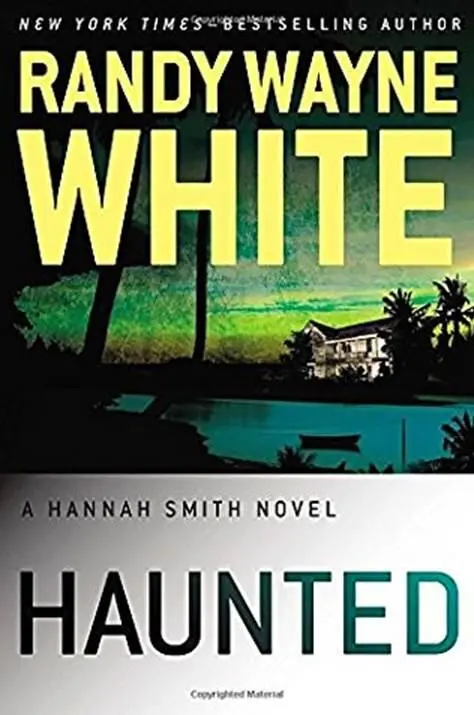
- Название:Haunted
- Автор:
- Жанр:
- Год:неизвестен
- ISBN:нет данных
- Рейтинг книги:5 / 5. Голосов: 1
-
Избранное:Добавить в избранное
- Отзывы:
-
Ваша оценка:
Haunted: краткое содержание, описание и аннотация
Предлагаем к чтению аннотацию, описание, краткое содержание или предисловие (зависит от того, что написал сам автор книги «Haunted»). Если вы не нашли необходимую информацию о книге — напишите в комментариях, мы постараемся отыскать её.
The house is historic, some say haunted. It is also slated to be razed and replaced by condos, unless Hannah Smith can do something about it. She's been hired by a wealthy Palm Beach widow to prove that the house's seller didn't disclose everything he knew about the place when he unloaded it, including its role in a bloody Civil War skirmish (in which two of Hannah's own distant relations had had a part), and the suicides – or were they murders? – of two previous owners.
Hannah sees it as a win-win opportunity: She can stop the condo project while tracking her family history. She doesn't believe in ghosts, anyway. But some things are more dangerous than ghosts. Among them, as she will learn, perhaps fatally, is human obsession.
Haunted — читать онлайн бесплатно полную книгу (весь текст) целиком
Ниже представлен текст книги, разбитый по страницам. Система сохранения места последней прочитанной страницы, позволяет с удобством читать онлайн бесплатно книгу «Haunted», без необходимости каждый раз заново искать на чём Вы остановились. Поставьте закладку, и сможете в любой момент перейти на страницу, на которой закончили чтение.
Интервал:
Закладка:
I was glad they were gone. The sky had descended on gray streaming clouds, but there was still plenty of light for photos. That gave me time, so I allowed myself to reread my recent discoveries in the journal.
I don’t know why I felt compelled to do so. My great-uncle’s callousness was as upsetting as the tragedy that had befallen a woman who was nameless and faceless to me. She hadn’t lived here in the old house, but I had walked the ruins of her property and life earlier that morning. I felt sure it was the homestead a mile downriver.
The “Spaniard”-a Brazilian timber grower-had been a master brick mason, as the cistern proved.
Sheepherder’s madness, he had said of his wife. The man sounded slightly mad himself, although I could force myself to understand. My well-educated friend Birdy had remarked on the difficulties that women faced when isolated by wilderness. But neither of us had projected the danger of living in a spot that might attract roaming bands of soldiers who were far removed from home and their own conscience. Little food, no salt, but time enough to get drunk-someone had stood by that cistern and emptied bottles of strong ale from Massachusetts.
A woman who could only scream prayers, not speak, had endured more than I wanted to think about but couldn’t help imagining.
Five men. Not three, she had said.
Brutes . The word was not strong enough.
Predators -it ignored the pile-on savagery of pack behavior.
Inhuman…
The word worked, but wasn’t quite right. Sadly, it described the behavior of more than the woman’s attackers. Captain Summerlin could be included after the threats he had penned. Hang the men with a cable, cut out their tongues. I could only project from his cryptic wording. To then reference a Sacred Obligation had the taint of blasphemy. But who was I to say what was conscionable and what was not during such a war? A man of my own blood had lived it. He had seen and done things his own way.
20th October, 1864 (Ft. Thompson, Labelle): The Federals sent Gen. Woodbury from Key West with a fresh troop in new uniform & kit to Ft. Myers & shoot our cattle where they stand. Goddamnt let them come. No one expected these sorts & it has turnt the stomach of even them that backs the North. For the price of a bushel of salt we expect the pleasure of settling this matter. Says Bro. Gatrell: lure the enemy so close it’s up to God to decide who lives or dies. I says Amen. 4” canon loaded with nails & pig shit will make quite a party for them who wants to dance. For them who runs, the fat pine is strung at every fence row. The Gerillas has been loosed & hells flames is ready…
Gerillas . Captain Summerlin had meant guerrillas , of course, a man who had seen much of the world but seldom the inside of a schoolhouse. There was no confusion, however, regarding his remarks about fat pine and hells flames .
I knew exactly what he meant. My mother’s old house is built of heart-of-pine- fat pine , or lighter wood , as it is known. Lumber so crystalized with turpentine, you can’t drive a nail through it even after a hundred years of curing. But a single match can cause a wall-or a fencerow-to explode into flames.
The knowledge produced in me an irrational shame for events that had occurred generations ago. Why hadn’t Capt. Summerlin blotted out his threats? Even with his coded mix of apostrophes and numbers, they were readable to someone willing to invest the effort. I had proven that. The man had protected himself in earlier entries but now laid the truth bare.
Why?
The question led to a truth I felt, not thought: this entry was Capt. Summerlin’s declaration of war. He had finally chosen a side, yet his convictions were neither blue nor gray. Revenge was the motivator but his true allegiance was to Florida. Vanquishing invaders was his goal. He and friends had baited a trap with salt-bushels of salt, of all things!-and those who entered were to be fired upon by cannon. For those who escaped, there was no escape. I had helped Belton Matás pace the distance from the cistern to a fencerow. Fifty long strides, for a man sprinting for his life. No evidence of fire remained, but I suspected it had once been a barrier of flames.
The scorched bricks we’d found came into my mind. The scorched bones I had seen behind the Cadence house materialized behind my eyes.
The leather-bound journal was on my lap. Once again, I attempted to open the next few pages. Used my fingernails, then a fingernail file from my purse. As I knew from experience, this had to be done gently, couldn’t be forced, so I had to govern my eagerness to confirm what I knew in my heart: Ben Summerlin and friends were the unknown raiders who had killed three Union soldiers near Labelle. Weeks later, they had laid a trap of cannon and flames on an unnamed river- this river. Lift my eyes, I could see the tree canopy that shaded water flowing a quarter mile away. My great-uncle had been among the gerillas set loose, a band of cow hunters turned man hunters. They had orchestrated the killings of an enemy who had perished under fire and in flames. Then he and his friends had allowed the dead to burn while digging shallow graves. What else explained scorched bones?
It was a time of war. Loathsome crimes had been committed. But I also had to wonder if greed had played a role. Belton had told me of the Union paymaster who, in 1864, had been sent to purchase cattle and pay troops at Fort Myers, but his boat had been ambushed by four-inch cannon. Rather than let the Confederates take the gold, he had jettisoned the money. No… Belton had clarified that point-the Cow Cavalry had ambushed the paymaster, not Confederate soldiers.
It was impossible to believe all these elements were coincidental.
Greed-it sullied whatever justice had been done. But who was I to say? I hadn’t suffered that poor woman’s pain and I was looking back from the distant, distant land of almost two centuries. Any attempt at moral judgment only proved my own callowness. My family disloyalty, too. Yet the shallow graves I had viewed that morning still nagged at my conscience. The graves were haphazard… indifferent… chaotic-but there was something else that troubled me. I couldn’t quite put my finger on it. The answer, I hoped, was hidden between these damn stubborn pages that I continued to pry into and cajole.
Finally… finally the paper began to separate from the glob to which it had been adjoined for decades. I put an eye to the open space and was disappointed to see the first lines of the next page had been scribbled black. When I attempted to see more, the snap of flaking paper forced me to stop.
I took a break to calm my fingers. It was six-fifteen. The sun would set in an hour. Still time for photos, but the harsh late-afternoon light was draining westward. I checked phone messages, took another look at the house. Windows above the balcony had dimmed to black domino eyes; the music room and cupola were isolated chambers joined by a pitched roof. The house bore the weight of wood and years in silence, indifferent as a rock, but the structure was animated by wind-churning trees and cawing crows and… something else.
I used a tissue on the windshield to confirm what might have been imagined. Smoke… Smoke leaked from the chimney as indiscernible as mist. Last night’s fire would have gone cold by dawn. Why was there smoke?
I lowered the windows and sniffed-woodsmoke. But that proved nothing. Ranchers in central Florida do controlled burns off and on all winter long. Somewhere someone-Joey Egret, possibly-had set a fire to clear brush that might fuel a major forest fire come spring. No doubt, however, the fire inside the house still smoldered. The chimney proved it.
Читать дальшеИнтервал:
Закладка:
Похожие книги на «Haunted»
Представляем Вашему вниманию похожие книги на «Haunted» списком для выбора. Мы отобрали схожую по названию и смыслу литературу в надежде предоставить читателям больше вариантов отыскать новые, интересные, ещё непрочитанные произведения.


Обсуждение, отзывы о книге «Haunted» и просто собственные мнения читателей. Оставьте ваши комментарии, напишите, что Вы думаете о произведении, его смысле или главных героях. Укажите что конкретно понравилось, а что нет, и почему Вы так считаете.