Philip Kerr - Berlin Noir
Здесь есть возможность читать онлайн «Philip Kerr - Berlin Noir» весь текст электронной книги совершенно бесплатно (целиком полную версию без сокращений). В некоторых случаях можно слушать аудио, скачать через торрент в формате fb2 и присутствует краткое содержание. Жанр: Детектив, на английском языке. Описание произведения, (предисловие) а так же отзывы посетителей доступны на портале библиотеки ЛибКат.
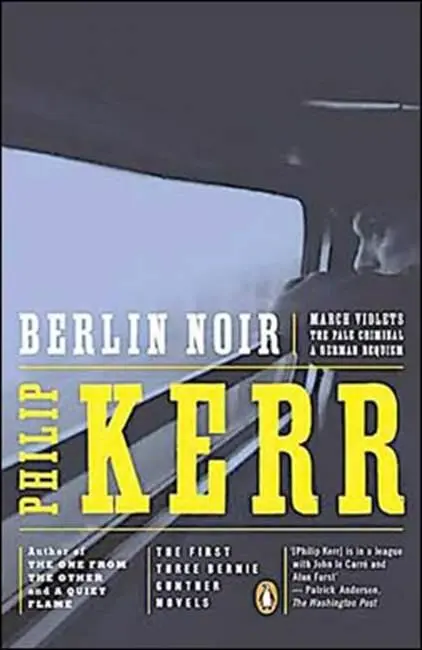
- Название:Berlin Noir
- Автор:
- Жанр:
- Год:неизвестен
- ISBN:нет данных
- Рейтинг книги:4 / 5. Голосов: 1
-
Избранное:Добавить в избранное
- Отзывы:
-
Ваша оценка:
Berlin Noir: краткое содержание, описание и аннотация
Предлагаем к чтению аннотацию, описание, краткое содержание или предисловие (зависит от того, что написал сам автор книги «Berlin Noir»). Если вы не нашли необходимую информацию о книге — напишите в комментариях, мы постараемся отыскать её.
These three mysteries are exciting and insightful looks at life inside Nazi Germany – richer and more readable than most histories of the period. We first meet ex-policeman Bernie Gunther in 1936, in March Violets (a term of derision which original Nazis used to describe late converts.) The Olympic Games are about to start; some of Bernie's Jewish friends are beginning to realize that they should have left while they could; and Gunther himself has been hired to look into two murders that reach high into the Nazi Party. In The Pale Criminal, it's 1938, and Gunther has been blackmailed into rejoining the police by Heydrich himself. And in A German Requiem, the saddest and most disturbing of the three books, it's 1947 as Gunther stumbles across a nightmare landscape that conceals even more death than he imagines.
Berlin Noir — читать онлайн бесплатно полную книгу (весь текст) целиком
Ниже представлен текст книги, разбитый по страницам. Система сохранения места последней прочитанной страницы, позволяет с удобством читать онлайн бесплатно книгу «Berlin Noir», без необходимости каждый раз заново искать на чём Вы остановились. Поставьте закладку, и сможете в любой момент перейти на страницу, на которой закончили чтение.
Интервал:
Закладка:
‘Are you a friend of his?’ said a man, an American, appearing behind me.
‘No,’ I said. ‘I came over because you don’t expect to hear gunfire in a place like this.’ I couldn’t tell if the American had been at the funeral already or if he had followed me from the chapel. He didn’t look like the man who had been standing outside Liebl’s office. I pointed at the grave. ‘Tell me, who’s the-’
‘A fellow called Linden.’
It is difficult for someone who does not speak German as a first language, so I might have been mistaken, but there seemed to be no trace of emotion in the American’s voice.
When I had seen enough, and having ascertained that there was nobody even vaguely resembling König among the mourners – not that I really expected to see him there – I walked quietly away. To my surprise I found the American walking alongside me.
‘Cremation is so much kinder to the thoughts of the living,’ he said. ‘It consumes all sorts of hideous imaginings. For me the putrefaction of a loved one is quite unthinkable. It remains in the thoughts with the persistence of a tapeworm. Death is quite bad enough without letting the maggots make a meal of it. I should know. I’ve buried both parents and a sister. But these people are Catholics. They don’t want anything to jeopardize their chances of bodily resurrection. As if God is going to bother with -’ he waved his arm at the whole cemetery ‘- all this. Are you a Catholic, Herr -?’
‘Sometimes,’ I said. ‘When I’m hurrying to catch a train, or trying to sober up.’
‘Linden used to pray to St Anthony,’ said the American. ‘I believe he’s the patron saint of lost things.’
Was he trying to be cryptic, I wondered. ‘Never use him myself,’ I said.
He followed me on to the road that led back to the chapel. It was a long avenue of severely pruned trees on which the gobbets of snow sitting on the sconce-like ends of the branches resembled the stumps of melted candles from some outsized requiem.
Pointing at one of the parked cars, a Mercedes, he said: ‘Like a lift to town? I’ve got a car here.’
It was true that I wasn’t much of a Catholic. Killing men, even Russians, wasn’t the kind of sin that was easy to explain to one’s maker. All the same I didn’t have to consult St Michael, the patron saint of policemen, to smell an MP.
‘You can drop me at the main gate, if you like,’ I heard myself reply.
‘Sure, hop in.’
He paid the funeral and the mourners no more attention. After all he had me, a new face, to interest him now. Perhaps I was someone who might shed some light on a dark corner of the whole affair. I wondered what he would have said if he could have known that my intentions were the same as his own; and that it was in the vague hope of just such an encounter that I had allowed myself to be persuaded to come to Linden’s funeral in the first place.
The American drove slowly, as if he were part of the cortège, no doubt hoping to spin out his chance to discover who I was and why I was there.
‘My name is Shields,’ he volunteered. ‘Roy Shields.’
‘Bernhard Gunther,’ I answered, seeing no reason to tease him with it.
‘Are you from Vienna?’
‘Not originally.’
‘Where, originally?’
‘Germany.’
‘No, I didn’t think you were Austrian.’
‘Your friend – Herr Linden,’ I said, changing the subject. ‘Did you know him well?’
The American laughed and found some cigarettes in the top pocket of his sports jacket. ‘Linden? I didn’t know him at all.’ He pulled one clear with his lips and then handed me the packet.
‘He got himself murdered a few weeks back, and my chief thought it would be a good idea if I were to represent our department at the funeral.’
‘And what department is that?’ I asked, although I was almost certain I already knew the answer.
‘The International Patrol.’ Lighting his cigarette he mimicked the style of the American radio broadcasters. ‘For your protection, call A29500.’ Then he handed me a book of matches from somewhere called the Zebra Club. ‘Waste of valuable time if you ask me, coming all the way down here like this.’
‘It’s not that far,’ I told him; and then: ‘Perhaps your chief was hoping that the murderer would put in an appearance.’
‘Hell, I should hope not,’ he laughed. ‘We’ve got that guy in gaol. No, the chief, Captain Clark, is the kind of fellow who likes to observe the proper protocols.’ Shields turned the car south towards the chapel. ‘Christ,’ he muttered, ‘this place is like a goddamned gridiron.’
‘You know, Gunther, that road we just turned off is almost a kilometre, as straight as an arrow. I caught sight of you when you were still a couple of hundred metres short of Linden’s funeral, and it looked to me like you were in a hurry to join us.’ He grinned, to himself it seemed. ‘Am I right?’
‘My father is buried only a short way from Linden’s grave. When I got there and saw the colour party I decided to come back a little later, when it’s quieter.’
‘You walked all that way and you didn’t bring a wreath?’
‘Did you bring one?’
‘Sure did. Cost me fifty schillings.’
‘Cost you, or cost your department?’
‘I guess we did pass a hat round at that.’
‘And you need to ask me why I didn’t bring a wreath.’
‘Come on, Gunther,’ Shields laughed. ‘There isn’t one of you people who isn’t involved in some kind of a racket. You’re all exchanging schillings for dollar scrip, or selling cigarettes on the black market. You know, I sometimes think that the Austrians are making more from breaking the rules than we are.’
‘That’s because you’re a policeman.’
We passed through the main gate on Simmeringer Hauptstrasse and drew up in front of the tram stop, where several men were already clinging to the outside of the packed tram car like a litter of hungry piglets on a sow’s belly.
‘Are you sure you don’t want that lift into town?’ said Shields.
‘No thanks. I have some business with some of the stonemasons.’
‘Well, it’s your funeral,’ he said with a grin, and sped away.
I walked along the high wall of the cemetery, where it seemed that most of Vienna’s market gardeners and stonemasons had their premises, and found a pathetic old woman standing in my way. She held up a penny candle and asked me if I had a light.
‘Here,’ I said, and gave her Shields’ book of matches.
When she made as if to take only one I told her to keep the whole book. ‘I can’t afford to pay you for it,’ she said, with real apology.
Just as surely as you know that a man waiting for a train will look at his watch, I knew that I would be seeing Shields again. But I wished him back right then and there so that I could have shown him one Austrian who didn’t have the price of a match, let alone a fifty-schilling wreath.
Herr Josef Pichler was a fairly typical Austrian: shorter and thinner than the average German, with pale, soft-looking skin, and a sparse, immature sort of moustache. The hangdog expression on his drawn-out muzzle of a face gave him the appearance of one who had consumed too much of the absurdly young wine that Austrians apparently consider drinkable. I met him standing in his yard, comparing the sketch-plan of a stone’s inscription with its final execution.
‘God’s greeting to you,’ he said sullenly. I replied in kind.
‘Are you Herr Pichler, the celebrated sculptor?’ I asked. Traudl had advised me that the Viennese have a passion for overblown titles and flattery.
‘I am,’ he said, with a slight swell of pride. ‘Does the gallant gentleman wish to consider ordering a piece?’ He spoke as if he had been the curator of an art-gallery on Dorotheergasse. ‘A fine headstone perhaps.’ He indicated a large slice of polished black marble on which names and a date had been inscribed and painted in gold. ‘Something marmoreal? A carved figure? A statue perhaps?’
Читать дальшеИнтервал:
Закладка:
Похожие книги на «Berlin Noir»
Представляем Вашему вниманию похожие книги на «Berlin Noir» списком для выбора. Мы отобрали схожую по названию и смыслу литературу в надежде предоставить читателям больше вариантов отыскать новые, интересные, ещё непрочитанные произведения.







Обсуждение, отзывы о книге «Berlin Noir» и просто собственные мнения читателей. Оставьте ваши комментарии, напишите, что Вы думаете о произведении, его смысле или главных героях. Укажите что конкретно понравилось, а что нет, и почему Вы так считаете.